
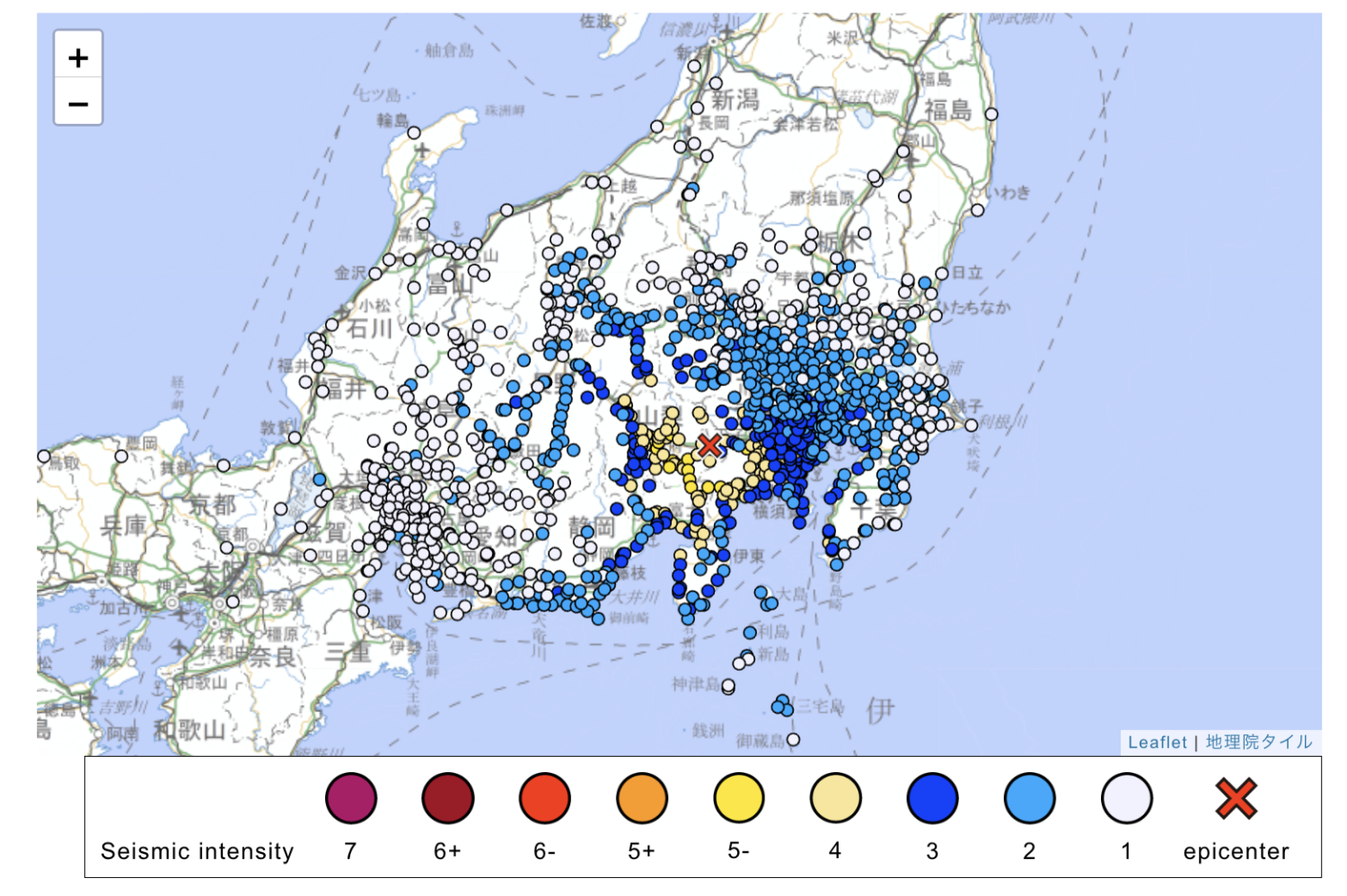
A magnitude 5.6 earthquake jolted Yamanashi and surrounding prefectures, including the Tokyo metropolitan area, on Friday evening, causing damage to some structures and triggering at least one landslide.
According to the Japan Meteorological Agency (JMA), there has been no change in observational data for Mount Fuji, which sits approximately 30 kilometers from the quake’s epicenter, and there is no threat of an immediate eruption.
The quake occurred at 10:29 p.m. at a depth of 20 kilometers. It registered lower 6 on Japan’s 7-point shindо scale in the town of Fujikawaguchiko in Yamanashi Prefecture, upper 5 in the city of Otsuki, and lower 5 in some areas of Shizuoka and Kanagawa prefectures. According to the JMA a lower 6 makes it difficult to stand, and unsecured furniture may fall over. There was no threat of a tsunami.
The quake left five people in Yamanashi Prefecture and one person in Kanagawa Prefecture injured, according to Chief Cabinet Secretary Minoru Kihara, who spoke at an emergency news conference at 12:40 a.m. citing data as of 12:10 a.m.
Approximately 2,860 households in Yamanashi, Saitama and Ibaraki prefectures experienced power outages following the quake, and a partial water outage occurred in the village of Yamanakako, Yamanashi Prefecture, although details were still being confirmed.
As of 11:25 p.m., authorities had received 24 emergency calls, including ones related to collapsed walls and traffic signal malfunctions.
At an emergency news conference at 12:40 a.m. Saturday, Ayataka Ebita, head of the JMA’s earthquake and tsunami monitoring division, warned that in the week following a large quake, there is a 10% to 20% chance of another major quake occurring in the same area, especially in the following two to three days.
He urged those in areas that experienced strong shaking to exercise caution, and especially those in areas prone to landslides, particularly as two tropical storms are approaching the main island of Honshu.
According to the JMA, those affected by the quake experienced Class 1 long-period ground motion, the lowest on the agency’s scale. Long-period ground motion is characterized by slow and prolonged shaking, which affects high rise buildings in particular. At Class 1, hanging objects start to swing and most people in high buildings can feel swaying.
Authorities in Yamanashi Prefecture advised people to take care to avoid potential hazards due to damaged buildings or roads that can not yet be addressed due to poor weather and lack of daylight.
A landslide occurred in the town of Nakai, Kanagawa Prefecture, and officials are assessing the situation, NHK reported. Another report said that a concrete wall had collapsed in the city of Fujiyoshida, Yamanashi Prefecture, but no injuries had been reported. In the city of Kofu, the prefectural capital, footage showed damage to a building and authorities directing pedestrians to avoid fallen debris.
This is the first time Yamanashi Prefecture has experienced an earthquake of shindo 6 in over 100 years, with the last time being in 1924 when a large quake hit western Kanagawa Prefecture. According to Ebita, earthquakes of shindo 5 and above occur in the Yamanashi area approximately once every 10 years.
While several earthquakes have occurred in the past week, with strong shaking felt in both Iwate and Chiba prefectures, Ebita stressed that they are “geographically far apart” and unrelated.
As of 12:40 a.m. sections of four expressways have been closed. Central Japan Railway reported that its Tokaido Shinkansen service was suspended between Toyohashi and Tokyo stations in the Tokyo-bound direction and between Tokyo and Nagoya in the outbound direction, but services resumed at 1:17 a.m. JR East Shinkansen services were suspended and delayed into Saturday morning but as of 1:08 a.m., all services had resumed normal operations.
Other JR rail services that were already experiencing delays and suspensions due to the tropical storms also reported delays caused by the quake.
Chubu Electric Power said shortly after 11 p.m. that no abnormalities had been identified at its Hamaoka Nuclear Power Plant in the city of Omaezaki, Shizuoka Prefecture, or at nearby radiation monitors, according to media reports.
Prime Minister Sanae Takaichi spoke briefly with reporters at the Prime Minister’s Office shortly after 11 p.m. The prime minister confirmed that the government has set up a crisis management center to assess impacts of the earthquake and coordinate any necessary response, and that a more detailed report would be received shortly.
Takaichi also warned those in areas that experienced strong shaking should remain on alert for further large quakes.
“I have directed that the government do everything possible in responding to this disaster. Human life is our top priority,” she stated.
More information:



