
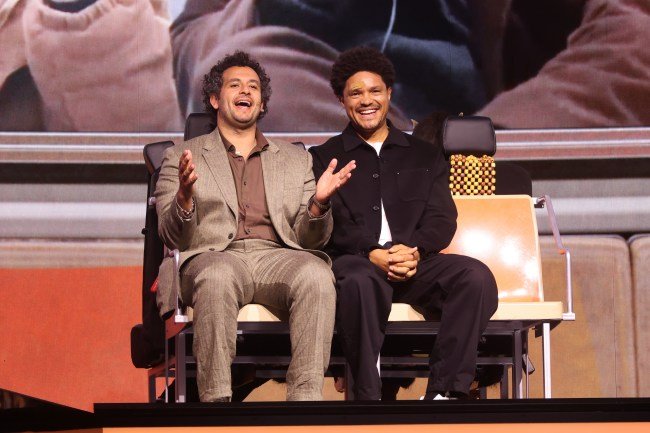
Welcome to It’s a Hit! In this series, IndieWire speaks to creators and showrunners behind a few of our favorite television programs about the moment they realized their show was breaking big.
“It’s crazy, but every once in a while it’s a hit right away,” said “SubwayTakes” co-creator and host Kareem Rahma, during a recent conversation with IndieWire over Zoom. In fact, his Emmy-nominated Short Form series had a proven audience before it even premiered. “I posted a trailer and the trailer got a million views. And I go, ‘Oh my God.’ Trailers don’t get a million views, because they’re trailers,” he said with disdain. “And then the first episode got two or three million views. And I was shocked and really scared and really nervous because I was like, ‘Oh no, I’m not prepared for this.’”


Rahma has been open about how the concept of him asking a person seated next to him on the subway to present and defend a unique and/or controversial opinion stemmed from looking for something more economical, after his original hit webseries “Keep the Meter Running,” where he would pay taxi drivers to give him their version of a tour through their city, became too costly. With “SubwayTakes,” all he needed were cameras, microphones, a fare card, and open seating to shoot an episode.
But while there are plenty of other webseries in the same realm, many of them also becoming coveted stops on a celebrity press tour, a major innovation he can take credit for is his adherence to the shortform medium from Day One. “The short form unscripted vertical video asset is the episode. It’s not a lift. It’s not a clip. There’s no other episode. This is the episode,” said Rahma. “And that was really helpful because I didn’t have to do the work of telling people to go watch the full length or worry about editing the full length, and editing the little thing, and then worry about doing clips. And it made me focus on making the highest quality single piece of content. Not even having to worry about distribution or where to put it and re-edit it.”
The actual greatest challenge he’s faced so far in producing SubwayTakes was how to go by expanding the format. The longer episodes featuring celebrity interviews, now called “SubwayTakes Uncut,” started “based on the fact that I had access to all these amazing celebrities and people that I’ve always wanted to meet,” he said. “I’m already spending an hour with them, so I may as well record the whole time.”
The first official “Uncut” guest was singer-songwriter Halsey, with the thought that Rahma could just keep interviewing her after she’d gotten through sharing and defending her take. In practice, “the production was a mess because we didn’t know what we were doing for long form. It was the first long form shoot,’ said Rahma. “We’re on the subway. We’re also like, ‘Oh, we have to get off the train now. So do we keep shooting?’ ‘Yes, keep the cameras rolling.’ Then we’re crossing the street going back on the subway. It was all over the place.”
It was clear lack of format was an issue, so the next thought with guest Ramy Youssef was to have the comedian take Rahma to his favorite restaurant after they wrap the “take” segment — a soft version of “Keep the Meter Running” that still proved to not be economical.
“We almost shut ‘Uncut’ down because we did at least 10 episodes and it wasn’t working and it’s way more expensive to produce and it cost thousands of dollars every time. And we’re like, ‘Do we just end this?’” But much to the surprise of Rahma, who compared the interview to “riding a wild horse,” and said that during the shoot he began thinking to himself “I don’t know if I’m good at this. . . I should probably quit,” the guest who was a turning point for the show was comedian Bill Burr.
“He is the first [‘Uncut’] episode that did extremely well. I think he got a million views. And the learning was that people are there for the takes, and he has a lot of them. So the show switched to being this format that’s like ‘Bill Burr discusses his five most controversial takes.’ That’s the show. It’s now take after take after take after take.”
The experience was another reminder of the lesson he had learned from day one: the audience is drawn in by the takes more so than the fame level of the guests. Rahma breaks down the demographics of who is invited on “SubwayTakes” as 95 percent unknowns. Though he rejects the label of “journalist” (“I see myself as a clown and a jester”), the host likens his show to a magazine when talking about how he makes creative decisions for it. “That’s how I look at the short form videos. I’m like, ‘Ok, I’m the editor-in-chief of a magazine. Who’s on the cover tomorrow?,’” he said, choosing from “hundreds of independent comedians and writers and journalists and authors and filmmakers and actors and clowns and random people that make it on the show, cab drivers, whatever.”
Looking at the programming calendar, Rahma asks “‘What do we need more of? What do we need less of? What can we take a break from?’ And that’s both take-wise as well as diversity-wise and gender-wise and religion-wise and industry-wise. I am trying to make it a melting pot of a show.” It also speaks to how he’s adopted much of the ethics that journalists abide by.
“I’m very particular about the guests I book, and I wouldn’t call myself an activist at all in the same way that I wouldn’t call myself a journalist, but I do believe that there’s a right and a wrong, and I think that the internet is a cesspool of people who are wrong. And it’s not even a matter of opinion. It’s a matter of fact. So for me, I’m not booking those people. And that’s just the way the cookie crumbles,” said Rahma. “They can definitely have different political viewpoints, but they certainly can’t be bigots or genocide enablers or outspoken about anti-gay rights or Islamophobic or antisemitic. I’m not having those people on the show. That’s not something I’m willing to do. And there are other shows that do that, but I’m not doing that.”
“SubwayTakes” has also welcomed representatives from non-profits like Artists for Humanity and Teach for America on the show on somewhat of a monthly basis, resulting in over $30,000 raised for the latter. “From an editorial perspective, it’s part of the job to not platform the people who are making the world a worse place. I try to give the platform to people making the world a better place. There is an undercurrent of social consciousness,” said the host.

If there is a celebrity guest on the show, they most likely asked to be there. “Most people, when they do come to us, they’re fans of the show, they’ve seen the show, they’re excited to be on the show, they come prepared with takes, they’re followers of the show, and they’ve seen hundreds of episodes, and they’re excited to be there. That’s always the most surprising part to me, is when some huge name, huge talent is like, ‘Dude, I love the show and thanks for having me on,’” said Rahma, who has welcomed guests ranging from Matt Damon to Jennifer Lopez to Cate Blanchett.
“Oftentimes people have been both canceled and celebrated for their takes, and I think it is definitely more of a highbrow show. It looks really simple. But if you listen to the conversations, they’re actually really complex and the takes range from really dumb things to really smart things to everything in between,” he said. One of his favorite examples is fellow Emmy nominee Sterling K. Brown, star of “Paradise,” sharing his take that Red Delicious Apples are not in fact delicious. “To me, those are the most fun conversations, the ones where my head goes, ‘Oh my God, never thought about that before,’” he said. The audience on that one, the comments were crazy. People were so passionate about it, and it’s fun to see people get around something that’s so low stakes, but high performance. At the end of the day, we’re all participating and in on the joke most of the time. That’s when the show’s at its best, when we’re all in on the joke.”
Rahma’s advice to any future guests is “Be yourself, don’t come over-prepared, simplify your take. Don’t try to impress the audience because the most impressive takes are the ones that are Larry David-isms, the mundane observational takes that we find in everyday life. And you will see that millions of people have an opinion on it.”
And the audience is always his priority. “I genuinely like them and want them to be happy, but also I want to keep pushing the Overton window as well as the format, and I have to respect the audience so I can’t just do whatever I want. But that’s a constant kind of dialogue that I’m having with them,” he said. “It’s not optimizing for the algorithm, it’s optimizing for the audience because I want my shows to be watched. That’s what I want. That’s why I make them. I’m not the kind of artist that’s like, ‘I don’t care if people see my work.’ I want people to listen to my music, watch my movies, watch my shows, buy my hats, whatever. I want them to participate.”
Rahma has even seen plenty of exceptions to the conventions around how frequently a YouTube channel has to publish a video or how long a clip needs to be to find an audience. For the latter, he recalls the Meta platform gave notice that his recent four and a half minute clip “SubwayTakes” episode with Oscar winner Javier Bardem would not be shown to new audiences if it was not cut down. “I was like, ‘Ok, so my options are to cut out some of the stuff that I really love or to just let it rip and not listen to this warning,’” He said. Rahma chose the latter option, “and the video crushed.”
“Optimizing for the algorithm is really optimizing for the audience and making something that people want to watch. And I will say it is difficult at times when I’m competing with people jumping out of helicopters or kicking a basketball out of a spaceship and into a hoop. But I’m happy with the results thus far, and I think that we will continue growing, especially as we continue to add different formats and different parts of the show on YouTube,” he said.
With the Emmy nomination (and possible Emmy win) for “SubwayTakes” being an indication that he and his team have a handle on the shortform version, some of those new additions he alludes to are more “Uncut” episodes, and live-to-tape special of his ticketed event “SubwayTakes Live,” in addition to the recent relaunch of “Keep the Meter Running.”
After all, YouTube is the content partner that has helped him go from jokingly closing celebrity interviews with “See you at the Emmys” to actually making good on his promise this year. “The minute I let go of the idea that I’m doing this so that I can get off the internet is the minute everything became extremely fun and super successful. And that is no shade to other platforms. It’s just I don’t have time to sit around and do development and meetings and this and that,” said Rahma. “I already have the ideas. I already have the intellectual property. I already have the skills. I already have the team to make it. So that’s what we do. We go make it.”
He added, “There’s no reason to go elsewhere. There’s no reason to pitch to develop it on another platform because for me, it’s about making the work, not about talking about the work.”



