
A visitor to Bucharest, Romania’s capital, will notice that many of the city’s buildings—which range from graceful Belle Époque mansions constructed in the late nineteenth century to unlovely apartment complexes thrown up during postwar urbanization—are marked with a bright-red disk. Unlike the blue plaques affixed to residences in London, which indicate where notable figures once lived, or the Stolpersteine (or stumbling stones) embedded in the sidewalks of German cities to mark the former homes of Holocaust victims, Bucharest’s red disks are not commemorative but predictive. “It means that, in the next earthquake, this building could fall down,” Radu Jude, the Romanian film director, explained to me recently, when I met him in the capital, his native city.
It’s been forty-nine years since Bucharest was last devastated by a major earthquake, on March 4, 1977. Dozens of flimsy apartment buildings collapsed; nearly fifteen hundred residents died. Nicolae Ceaușescu, Romania’s Communist leader, seized the opportunity to remake the ravaged city, ordering not just the demolition of compromised structures but a more extensive urban clearance. The entire neighborhood of Uranus, whose historic churches were built along hilly, cobblestoned streets, was razed. In its place rose the grandiose Palace of the Parliament—a neoclassical hulk that is the second-largest administrative building in the world, surpassed only by the Pentagon.
Before the building was completed, Ceaușescu’s reign ended in revolution. In December, 1989, at the conclusion of a year when Communist regimes across Eastern Europe were collapsing, Ceaușescu ordered the violent quashing of demonstrations in the western city of Timișoara. Dozens of protesters died, and not long afterward Ceaușescu, while delivering a speech from the balcony of the Communist Party’s Bucharest headquarters, was jeered into silence by a furious public. He was soon captured by the Romanian Army as he attempted to flee the country. On Christmas Day, a military tribunal sentenced him to death and executed him by firing squad.
Jude, who was born a month after the 1977 earthquake, was twelve when this political earthquake occurred. “The rumors about what had happened in Timișoara, and how many people were killed, were everywhere,” he recalled, as we sat in the office of his video editor, in an elegant villa in central Bucharest. When the revolution happened, he told me, he was spending the Christmas holidays with his grandparents, in a village outside the city, “but it was quite close to a military airport, so you could hear gunshots.” After footage of Ceaușescu’s corpse was broadcast on television, “there was a huge joy—you could feel the change.” His grandfather cursed the former leader while Jude’s grandmother wept at Ceaușescu’s execution—not because she admired him but because, Jude said, “it felt like a loss of something that was essential to her.” As it turned out, he noted, “many more people were killed after Ceaușescu left, because of the chaos.” The dictator’s successor, Ion Iliescu, viciously crushed pro-democracy demonstrations. It took until the end of 1991 for a new constitution to be established.
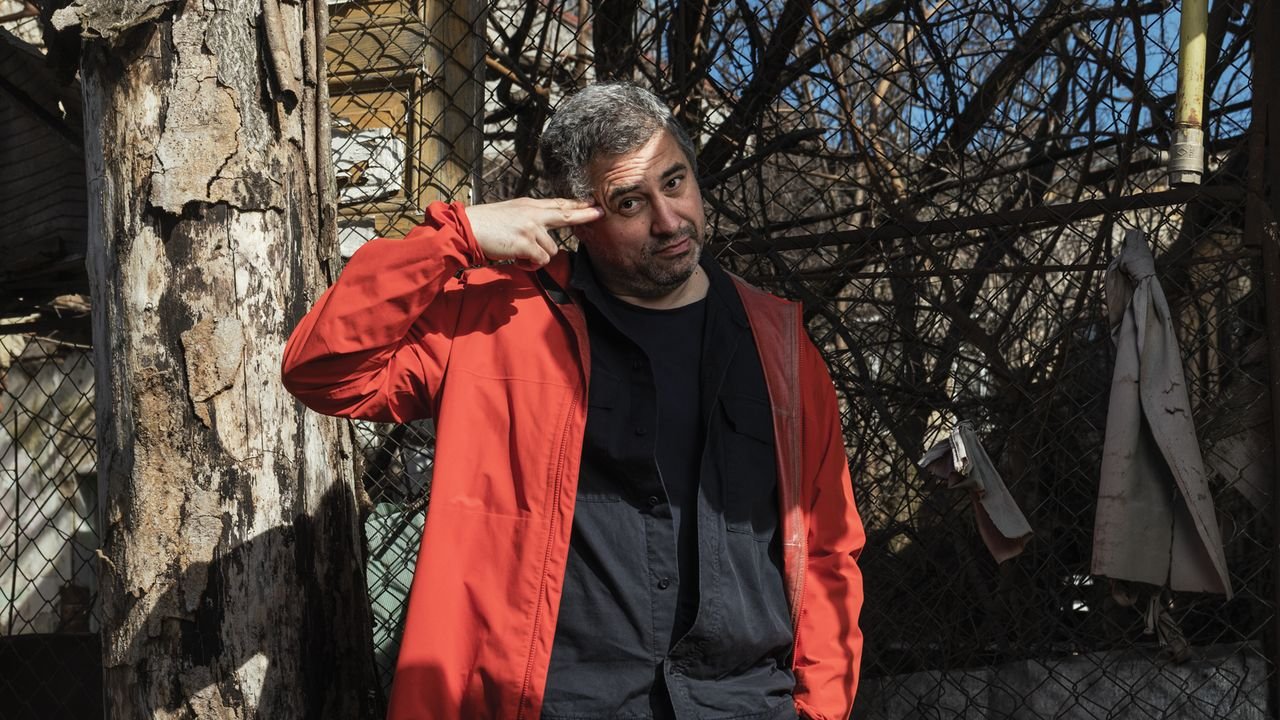
Similarly, Ceaușescu’s authoritarian makeover of Bucharest has been dwarfed by unbridled development since the revolution. “The earthquake destroyed houses everywhere,” Jude said. “But there was much more destruction, in a paradoxical way, in a free society—by bad planning, bad management, corrupt politicians, and greedy real-estate investors. There are more monuments of architecture destroyed after the revolution than in Ceaușescu’s time.” We headed out into the streets, and Jude led me to sites of vanished historic structures: a nineteenth-century marketplace demolished to accommodate a widened road, an ornate cinema whose only remnants are a few bricks littering a parking lot. As we navigated sidewalks narrowed by late-winter heaps of dirty snow, Jude, who is a big, bearish man with bristly salt-and-pepper hair and a scruff of beard, pointed out the buildings marked with red disks. Other signs warned of danger from crumbling masonry overhead, though there was none of the scaffolding that might accompany such notices. Jude mentioned that a friend of his, who had recently returned from Odesa, in Ukraine, had said that Bucharest resembles a wartime city more than Odesa does.



