
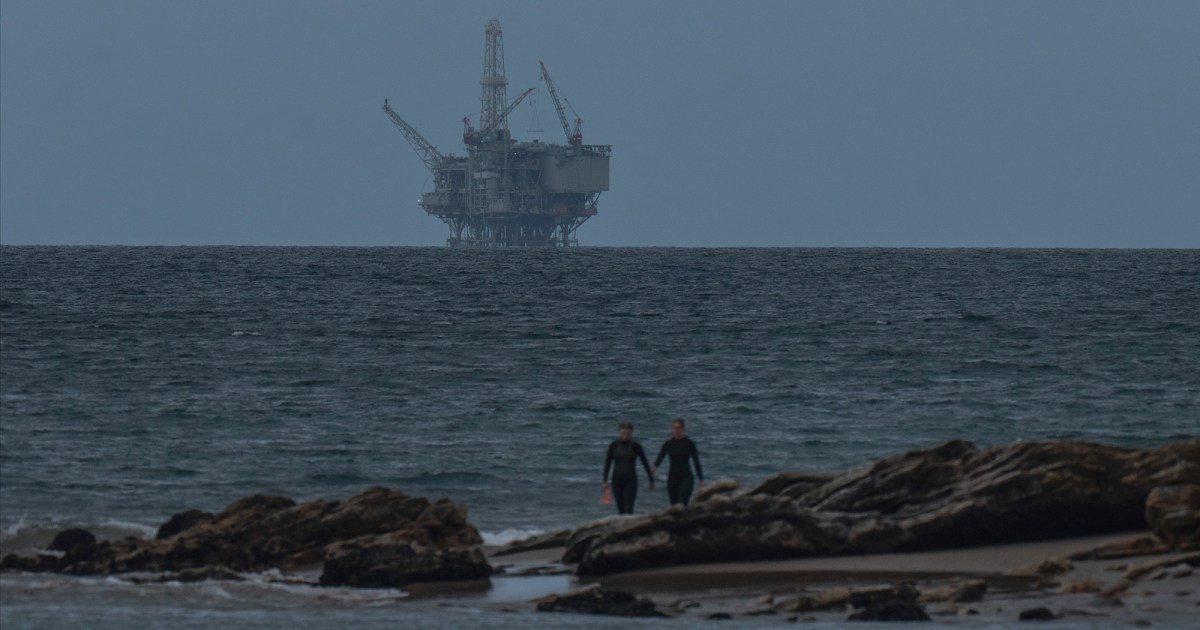
An offshore drilling platform operated by Sable Offshore Corp. is seen from Refugio State Beach.Jae C. Hong/AP
For roughly a year and a half, California state and local authorities have been locked in a power struggle with the Trump administration over who gets to regulate oil production off the coast of Santa Barbara, a beach town beloved by surfers, swimmers, tourists, and nature lovers—and by extension, the entire West Coast.
The fight revolves around Sable Offshore, a small Houston-based company that, on the order of the Department of Energy (DOE), recently resumed pumping oil through an offshore pipeline that had been out of service since a disastrous 2015 spill.
“WELLS FLOWING…$ALES METER ROLLING…AMERICAN OIL FROM AMERICAN $OIL!” a sign in front of one of Sable’s onshore facilities now reads.
The DOE justified its intervention as an effort to boost domestic energy production in the name of national security. Foes of the pipeline restart say it’s an attempt by the Trump administration to quash states’ rights and eviscerate environmental regulations, and maybe troll a blue state in the process.
The administration appears to have won the latest round, but it’s not over.
The messy dispute has spawned nearly a dozen legal actions, including lawsuits brought by Sable and its allies; environmental groups; and federal, state, and local agencies—the state, for example, sued Energy Secretary Chris Wright for invoking the Defense Production Act to restart the pipeline. Sable sued Santa Barbara County for refusing it a business-related permit and the California Coastal Commission for denying it permits to repair and operate pipelines along the coast. Other legal actions have accused Sable, which did not respond to requests for comment or to written questions for this story, of flouting environmental laws, doing unpermitted work, and trespassing on state land.
“Seizing a big chunk of one of California’s most beautiful parks to boost a private oil company would be an unlawful and utterly outrageous abuse of federal power.”
Last Wednesday, in a ruling involving four of the cases, US District Judge Stephen Wilson fined Sable $1.5 million for violating a consent degree it had inherited from Plains All American, the company that operated the pipeline at the time of the 2015 Refugio Oil Spill. But the judge, in a blow to the pipeline foes, also ruled that the Pipeline and Hazardous Materials Safety Administration—the federal agency that officially approved the restart—was authorized to do so under the Defense Production Act, which Wright invoked in his March 2026 order demanding that Sable start pumping oil over state and local objections.
The state has already filed appeals in two of the cases that Wilson ruled on, and will likely appeal a third. The fourth case was sent back to state court, Linda Krop, chief counsel for one of the plaintiffs, the Environmental Defense Center, told me.
A July ruling in Sable’s suit against the county went the other way, however. District Judge Dolly Gee, Wilson’s district court colleague, ruled that Sable had not demonstrated that the Defense Production Act, which applies mainly to contracts, preempts the state and local decisions in question. “So we have these two competing district court rulings now on the preemption issue” that need to be sorted out by the appeals court, Krop said, and the California lawsuit challenging Wright’s DPA order is still pending; the administration’s motion to dismiss is due for a hearing in September.
Legal wrangling aside, the heavy-handed intervention of administration officials in what had been primarily a state and local fight has raised eyebrows as to their true motive, and whether President Donald Trump’s antipathy for blue states is playing a role.
The contested pipeline is part of the Santa Ynez Unit, an offshore oil and gas field with three drilling platforms connecting to an onshore processing facility. The unit was owned by Plains All American when it was shut down in 2015 after a disastrous pipeline rupture left more than 100 miles of coastline coated with 100,000 gallons of oil.
In 2020, Plains All American and state authorities entered into a federal consent decree that outlined the company’s repair plans. Two years later, the Santa Ynez Unit was taken over by ExxonMobil. Sable acquired it in 2024 with an eye toward resuming production.
The administration has sent “a message to oil companies that you can violate court orders, you can violate shutdown orders or cease-and-desist orders.”
Since then, Sable has embarked on major unpermitted repairs and construction despite multiple cease and desist orders from the California Coastal Commission, prompting state Attorney General Rob Bonta to file a lawsuit against the company. “Sable became the outlaw oil company on the West Coast,” says Richard Charter, a longtime opponent of offshore drilling who oversees the Local Government Outer Continental Shelf Coordination Program, a group of elected officials working to protect California’s coastal economy. The outcome of the dispute, he told me, “will probably be more determined by politics than the reality of science and functionality of safety.”
Trump has certainly kept his campaign promise to boost an oil industry that spent handsomely to help put him in power. Since taking office, he’s throttled offshore wind development and moved to open vast tracts of once-protected public lands and waters to oil and gas exploration. On his first day back, Trump issued two executive orders, one declaring a national energy emergency and the other calling for the expansion of fossil-fuel production and use.
In March, around the time Iran closed the Strait of Hormuz, Trump invoked the Defense Production Act—which Congress passed in 1950 to boost domestic manufacturing during the Korean War—to increase oil production in the name of national security. Wright used Trump’s executive order as the basis for his Sable order.
Sable upped the ante in early June, when it wrote a letter to the DOE asking the federal government to invoke eminent domain to seize state land for its project. Specifically, it asked the administration to condemn a 3-mile stretch off the coast in addition to a large section of Gaviota State Park, where dramatic cliffs meet the sea alongside Highway 1. “Seizing a big chunk of one of California’s most beautiful parks to boost a private oil company would be an unlawful and utterly outrageous abuse of federal power,” Talia Nimmer, an attorney at the Center for Biological Diversity, which is also involved in the legal skirmishes, said in a press release.
A few days later, Energy Secretary Chris Wright and Secretary of Interior Doug Burgum, CNN crew in tow, visited a Sable drilling platform off Santa Barbara to hail the reopening. They assured reporters that the move would boost domestic production, lower gas prices, and support California’s military bases—all of which was contested by experts I spoke with.
The notion of the pipeline resart having anything to do with national security is far fetched. The closure of the Strait of Hormuz has kept 12 million to 15 million barrels of oil per day from reaching global markets, according to Paasha Mahdavi, a professor of political science and director of the Energy Governance and Political Economy Lab at UC Santa Barbara. Sable’s local operation is slated to produce, at most, 50,000 barrels a day—about 0.04 percent of global production.
“The last thing California wants is more offshore drilling…we can all kind of smell it, that this is more of a political attack.”
“What we have off California is a relative drop in the bucket and wouldn’t have a meaningful impact,” says Pete Stauffer, senior ocean protection manager for Surfrider Foundation, which is involved in a state campaign to stop offshore drilling.
With so little oil at stake, Krop, EDC’s attorney, views Wright’s order as a shot across the bow of California, a state Trump openly disdains, and a wedge for other would-be oil drillers. “With Trump’s blessing, it sends a message to oil companies,” she says, “that you can violate court orders, you can violate shutdown orders or cease-and-desist orders.”
The administration is expected, perhaps within months, to release its updated five-year offshore oil and gas leasing plan—an early draft revealed Trump’s desire to open up the entirety of the California and Alaska coasts, and the Gulf of Mexico, for drilling.
“I separate Sable completely from the five-year leasing plan,” Charter told me. “But Sable, if they are in fact behind the effort to gut the California Coastal Commission and diminish state rules in federal decisions about space launches, about desal[ination], about offshore drilling, about ocean mining, then that has implications that are pretty global.”
The California Coastal Commission has been at odds with Sable from the start. It has filed three cease-and-desist letters against the company for unpermitted construction and slapped it with an $18 million fine—the largest in commission history. “The attack on the Coastal Commission is clearly an attack on states’ rights,” Charter says.
“The last thing California wants is more offshore drilling…we can all kind of smell it, that this is more of a political attack than having anything to do with energy production,” says Brady Bradshaw, senior oceans campaigner at the Center for Biological Diversity.
Sable and administration officials continue to assert that its oil will increase domestic production and therefore reduce the need for foreign imports. “To argue that Californians wouldn’t benefit from a larger supply of oil is just stupid nonsense,” DOE press secretary Ben Dietderich said in an email, adding that California has the nation’s most expensive gas and second highest electricity rates. (The US Energy Information Administration attributes the state’s high gas prices to excise taxes and fees, strict fuel formulation requirements, and limited refining capacity—not oil supply.)
Dietderich also said the Santa Ynez Unit restart boosts in-state oil production by 15 percent: “Any climate activist who believes it would be better for the climate or for our national security to import those barrels from thousands of miles away is not being honest.”
But the Santa Ynez oil is heavy and requires a lot of refining, detracting from its value. An economic analysis Mahdavi conducted last year concluded that restarting the unit would “have limited to no impacts on California oil markets through 2045.”
California’s tourism economy relies on an unsullied coastline, with coastal activities contributing tens of billions of dollars to the state’s GDP.
His analysis notes that the oil Sable now produces in Santa Barbara is “not more cost competitive than [that of] existing foreign suppliers to California.” Oil consumption in California has been on a long, slow decline, Mahdavi told me, and the Santa Ynez oil won’t affect state gas prices.
Sable’s opponents have expressed concerns, too, over the company’s financial position. ExxonMobil loaned it nearly $700 million at a high interest rate to purchase the Santa Ynez assets. Sable has reported more than $1 billion in losses over the past three years. It had zero revenues prior to March, when it began producing oil. For the second quarter, April through June, it posted a $64 million loss on revenue of $137 million, underperforming Wall Street’s expectations.
The concern here, says the Center for Biological Diversity’s Bradshaw, is that Sable, unlike ExxonMobil, lacks sufficient financial resources to manage a major spill—and that the transfer of liability from ExxonMobil to Sable will leave taxpayers on the hook for any cleanup were such a disaster to happen again.
What’s more, though Sable’s Santa Barbara operation may have little effect on oil markets per Mahdavi’s analysis, it will have sizable negative impacts on the environment. Restarting the unit, Mahdavi calculated, will boost global greenhouse gas emissions by the equivalent of 2.5 million tons of CO2 per year—about the same as putting 530,000 gas-powered cars on the road.
With relatively little economic upside and significant downsides in terms of pollution and spill risk, Mahdavi views the pipeline restart, and Trump’s intervention, as problematic. “It is a very clear-cut abuse of power by Washington, DC,” he says. “That’s the defining feature of the American Republic that we [just celebrated] 250 years of: that states have rights and jurisdiction over what happens on their lands and waters.”
A similar sentiment is fueling public support to protect the coast, Charter told me. Santa Barbara community leaders have hosted protests against Sable and offshore drilling. “The community’s been infuriated,” Stauffer says. In May, Surfrider Foundation and other groups hosted a “Paddle Out to Protect our Coast” event, where surfers took to the ocean with signs that say, “drilling is killing.”
California’s tourism economy relies on an unsullied coastline, with coastal activities contributing tens of billions of dollars to the state’s GDP. The coast’s rugged beauty is also a point of pride for Californians. The prospect of the federal government auctioning it off for drilling is very unpopular, Charter says.
“This is a political football game for the entire coast of America,” he told me. “The Trump administration is underestimating how much people care.”



