
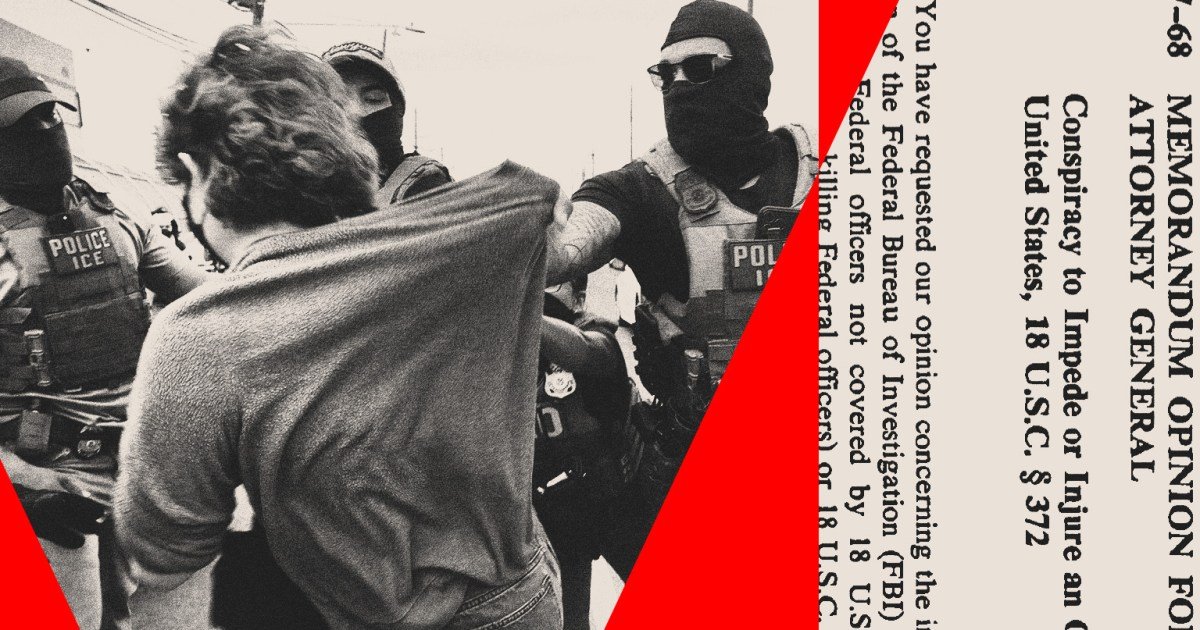
Federal prosecutor Richard Barker resigned rather than pursue conspiracy charges against the newly convicted Spokane activists.Mother Jones illustration; Spencer Platt/Getty; Wikimedia
On a Wednesday afternoon last June, Bajun Mavalwalla II, Jac Archer, and Justice Forral gathered with hundreds of others to protest outside an ICE office in Spokane, Washington. Word had spread on social media that two young Venezuelan immigrants—both of whom came to the United States legally—had been detained at a routine ICE check-in.
Mavalwalla, Archer, and Forral—now known as the “Spokane Three”—were charged in July with “conspiracy to impede or injure” officers of the law for participating in that protest, in which people attempted to block an ICE vehicle from exiting the field office.
All three were found guilty on Wednesday of “conspiracy to impede or injure an officer” or “aiding and abetting another to conspire,” felony convictions with the potential for significant prison time. It’s a significant defeat for protesters following Trump administration prosecutors’ repeated failures to convict people who attend anti-ICE rallies.
Videos from the day show brief scuffles—protesters and ICE agents pushing each other—but no evidence of serious injury to anyone. “None of the protesters were hurt. Fortunately, none of the law enforcement officers were hurt either,” Richard Barker, then the acting US Attorney for eastern Washington, told PBS in March. Yet local police arrested more than 30 people on the scene.
The Spokane Three were among the first ICE protesters to be brought up on conspiracy charges, which carry up to six years in prison and a $250,000 fine. It’s become a common prosecutorial tactic: in the Chicago area, the “Broadview Six” had similar conspiracy charges dismissed in April; in July of 2025, another conspiracy case against Los Angeles protesters crumbled.
During DHS’ high-profile occupations of cities like Minneapolis, Barker and almost 100 other federal prosecutors came under severe Trump administration pressure to prosecute ICE protesters. It was an order Barker resigned rather than carry out. In that March interview, Barker told PBS he “didn’t feel in this case that a conspiracy charge that would carry a six-year term of incarceration was true to who I was or who I wanted to be as a federal prosecutor.”
But his successor did, charging Mavalwalla, Archer, Forral, and six other people with conspiracy felonies and sending FBI agents to arrest them. Six of the nine took plea deals, but Mavalwalla, Archer, and Forral—a military veteran and two organizers with the local group Spokane Communities Against Racism—decided to fight. The government’s case, they thought, was weak: the protest sprang up from a single outraged Facebook post by a former city councilor who was legal guardian to one of the two Venezuelan men detained.
It was the “most spontaneous action that I’ve seen in my lifetime,” Hadley Morrow, a friend of Archer and Forral, said. “It’s really hard to imagine where the conspiracy is.”
And the case was marred by allegations against some of the officers involved: one sheriff’s deputy who was on the scene was captured on body camera saying “I want to hit someone with a stick today,” while an ICE agent who testified at the trial also spewed racist and anti-LGBTQ+ rhetoric in Facebook posts, local media outlet Range revealed.
“Conspiracy” legally entails a group of people who “agree to commit an illegal act,” legal scholar Steffen Seitz, who studies the use of conspiracy charges against social movements at the University of Denver, said in an interview. But it’s easier to convince a jury there’s “some kind of mutual understanding lurking in the background” when people show up with similar signs and make similar social media posts, Seitz added.
“If people become chilled from engaging in them because of the threat of this kind of vague criminal liability, then we’re all worse off,” Seitz said.
The government’s exhibits, meant to prove that conspiracy, include images of Archer holding a clipboard and megaphone, Forral pointing at a car, Mavalwalla linking arms with others; and a video of Mavalwalla holding an umbrella—all things one might expect attendees of a protest to do. “If those tools are decided to be evidence of conspiracy, then the tools that we have as organizers to keep each other safe in protest have been criminalized against us, and that is really scary,” Morrow said.
“They’re calling reading and reacting to a Facebook post a conspiracy,” Morrow told me before the case began. Archer, Mavalwalla, and Forral all plan to appeal, and to file a motion asking the judge to discard their guilty verdicts.
“While we respect the decision of the jury, this matter is not over,” said La Rond Baker, legal director of the ACLU of Washington. “We remain concerned about the chilling effect that the Department of Justice’s charging decisions will have on protest and free expression in this country. The Administration has a demonstrable history of using the Department of Justice to silence and punish its critics. Using the power of government to deter criticism is undemocratic and counter to the values of our state and the country.”



