
This is an edition of The Atlantic Daily, a newsletter that guides you through the biggest stories of the day, helps you discover new ideas, and recommends the best in culture. Sign up for it here.
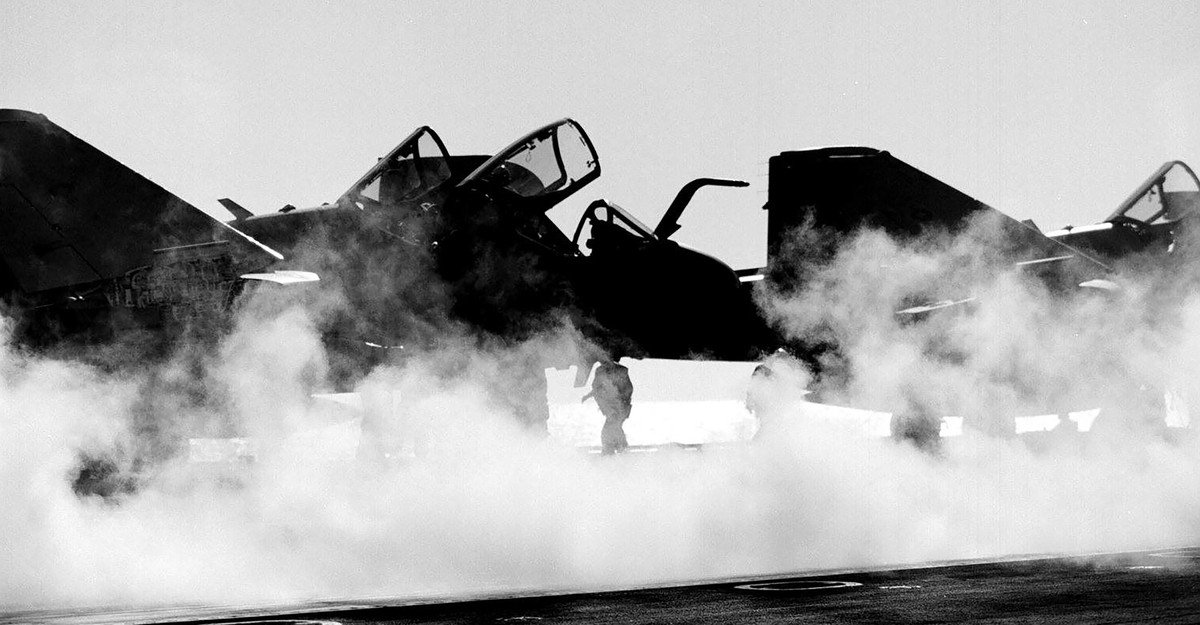
Over the past nine years, Donald Trump has returned again and again to the concept of steam power. He loves the way that steam propels fighter jets off the decks of aircraft carriers, and he laments that the Navy has pivoted to electromagnetic launchers in its new ships. “That beautiful scene,” he rhapsodized at a rally in 2023: “That steam goes off, and that plane gets thrown the hell off; the power, beautiful. And it’s cheap!”
By The Guardian’s accounting, Trump has spoken publicly about these steam catapults every year since 2017, when he claimed to have told the crew of the USS Gerald Ford that they’d be “going to goddamned steam.” The Gerald Ford is the only one of the Navy’s 11 operational aircraft carriers that’s not currently equipped with steam catapults. Instead, it uses the more modern Electromagnetic Aircraft Launch System (EMALS), which runs on electricity from the vessel’s two nuclear reactors. Trump’s wish for the Gerald Ford to return to steam was never fulfilled; the ship was already the water. Until last week, future ships were set to use electromagnetic propulsion too. But on Thursday, Trump ordered one of the Navy’s planned carriers, the USS Doris Miller, to be outfitted with steam catapults instead.
It’s a potential logistical nightmare. Although the ship isn’t expected to be assembled until later this year, its parts are already under construction. Experts have said that returning to steam power at this stage in the ship’s development could dramatically increase the cost to taxpayers and delay the building process. The Doris Miller won’t be completed until the mid-2030s, and a future administration may backpedal. But the fact that the president remains so dedicated to the idea says something about his commitment to aesthetics over strategy—and to remaking the military according to his personal preferences.
Trump’s order gives officials 60 days to figure out the details, but plans for the Doris Miller are already under way. General Atomics, the contractor responsible for the ship’s EMALS system, released a statement explaining that “nearly 50 percent of production” is complete and warning that “changing course now would introduce significant cost, schedule and integration risks.” Electrical infrastructure can’t be easily swapped for steam once a ship’s layout has been mapped. Areas on the Doris Miller that might have housed pipes have been designated for other things. Bryan Clark, a naval analyst at the Hudson Institute, told me that such an extreme redesign of the ship’s interior could cost the Navy billions of dollars.
EMALS isn’t perfect. Its development was lengthy, even by the Navy’s standards; the Gerald Ford, on which it debuted, cost the U.S. billions of dollars more than expected. But the investment has now been made. EMALS has been successfully launching planes for years. Part of Trump’s somewhat-opaque argument against the new system is that it’s a fancy, unnecessarily complex replacement for the old-fashioned way of doing things. “Digital,” he said in 2017, is “very complicated. You have to be Albert Einstein to figure it out.” Last month, he claimed to have been told that only “geniuses” from MIT could work on it.
Trump is right to suggest that when it comes to military technology, flashier doesn’t always mean better. After all, Iran’s cheap drones have consistently challenged the far richer and better-equipped United States. But steam isn’t as efficient as he thinks. Today, Clark told me, electromagnetism is a more reliable way to get a plane into the air, requiring fewer repairs in the aggregate. This is one reason that, despite the cost of developing EMALS, Trump’s claim that steam is a “cheap” alternative doesn’t necessarily hold up; a ship that requires fewer repairs may require fewer taxpayer dollars in the long run.
The president hasn’t explained why he chose to make such a cumbersome change at this particular moment. Other, more pressing issues could likely use his attention: A shortage of certain kinds of munition, for example, has put the U.S. at a disadvantage in the war with Iran. And the Navy has lately been facing criticism over the conditions aboard another carrier, the USS Abraham Lincoln, which has been deployed in the Middle East for almost nine months. Sailors have reported food shortages, degraded living conditions, and mental-health struggles. The president dismissed CNN’s report about conditions on the ship as “fake news,” but Admiral Brad Cooper, who’s overseeing the war in Iran, acknowledged the mental-health concerns on Sunday. The USS George Washington is now set to relieve the carrier.
Trump’s recurring fascination with steam reflects his broad interest in how things should look rather than how things should work. He’s reportedly considering asking the Navy to make another design change: shifting the command center on new aircraft carriers farther forward so that the ships can look more like World War II–era vessels. The current placement of the command center at the back of the ships “was done for efficiency and safety,” three current and former U.S. officials told The Washington Post. In December, Trump announced the development of a new class of battleship, to be built according to his own preferences. He wants it bigger and more attractive, and has even given it his own name—the “Trump class.” (Earlier this month, the Congressional Budget Office estimated that the new ships could cost Americans about $275 billion in all.) “I am a very aesthetic person,” Trump said at the time.
That’s one way to put it. Since returning to office, he’s demolished the White House’s East Wing to build a gilded ballroom, paved over the Rose Garden, and planned to put an imperial arch near the Lincoln Memorial. The president is apparently on a mission to align American institutions with his own taste—and to bulldoze what’s already been built to do so. The “beautiful scene” of a steam catapult may please Trump in much the same way that these other forays into design and architecture do. But the U.S. is at war. It’s probably not the best time to delegate the Navy’s resources to a vanity project.
Related:
Here are three new stories from The Atlantic:
Today’s News
- ABC sued the Federal Communications Commission, accusing the agency of violating its First Amendment rights and asking a federal court to block regulatory actions that could pose an “existential threat” to the network’s ability to operate.
- President Trump posted a map that labels the Strait of Hormuz a “new U.S. territory”, prompting an Iranian deputy foreign minister to call the claim a “delusion.” Iranian Parliament Speaker Mohammad Bagher Ghalibaf separately told Parliament that the strait will remain closed until Washington meets Tehran’s demands, including by lifting the blockade and ending military operations.
- A federal judge cleared the way for the Trump administration to end the Temporary Protected Status for about 5,000 Ethiopians living in the United States, denying a request to keep the deportation protections in place while a legal challenge proceeds.
Dispatches
Explore all of our newsletters here.
Evening Read
What Really Happens If China Wins the AI Race?
By Matteo Wong
As China releases ever more capable AI models—ones that compete with Silicon Valley’s top offerings—many American AI and national-security researchers have been arguing, loudly and forcefully, that the world should fear Chinese AI supremacy. The outcomes they envision are catastrophic. I spoke with a number of such experts recently, and they warned of bots that could devise an impenetrable missile-defense system that makes obsolete America’s nuclear arsenal, or manufacture an endless drone army that overwhelms American defenses …
Perhaps anything is possible. At a moment when AI models are self-directing massive security breaches and designing novel pathogens, when Anthropic CEO Dario Amodei is warning about an “AI-enabled totalitarian nightmare” led by China, the worst-case scenarios can seem closer and closer.
Read the full article.
More From The Atlantic
Culture Break

Look inside. Josef Palermo spent 10 months working at the Kennedy Center because he wanted to help protect it. This past spring, he reported on the “hostile political takeover” of the nation’s cultural center.
Watch. What happens to anger when it can’t be absorbed? Sophie Gilbert explores the new TV series Furious (streaming on Hulu) and the woman at its center, whose rage has metastasized into something darker.
Play our daily crossword.
Rafaela Jinich contributed to this newsletter.
When you buy a book using a link in this newsletter, we receive a commission. Thank you for supporting The Atlantic.



