
In early 2023, several years after the winding down of the campaign of mass internment that ran from 2017 to 2019, local authorities in the Uyghur heartland of China’s Xinjiang region received a chilling order. Similar to the mass internment drive that began in 2017, they were instructed to meet strict quotas for the detention of Uyghur residents, but this time for short-term detention. To hit these targets, grassroots officials combed through the preceding decade of residents’ lives, hunting for anyone who had allegedly violated government orders or failed to submit fully to state management.
Infractions as minor as missing a weekly flag-raising ceremony, declining unpaid communal labor or state-mandated labor transfers, or possessing fitness equipment such as dumbbells suddenly triggered immediate detention. Detainees were held for up to 15 days in intentionally austere conditions, designed to instill fear. The explicit goal was total submission through calculated intimidation.
For years, the international community has struggled to see past Beijing’s wall of secrecy in Xinjiang. Following the wave of journalism and investigative research that exposed the mass internment campaign at its height, obtaining accurate insight into the region has grown significantly harder. Victims cannot leave, independent reporting is obstructed, and Beijing presents a facade of happy Uyghurs living ordinary lives.
But the granular details of Xinjiang’s continued repression are now coming to light, thanks to a rare source: firsthand testimony from a former insider within the Chinese police apparatus. According to this witness, Beijing has not dismantled its machinery of repression in Xinjiang but recalibrated it. Coercive policies dominate ordinary life, but they have become more clandestine and decentralized, making them harder for the outside world to detect.
Zhang in front of a local government office in the village of Urushkey, Hanerik township, Hotan County, at a propaganda session in 2023.
The architect of this recalibrated system was Ma Xingrui, who succeeded the notorious Chen Quanguo as Xinjiang’s regional Communist Party secretary in December 2021. Under Chen, the state had relied on highly visible, campaign-style mobilization, interning unprecedented numbers of Uyghurs and other ethnic populations in extrajudicial internment camps. This prior mobilization was driven by top-down detention quotas, establishing an administrative precedent for the short-term detention targets that drive current enforcement.
When Ma, a technocrat and former governor of Guangdong province, took over, observers wondered if he might pivot the region away from mass securitization and toward economic development.
Eyewitnesses I interviewed recalled that Ma’s arrival in Xinjiang was initially met with cautious optimism. He abolished the most visible police tactics and temporarily relaxed certain social controls. But Ma’s administration merely shifted the region’s governance from high-visibility repression to highly concealed coercion.
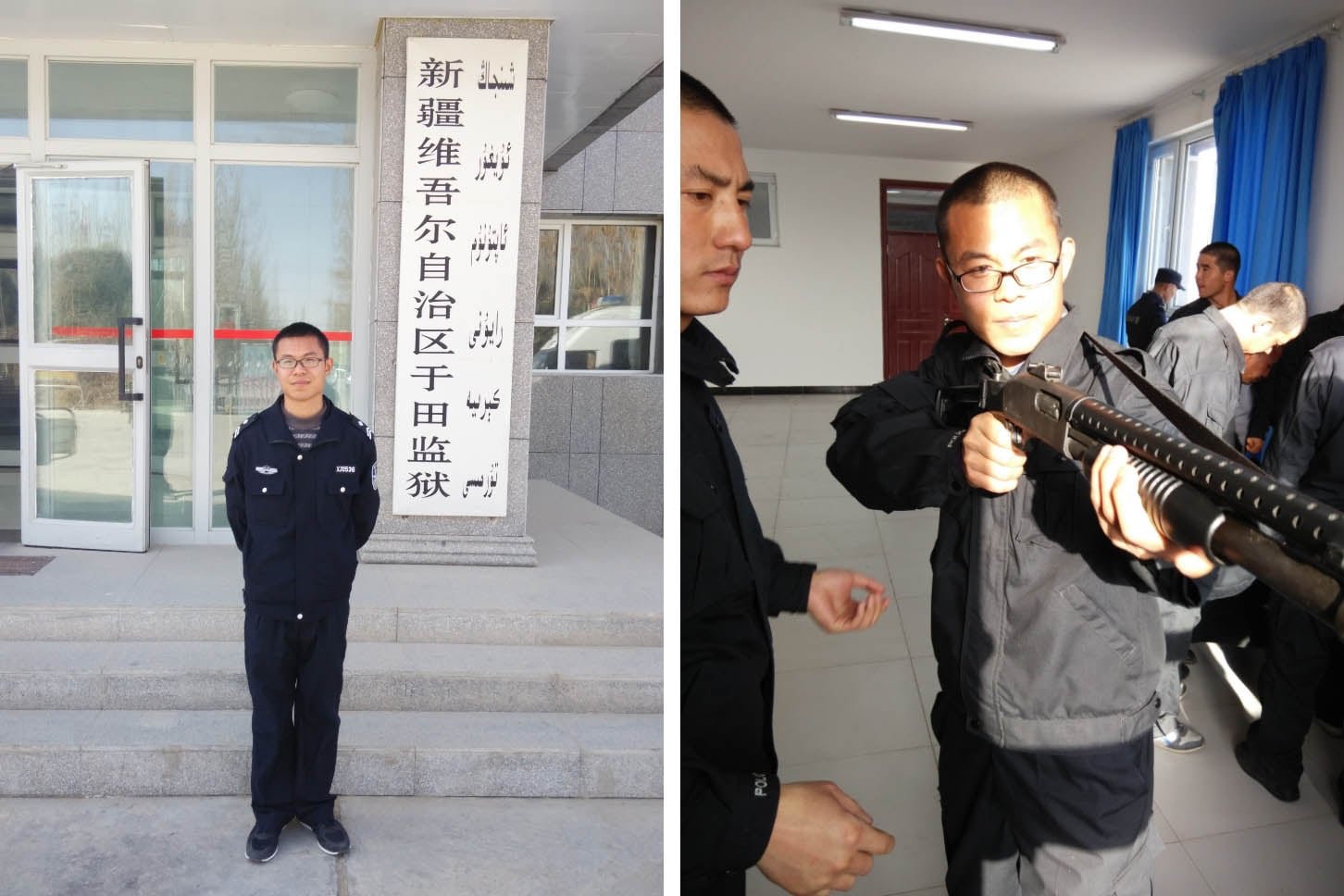
The specifics of Xinjiang’s newly concealed coercion emerge from the testimony of Zhang Yabo, a Han Chinese citizen who moved to Xinjiang in 2006. During the past few months, I had extensive conversations with Zhang, who provided me with comprehensive documentation to verify his service history. After working as a schoolteacher, he joined the police in 2014 and was deployed to the Uyghur heartland region of Hotan.
Between 2014 and 2016, as a detention center correctional officer, Zhang witnessed the routine beating and torture of Uyghur detainees, including victims being suspended from ceilings for 24 hours. A colleague raped a female detainee while interrogating her. Zhang saw detainees die from the abuses. In 2017, during a two-week stint at a detention center at the height of the mass internment campaign, Zhang recalled witnessing severe overcrowding, “abysmal” conditions, and fatalities occurring with “alarming frequency.”
Between late 2016 and 2023, Zhang worked as a village police officer. He transferred Uyghurs released from reeducation camps to detention centers, many of whom were subsequently sentenced to long prison terms. Zhang estimates that half or more of the released camp detainees in his jurisdiction ended up in prisons.
Official statistics corroborate the staggering scale of this carceral shift, revealing that more than half a million individuals were sentenced to prison between 2017 and 2021. Zhang also supervised state-mandated forced labor transfers, including groups of Uyghurs forced to harvest cotton under police supervision.

Zhang supervises Uyghur laborers from his village during the December 2018 cotton harvest, seen in Shaya County, China. Escape from the fields was prevented through close supervision and police checkpoints.
Zhang’s testimony also reveals that actual internment numbers may have exceeded even the regional leadership’s internal estimates. In 2019, while stationed at the Hotan County reeducation headquarters, Zhang observed how county officials routinely concealed the true scale of mass internment from their superiors. Trapped between conflicting party directives, local officials carried out sweeping detention orders, only to later conceal the resulting numbers for fear of being disciplined for governing “unstable” jurisdictions.
Zhang broadly estimates that around 25 percent of the adult population in his village was interned in reeducation camps, excluding those separately transferred to formal prisons. To conceal the campaign from the outside world, in early 2020 the authorities issued strict orders to all local security forces to destroy every single file related to the reeducation camps.
In late 2023, Zhang resigned and fled the country. Since then, the Chinese authorities have privately accused him of “endangering national security,” frozen his bank accounts, and threatened his family in China.
The recent 2023 detention drive that Zhang facilitated in Hotan is corroborated by broader regional trends. Witness accounts that I obtained describe a parallel wave of arbitrary detentions in Urumqi, the regional capital, following the end of the zero-COVID policy. This wave specifically targeted young Uyghurs swept up following widespread protests against pandemic lockdowns.
Xinjiang’s renewed repression aligns with a clear shift in Chinese leader Xi Jinping’s rhetoric. During a central government forum on Xinjiang in 2020, Xi struck a triumphalist tone, declaring the party’s regional policies a complete success and emphasizing economic progress without mentioning danger. But during an unannounced visit to Urumqi in August 2023, his message turned somber. Xi warned of hidden dangers and demanded a renewed focus on regional securitization.
To perpetuate the profound dread established during the mass internment era, Ma’s administration deployed preemptive, rotating short-term detentions to ensure enduring subjugation. By keeping the lockups brief but systematic, the state maintains pervasive fear while projecting an illusion of normalcy. Under this normalized stability, Xinjiang is facilitating a sweeping project of ethnic assimilation. According to Zhang, the drastic suppression of Uyghur language, culture, and religion initiated under Chen continued unabated after Ma took office.
By the time that Zhang left the police force in late 2023, traditional customs and religious beliefs in his area of deployment had been effectively eradicated. Reading the Quran, praying at home, and observing the Ramadan fast were strictly forbidden. The state compelled Uyghur officials to consume pork as a loyalty test. Zhang noted that most mosques were destroyed, and one remaining mosque in his area was guarded 24 hours a day to prevent villagers from entering.
Cultural erasure extends deep into the educational system and daily village life. Learning or speaking the Uyghur language is prohibited in schools. Zhang describes a new generation that is growing up increasingly detached from their own language.
This cultural erasure is inextricably linked to the region’s economic mandates—specifically, the state-imposed transfer of rural surplus labor. Beijing frames these transfers as voluntary poverty alleviation. Yet Zhang’s testimony dismantles this official narrative and confirms that these programs actually operate as a vast mechanism for state-imposed forced labor and demographic engineering.
Under Ma, labor transfers experienced massive quantitative growth, evolving from acute mobilization into normalized and inescapable state-mandated employment. Official reports document that labor transfers reached a record of 3.4 million transfer instances by 2025 (involving more than 3 million distinct individuals, some of whom were transferred more than once in the same year).
However, the state’s own security policies are creating a severe logistical problem for local officials. Because the government had already subjected a vast portion of the working-age demographic to forced labor or detention over the preceding years, the available local workforce is insufficient to meet increased transfer quotas.
According to Zhang, this structural deficit is placing immense pressure on grassroots cadres to deliver bodies by any means necessary. To force compliance, village committees and local police forces are weaponizing their unilateral authority over residents’ lives.
Zhang witnessed how officials utilize a broad range of administrative harassments and explicit threats to coerce individuals into accepting work assignments regardless of personal preference.

Zhang (right) handles a case in an undisclosed location in Xinjiang province, China, in August 2023. Parts of the embedded text have been blurred to conceal sensitive information.
Resistance is penalized with additional mandatory Mandarin instruction, unpaid communal labor, and persistent home visits by cadres. Uyghurs who repeatedly reject these labor transfers are swept into short-term detention facilities where they are, in Zhang’s words, “intentionally subjected to hardship and suffering to force them to obey.”
This aggressive extraction of working-age adults is systematically hollowing out rural communities. Zhang observed the village population contract sharply, leaving behind primarily the elderly, the sick, and young children. He saw this state-engineered demographic void create a severe child care deficit, resulting in drownings of unsupervised children and compelling local officials to issue warnings against children playing near bodies of water.
The documentary record from Ma’s tenure confirms this coercive environment. A 2023 prefecture directive instructed cadres to “transform the mindsets” of farmers to ensure compliance with work assignments. A recent local planning document from a majority Uyghur county similarly confirms Zhang’s observations about Xinjiang’s aggressive demographic engineering tactics. The document outlines standards requiring an expansion of labor transfers to other Chinese provinces while mandating “gratitude education” and “ethnic unity education” to transform farmers into industrial workers.
As Zhang explained, in practice, the mandate to transform mindsets through “thought work” means subjecting reluctant villagers to explicit threats or punishing them with daily summons to village committee meetings that can last until 2 or 3 in the morning.
This bureaucratic normalization of forced displacement exemplifies the defining achievement of Ma’s tenure: the evolution of Xinjiang’s governance from the overt crackdowns of the Chen era to a long-term reality of inescapable control. In political science terms, the system has transitioned from despotic power to an unprecedented expansion of infrastructural power.
Despotic power relies on arbitrary coercion and visible violence—tactics defining the height of the mass internment drive. While effective at forcing immediate submission, such overt repression is both economically disruptive and politically costly to sustain. Infrastructural power, conversely, rests on the state’s logistical capacity to penetrate society and implement policy through invisible bureaucratic processes.

Screenshots taken from a propaganda video produced by the local government work team show a Monday morning flag-raising ceremony in Urushkey village, where Zhang was stationed, in 2023.
By further integrating stability maintenance into grassroots governance, the Chinese party-state has transitioned from the visible brutality of mass internment to the clandestine administrative finality of engineered compliance.
Ma skillfully coupled the intensification of Xinjiang’s coercive labor programs with an explosive expansion in international trade. According to official customs data, direct exports to the United States, Canada, the United Kingdom, and the European Union surged by a staggering 465 percent during his tenure from 2021 to 2025. Between 2024 and 2025 alone, they jumped by 71 percent.
Yet despite successfully orchestrating what Ma himself termed a “positive interaction between high-quality development and high-level security,” his tenure ended abruptly. In July 2025, Beijing unexpectedly replaced him with Chen Xiaojiang. Ma is now officially under investigation for corruption:
As the international community struggles to monitor a region where highly visible atrocities have faded into administrative normalization, the testimony of insiders such as Zhang shatters the illusion that Xinjiang’s governance has become more lenient. The region’s machinery of repression has traded campaign-style coercion for a model that is more sustainable and penetrative, rendering the dissolution of Uyghur communities a permanent structural reality.
As Zhang’s testimony demonstrates, the region’s repression did not end with the mass internments; it merely evolved to reflect a normalized logic of political paranoia at the center. Driven by the leadership’s impossible quest for permanent invulnerability, this relentless demand for total social control creates the conditions in which mass atrocities breed.



