
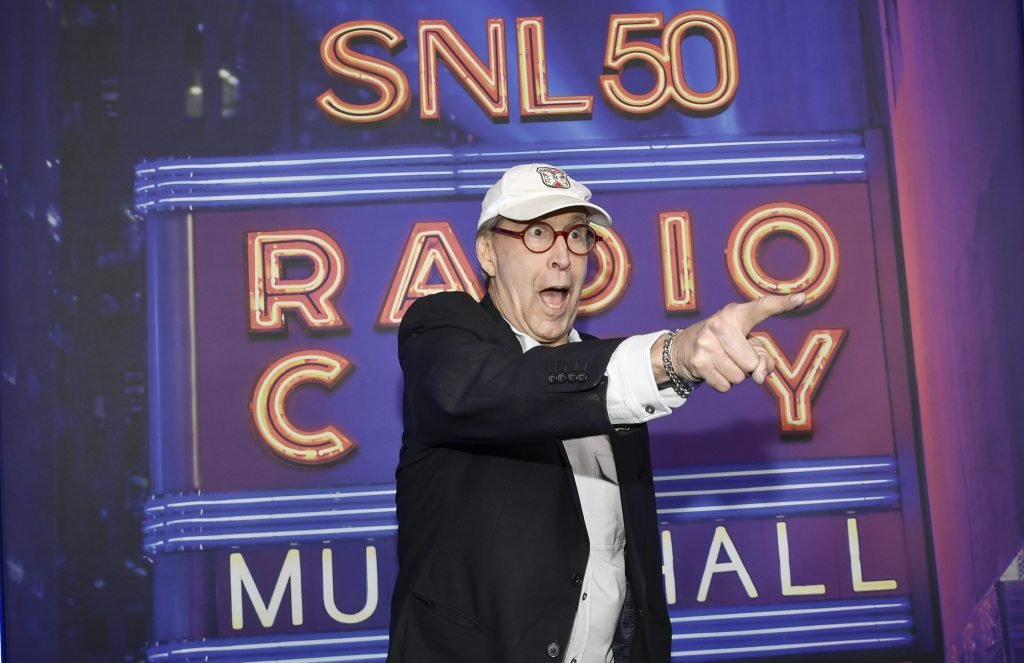
Those who come to the new documentary “I’m Chevy Chase and You’re Not” hoping to see its star buried by his own contemptible reputation will not be disappointed. It’s all there — the condescension, the slights, the drugs, the firing from “Community” and his painful ostracism last year at the 50th anniversary of “Saturday Night Live.”
Almost immediately in the CNN Films documentary, Chase shovels fresh dirt on himself, telling intrepid filmmaker Marina Zenovich that her task will not be easy. Why?
“You’re not bright enough,” he tells her. “I’m complex, and I’m deep, and I can be hurt easily, and I react spontaneously to people who want to figure me out.”
But Zenovich was undaunted and came away with a deeply human and authentic film about one of the biggest pop-culture stars of the late 1970s and early ’80s, charting the comedian’s rise from Bard College prankster to self-indulgent “Saturday Night Live” star and unlikely big-screen sex symbol, then documenting the fall, with cocaine addiction, extended bouts of depression, a litany of on-set disputes and near-fatal heart failure in 2021.
“I’m Chevy Chase and You’re Not” also includes a section on his dark childhood, in which he discusses being raised by a mother with mental health issues and a stepfather who physically and emotionally abused him.
Revealing testimony comes from family, friends and former collaborators including former agent Mike Ovitz, Lorne Michaels, Dan Aykroyd, Martin Short, Garrett Morris, Beverly D’Angelo, Goldie Hawn, Ryan Reynolds and others.
“I don’t think he consciously wants to be an a–hole,” says Alan Greisman, a friend and producer of his 1981 movie “Modern Problems.” “I think the a–hole version of him is somebody who is desperate for something he either lost or doesn’t have.”
Zenovich’s other films include documentaries on troubled comedy legends Richard Pryor and Robin Williams, as well as cyclist Lance Armstrong and disgraced filmmaker Roman Polanski, the latter winning two Emmy awards.
In a recent interview with Variety, Zenovich acknowledged the film is not an attractive portrait of Chase: “[It] was a hard watch for him and his family, but I think in the end they appreciate it.”
But with Chase alternating between sunny tour guide and cagey sparring partner, Zenovich manages to surgically separate jerk from unconventional genius, as well as the wounded man underneath. And if you didn’t know that Chase was an original member of the band that would later be known as Steely Dan, well, now you do.
The Fort Lauderdale International Film Festival will show “I’m Chevy Chase and You’re Not” at Savor Cinema on Thursday, with Chase in attendance, a screening that was almost immediately sold out. Chase, recipient of the 2026 FLIFF Lifetime Achievement Award, will take part in a post-film Q&A session with Zenovich that is sure to be fascinating.
The film, which premiered on CNN on Jan. 1, also is available on the CNN app for subscribers, as well as streaming services including HBO Max and Hulu + Live TV.
Why did he make the film?
Speaking from his home in Bedford, New York, about an hour outside of Manhattan, the 82-year-old Chase answered a few questions about the documentary, including, “Why do it at all?”
“Here’s the thing — they asked me to do it. I liked it, it’s very real. … I mean, honestly, my life is what it is. I like my life,” he said, laughing. “I can’t imagine what could have been hard about it. It’s not like I came out of prison and didn’t want anybody to know.”
Is he happy?
About halfway into it, after a minefield of personal and professional controversies, the film arrives in Bedford, where Chase and his wife of more than 40 years, Jayni, raised their three daughters. It’s the holidays, and he seems humbled at local showings of “National Lampoon’s Christmas Vacation.” We watch him respond to the piles of fan mail he receives each week, typically including a half-dozen wedding invitations. Is he as happy as he appears? How does he define it?
“What a funny question,” he said. “I don’t know how to answer that. You know, I live with a smile all day. There you are.”

Depression unlocked
There are many tender moments in the film, including a section on the period of deep depression that followed his Fox talk show being canceled after six weeks on the air in 1993. His daughter, Caley, recalls being a child and luring Chase out of bed by playing the piano. How did it feel to hear that from her?
“Oh, it’s lovely. You know, I played jazz piano. And my daughter plays beautiful piano,” he said. “I don’t specifically recall how that all came about, but, you know, I have a great family. They’re just wonderful people. And she could have been playing the piano or dancing the Charleston, whatever it was, it brought me out of my depression.”
‘Hard work and effort’
The impatience that Chase brought to his work, along with his provocative, improvisational style of comedy and communicating, feels a little like jazz. Did his experience with jazz piano influence his art?
“I grew up on people like Bill Evans, who I became a friend with. Bill Evans was a wonderful jazz pianist. I loved Bill and I could spend time under his piano when he practiced, eight hours a day. And when he said eight hours a day, he meant it,” Chase said. “So at that level, you know, you learn something about everything that’s artistic — that it doesn’t just come in a breeze, it comes with a lot of hard work and effort. And so I learned a great deal from that friendship and from being at his house with him. There are others too that were great, but that was a very special relationship.”
The Steely Dan story
The film audience learns that Chase played drums with Bard College classmates Donald Fagen and Walter Becker before he left to seek his fortune in New York. Fagen and Becker, of course, would go on to form Steely Dan. Chase said he’s still in touch with Fagen.
“We weren’t called Steely Dan at that time. We were just called the Very Bad Jazz Band … the name I came up with, for no particular reason. Then they called themselves Steely Dan as I was leaving. Maybe my leaving caused them to become famous,” he said, laughing.
‘Caddyshack’ memories
Ovitz, his former agent, describes “Caddyshack” as the best showcase for everything that made Chase a star — the debonair presence, the physical humor. Does Chase have a favorite memory of shooting that film in South Florida?
“Oh, boy. It’s a long time ago. I just loved being on a golf course, being with those guys. You know, Ted Knight was brilliant, and I became good friends with him. … Then there’s the idiocy of Rodney Dangerfield. He was very funny in his own right,” he said.
There’s a classic scene with Bill Murray, where the dapper Chase must play a ball that has landed in Murray’s trashy shack at night. It was famously unscripted, like two jazz musicians trading solos.
“Yeah, one is good, the other one not so good,” Chase said, laughing, and pointing out that he is the former. “I’m the good one. There’s not a lot of jazz with Billy. [Laughs] But, no, I know what you’re saying and I agree. It was sort of like two jazz musicians.”
Almost no regrets
By the end of the film, Chase seems to be a man at peace with his decisions. Does he have any regrets?
“I don’t. I don’t have any regrets,” he said. “I’m beginning to regret this call. [Laughs] Now I know what it feels like! [Laughs]”
For more information on the Fort Lauderdale International Film Festival, visit FLIFF.com.
Staff writer Ben Crandell can be reached at bcrandell@sunsentinel.com. Follow on IG: @BenCrandell.



