
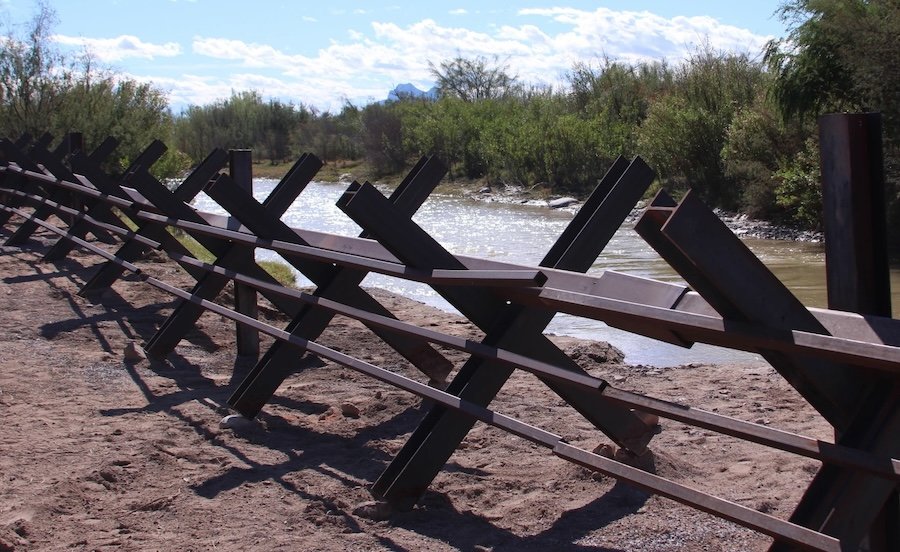
The U.S. Supreme Court stayed a federal judge’s injunction that had halted barrier and road construction across the Border Patrol’s Big Bend Sector in West Texas. The order clears the way for work to resume on five federal contracts worth about $7.5 billion.
In an unsigned opinion on Nov. 9, the court says the government is “exceedingly likely to prevail” on its argument that U.S. District Judge Kathleen Cardone of the Western District of Texas lacked jurisdiction over the plaintiffs’ major-questions-doctrine claim. Justice Ketanji Brown Jackson noted she would have denied the stay but did not write a separate dissent.
Cardone’s Oct. 2 injunction blocked DHS from using waivers to bypass environmental and cultural-resource reviews and halted all construction and ground-disturbing work across the Big Bend Sector, which includes portions of Big Bend National Park.
The high court’s stay will remain in place while the justices decide whether to hear the case. If the court declines to take it up, the stay on Cardone’s injunction halting construction will automatically end, and the border wall construction will be restricted in Big Bend. If the court agrees to review the case, construction will be able to continue until the justices issue a final ruling.
U.S. Customs and Border Protection did not immediately respond to ENR’s inquiries about whether crews are back at work or when they will be.
Three contractors hold the five contracts on the project. Barnard Construction Co. holds two totaling nearly $2 billion and Fisher Sand & Gravel Co. holds two totaling about $3.8 billion. Southwest Valley Constructors Co., a Kiewit Corp. unit, holds a $1.72-billion task order centered on Big Bend National Park. Before the injunction, contractors began erecting 30-ft-high steel barrier panels on Sept. 15 along a 47-mile stretch in Hudspeth County.
Southwest Valley’s contract covers 17 miles of noncontiguous, low-profile vehicle barriers and about 205 miles of patrol-road improvements and other infrastructure in and around the park. Its current performance period ends May 11, 2027, with options into 2028.
CBP describes the park project as a combination of vehicle barriers, roads and detection technology designed to complement the region’s natural obstacles, rather than the bollard-style pedestrian barriers planned for other segments. In August, the agency said it was coordinating road-design requirements with the National Park Service and local officials.
Three other projects, awarded March 5, call for 30-ft bollard-style pedestrian barriers. Another, awarded June 2, covers about 160 miles of vehicle barriers. The program runs across West Texas and into the Del Rio Sector toward Lake Amistad.
The projects are being carried out under a federal law that DHS says gives the Homeland Security secretary broad authority to waive legal requirements for certain border construction. Section 102 of the Illegal Immigration Reform and Immigrant Responsibility Act authorizes barriers and roads to deter illegal crossings in areas of high illegal entry. It allows the Homeland Security secretary to waive “all legal requirements” the secretary determines necessary to expedite that work. It also limits court challenges to those waivers to claims alleging a constitutional violation.
The plaintiffs, including the Center for Biological Diversity, Friends of the Ruidosa Church and a local river guide and landowner, argued that DHS’s waiver authority violated the major-questions doctrine. Judge Cardone treated that argument as a constitutional claim, but the Supreme Court said the major-questions doctrine is simply a tool for interpreting laws, not a constitutional right. As the court put it, “There is no such thing as a ‘constitutional’ major-questions claim.”
The court cites a declaration from a U.S. Customs and Border Protection official stating the injunction costs the government nearly half a million dollars a day, money that “cannot be recouped.” By allowing waivers of environmental and conservation laws, the court says, Congress showed “a clear preference for expeditious border construction over the very harms respondents assert.”
“This horrific decision clears the way for contractors to bulldoze pristine desert and dynamite canyon walls before the courts have even decided whether this destruction is legal,” says Laiken Jordahl, national public lands advocate at the Center for Biological Diversity, in a Nov. 9 release.
The Supreme Court’s order leaves a separate legal challenge unresolved. The opinion does not decide whether the Big Bend Sector qualifies as an area of high illegal entry. It notes the secretary’s finding but grants the stay based on the government’s likely success on its jurisdictional argument and the other factors governing interim relief. It stays only the injunction in the Western District of Texas case.
The high-illegal-entry designation is central to a suit filed Sept. 14 in federal court in Washington, D.C., by Conserve Big Bend and six landowners. The suit challenges DHS determinations supporting about 600 miles of planned barrier work across five project areas.
Those plaintiffs cite CBP figures showing the 517-mile Big Bend Sector recorded 3,096 apprehensions in fiscal 2025, the fewest of any Southwest sector. They argue the numbers do not support using the expedited construction authority there.
Source: www.enr.com



