
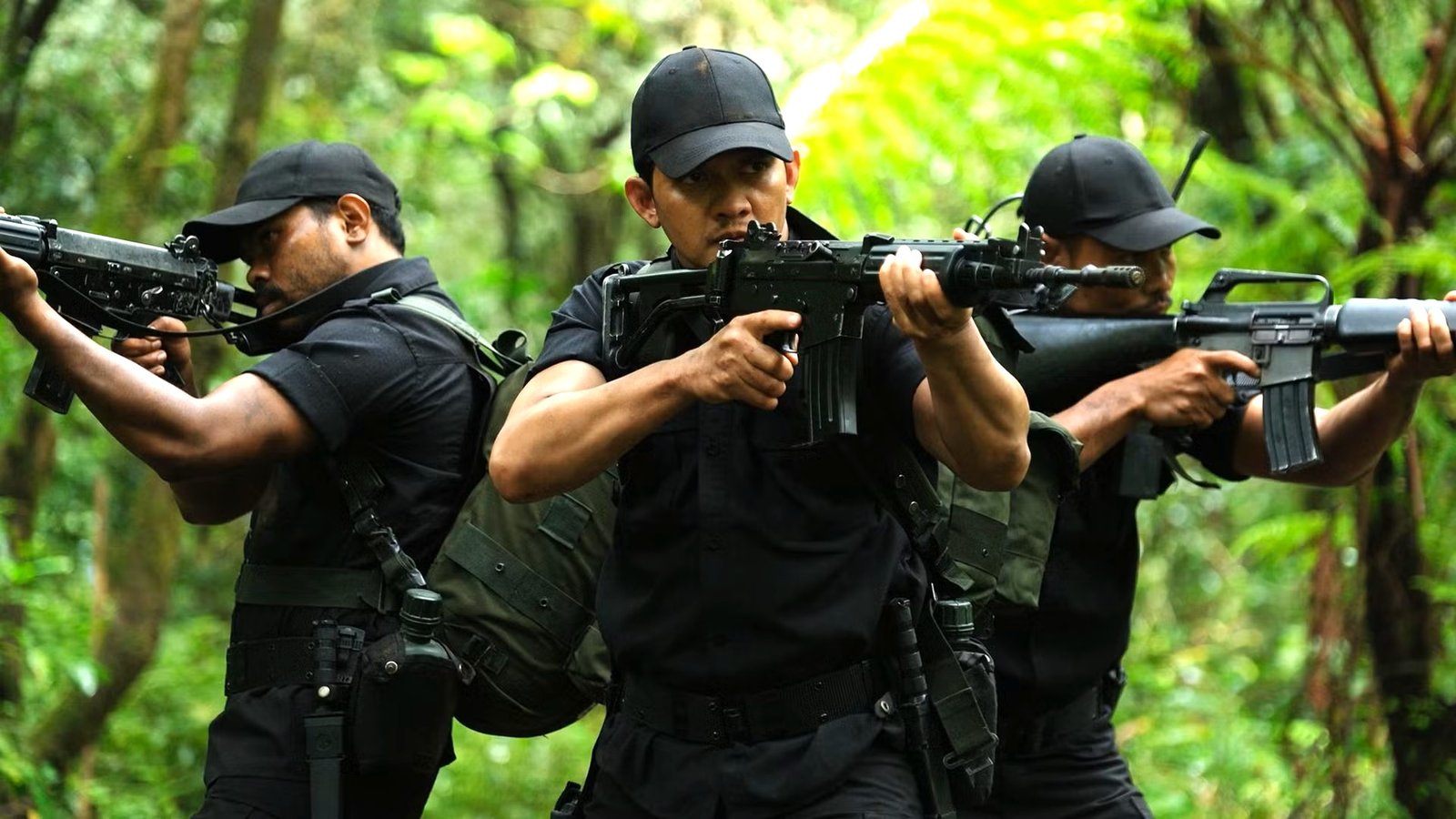
After “Merantau” and “The Raid” made him famous, Indonesian martial artist and silat master Iko Uwais appeared in several Hollywood movies. He later returned home to start his own company, Uwais Pictures. His first project is “Timur,” a military search-and-rescue film that he directed and starred in. (Asian Movie Pulse)
Buy This Title
by clicking on the image below
“Timur” draws inspiration from the 1996 Mapenduma hostage crisis in Papua, Indonesia, when the Free Papua Movement took members of a World Wildlife Fund research mission hostage. Uwais’s version begins in a thick Indonesian rainforest, where a group of dedicated, mixed race researchers collect samples. That night at their camp, they see men with torches and weapons approaching from the dark jungle.
After forcing their way in under orders from Commander Tobias, the terrorists snatch up the six researchers, kill the village head, and march off into the jungle. To their surprise, the researchers learn that Apolo and Yoseph, their trusted local guides, are actually working for Tobias. Upon learning about the hostage situation, the Indonesian government quickly dispatches its top Jaguar Team of elite officers, led by commando Timur, for the dangerous rescue mission.
Initially, “Timur” looks like a typical military search and rescue adventure. However, judging from the overload of flashbacks, the themes of friendship, brotherhood and family bonding soon start to surface and dominate the story. As boys growing up in the highlands, Timur, Sila and Apolo were under the care of a foster couple. This inseparable trio, though not related by blood, became brothers through their strong bond. One day, Timur had to leave, and his departure shocked the other boys. Devastated, Apolo felt abandoned. Twenty years later, the rescue mission has become personal for commando Timur, since he knows that he has to face his terrorist brother Apolo.
Visually, the opening establishing shots of the rainforest in Iko Uwais’s directorial debut look impressive. The carefully framed misty treetops, highlands, streams and wildlife, captured through the cinematography of Dimas Imam Subhono, make the Indonesian jungle come alive. This also applies to the equally memorable shots of the military helicopters and vehicles in action during the drop off and rescue sequences. Obviously, Uwais had help from the Army in providing those war machines to make his work look more authentic. In return, he even praises the Indonesian military for its efficient rescue operations during the closing moments.
The rescue mission provides the opportunity for the movie to show off its action sequences and also gives the Uwais Team the chance to display its stunt and martial arts skills. However, the gunfights, though well choreographed, are hardly original or memorable. Nonetheless, the grittier hand-to-hand combat with machetes is at times the standout element. Unfortunately, these fight sequences go on far too long, eventually becoming repetitive while lacking credibility and impact.
Understandably, Uwais tries to create more atmosphere and impact in his fight scenes by making extensive use of handheld and shaky cameras. However, the resulting mostly medium shots and constantly jittery fights, combined with minimal editing, become too chaotic, confusing and even nauseating to watch. At times, it is equally difficult to figure out who is fighting whom. In addition, the poorly executed digital blood effects only cheapen the overall look.
In general, the supporting actors play their parts reasonably well. Timur’s best friend Apolo, portrayed by Aufa Assagaf, is a tragic character who suffers a series of setbacks and eventually chooses the wrong path. Jimmy Kobogau has the smallest role as Sila, the third member of the trio. As Frans, the second in command of the terrorists, Macho Hungan is memorable and gets to show off his kicking skills. In contrast, Arnold Kobogau appears briefly as the rather laid back and non threatening terrorist Commander Tobias.
Apart from a plot and visuals that borrow heavily from “The Raid”, “Predator” and John Woo’s “Bullet in the Head”, Uwais shows promise as a filmmaker. He obviously put a lot of effort into his first directorial feature, managing a huge cast while shooting under the tough conditions of the Indonesian jungle. Hopefully, his next action project will feature less distracting and jittery camera work, along with a more involving plot.



