
Published September 10, 2026 06:00AM
SUMMARY:
- Although the “Norwegian Method” is famous for its metrics and tech, the true secret to Norway’s triathlon dominance is the squad’s collaborative group training culture.
- Psychological research and elite triathletes confirm that training together leverages the Köhler effect to increase motivation, help athletes push past individual limits, and yield better results.
Recently, Kristian Blummenfelt posted a video on Instagram of himself with training buddies Gustav Iden and Casper Stornes. Set against a verdant backdrop of mountain peaks and evergreen trees in St. Moritz, Switzerland, the three are shown circling a track. The simple caption: “13 days out from the 70.3 world championships.”
The 10-second clip was understated, but the message was loud and clear: These three Norwegians are fit. They’re ready for Nice. And, of course, they’re in it together.
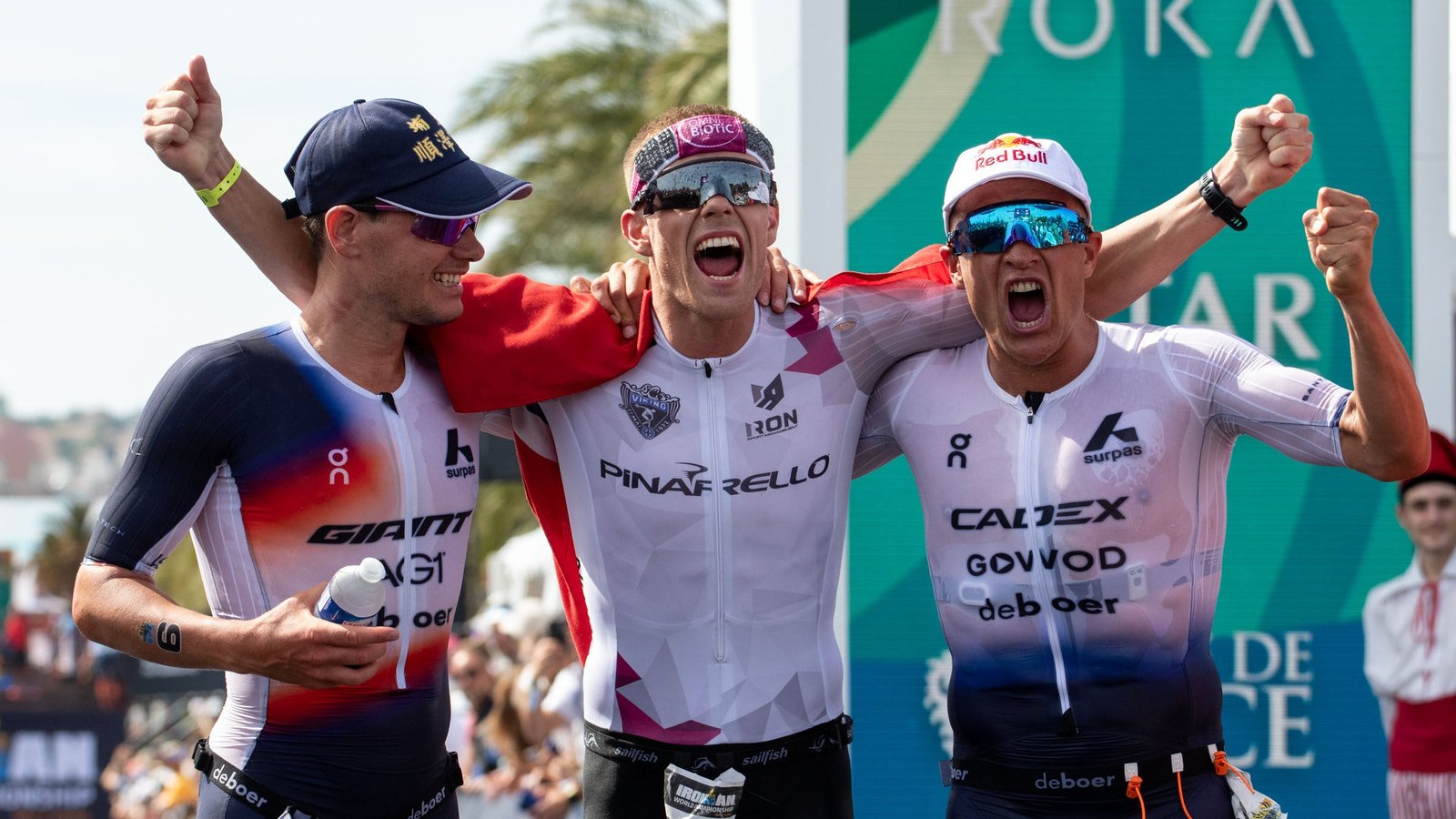
It was this trio, after all, that burst onto the triathlon scene in 2018, shocking the world by becoming the first country to sweep a men’s World Triathlon Series podium at a race in Bermuda. They’ve since swept more podiums — most notably at the 2025 Ironman World Championship in Nice with Stornes, Iden, and Blummenfelt going 1-2-3 respectively — and their training, also known as the “Norwegian Method,” has become a blueprint for endurance athletes around the world.
It’s clearly working: double-threshold days, lactate testing, heart-rate data, and a near-obsessive attention to training metrics have helped make the Norwegian approach one of the most influential training systems in endurance sport.
But there’s another part of the Norwegian Method that gets less attention: they train together, push one another, and compete with one another, all while having a pretty good time. While the data and details may optimize the training, the social part of it all might just be their secret sauce.
So what can age-group triathletes learn from that? In an era when training has become more and more individualized, with artificial intelligence capable of building a customized program in seconds, have triathletes neglected the “better together” part of the Norwegian Method?
From club culture to solo training
There was a time when, for many, joining a triathlon club was almost synonymous with registering for your first race.
During the triathlon boom of the early 2000s, clubs became a prominent part of the sport. Between 2000 and 2010, the number of triathlon clubs in the U.S. grew from just 50 to 869, while USA Triathlon (USAT) membership climbed from 58,000 in 2005 to 140,000 by 2010. The growth of clubs reflected the rapid expansion of the sport itself, as thousands of new athletes entered triathlon and sought out that camaraderie, structure, and shared motivation that clubs provided.
Today, however, that club landscape is less robust. While some established clubs have kept their numbers fairly steady, participation in triathlon clubs has declined overall. USA Triathlon currently lists 434 adult triathlon clubs that are proactively affiliated with the organization, down from 604 in 2023. This trend raises a larger question: What happened to the community element of the sport?
COVID almost certainly played a role. Like many recreational sports, triathlon was disrupted by restrictions on group activities and in-person events. Athletes who had trained together suddenly had to train alone, races fell off the calendar, and group workouts came to a halt. For a while, solo training was one of the only paths forward for triathletes, and some of those habits stuck.
But COVID may not be the whole story: By 2020, triathlon was already becoming easier to do on your own, and that has only become more so in ensuing years. Work-from-home schedules give athletes more freedom to fit workouts into their day when it works for them, while AI-generated training plans, smart trainers, and wearable technology provide much of the structure and feedback that once came from a club, especially those that were coach-led. An athlete can now get a training plan in seconds and connect online with other athletes without ever showing up for a group practice.
Then there are the administrative hurdles. In 2024, USAT stopped subsidizing insurance premiums for clubs. While clubs still get coverage through USAT, they are now connected directly with brokers to tailor policies based on their specific size and membership. This makes it tough for local clubs with smaller budgets to stay afloat, especially those that are volunteer-led.
“Ten years ago, half the kits on course were regional and local tri clubs,” says Michelle Lake, an endurance business coach and founder and owner of Fiv3 Racing based in Reston, Va. “Local clubs have struggled for several reasons: board volunteers burn out, and key positions leave huge holes in leadership when someone takes a break from the sport. At some point, giving to their family or day job matters more than running a tri club.”
Lake, who has studied the business of triathlon for more than a decade, says that while some big-city clubs, like those in Los Angeles, San Diego, and DC, have been able to stay active, the void of local clubs is being filled by apparel-backed groups, like Team Zoot and Wyn Racing, which offer an online community and gatherings at specific races, but not the in-person, day-to-day group training and socialization of a hyper-local club.
“It’s a fun environment for triathletes, and you do feel like you’re part of something, but it’s not quite the same,” she said.
Despite these hurdles, triathlon clubs are far from obsolete. USA Triathlon has made clubs a major focus, eyeing them as a primary engine for building community and boosting race participation. A huge part of that push centers on attracting the 20-to-29-year-old crowd — a demographic that’s currently fueling a massive explosion in run club culture.
According to Running USA, run club membership across the country has jumped 25% in recent years, driven by younger athletes who are especially eager to train together when the environment feels right.
“People want to do the sport together,” Lake noted. “Run clubs have a much lower barrier to entry. The real challenge for triathlon now is giving Millennials and Gen Z that same sense of community with that same ease of entry.”
Triathletes are better together
It doesn’t take a squad of Norwegians to show us that there are benefits to training together. This is a concept first explored back in the 1920s, when German psychologist Otto Köhler observed that people working on difficult tasks often performed better as part of a group than they did individually. The phenomenon, known as the Köhler effect, shows that no one wants to be the weak link in a group — driving athletes to push past perceived limits.
More recent research has pointed to the psychological benefits of exercising with other people, including increased motivation, accountability, and overall performance.
“You can be exhausted and not really in the mood to exercise, but when you know a group is waiting for you and that you will see familiar faces, getting out of bed and putting on your sneakers becomes a little less daunting,” said Kendall Maloof, LMFT, a licensed therapist in Nampa, Idaho.
“When you are alone, physical effort is just that: physical effort. But when you are around other people, there is also conversation, humor, and motivation,” Maloof says. “Everyone loves company, even during discomfort. It gives us a reason and the motivation to return after the initial adrenaline rush has worn off.”
Mirinda Carfrae, a three-time Ironman World Champion based in Boulder, Colo., reflects that she had her best days in the sport while training with a squad of women under the direction of Coach Siri Lindley. “Was I happy when this bunch of women showed up to train with me? Not at first. But Siri said, ‘This is how you get better, training with the best in the world. You rise to the challenge, and you’re training with each other, but also that competition as well,’” shared Carfrae.
For their part, Blummenfelt, Stornes, and Iden have been part of the same training squad since they were teens growing up in Bergen, Norway, back when their then-coach Arild Tveiten tapped them as high schoolers to be part of the country’s first-ever triathlon national team. In a sport built around individual results, the trio have remained best friends — and have credited that closeness with helping them stay consistent in the sport.
“It definitely helps you get that quality in training, because you sort of see that world-class level right next to you,” Blummenfelt said in an interview with Bob Babbitt. “If you are worried about how you will do in a race in a few weeks’ time, then you just have to see if you’re keeping up with Gustav [Iden], and if you are, then you know you will likely be fighting for the win. It gives you the confidence that you can trust you’re doing the right thing, but it also keeps you on your toes, and you learn from each other’s mistakes.”
Community first
That same philosophy inspired Carfrae and her husband, Tim O’Donnell, to start Salty Bears Racing, a triathlon club built around community first. The idea was to create an environment where triathlon is a part of someone’s life, but doesn’t solely define it.
“We wanted to invite like-minded people to join our community, and to create a positive environment where triathlon was a vehicle to a healthier life,” Carfrae said. “Building community was really important to us because when we had good training partners, a squad, it enhanced the experience so much.”
As a coach, Carfrae sees the value of individualized training, saying that athletes have different abilities and schedules, and today’s technology can help them train with a level of specificity that wasn’t possible when she began racing. Still, she says, there’s a limit to how much an athlete can push themselves totally solo.
“You can hop online and have ChatGPT create a program, and you can go out and do it,” she said. “You can get far with that if you’re disciplined, but over time, I don’t think you’ll see improvement anymore. When you’re having fun, being pushed by others, you will probably see better results.”
Which brings the conversation back to the Norwegians. While the triathlon world has been dazzled by the lactate testing, the double-threshold sessions, and the mountains of data behind their success, beyond that precision is something a lot less complicated: athletes who have spent years training together and enjoying the process. And, Carfrae says, it’s something any athlete can replicate, even without the endurance engine of a Blummenfelt or Iden.
“Eventually the love for the sport and the motivation to push hard goes away,” Carfrae said. “If you have a strong community, that’ll pull you back. You’re going to show up, work that much harder, and enjoy it more. And a happy athlete is a fast athlete.”



