
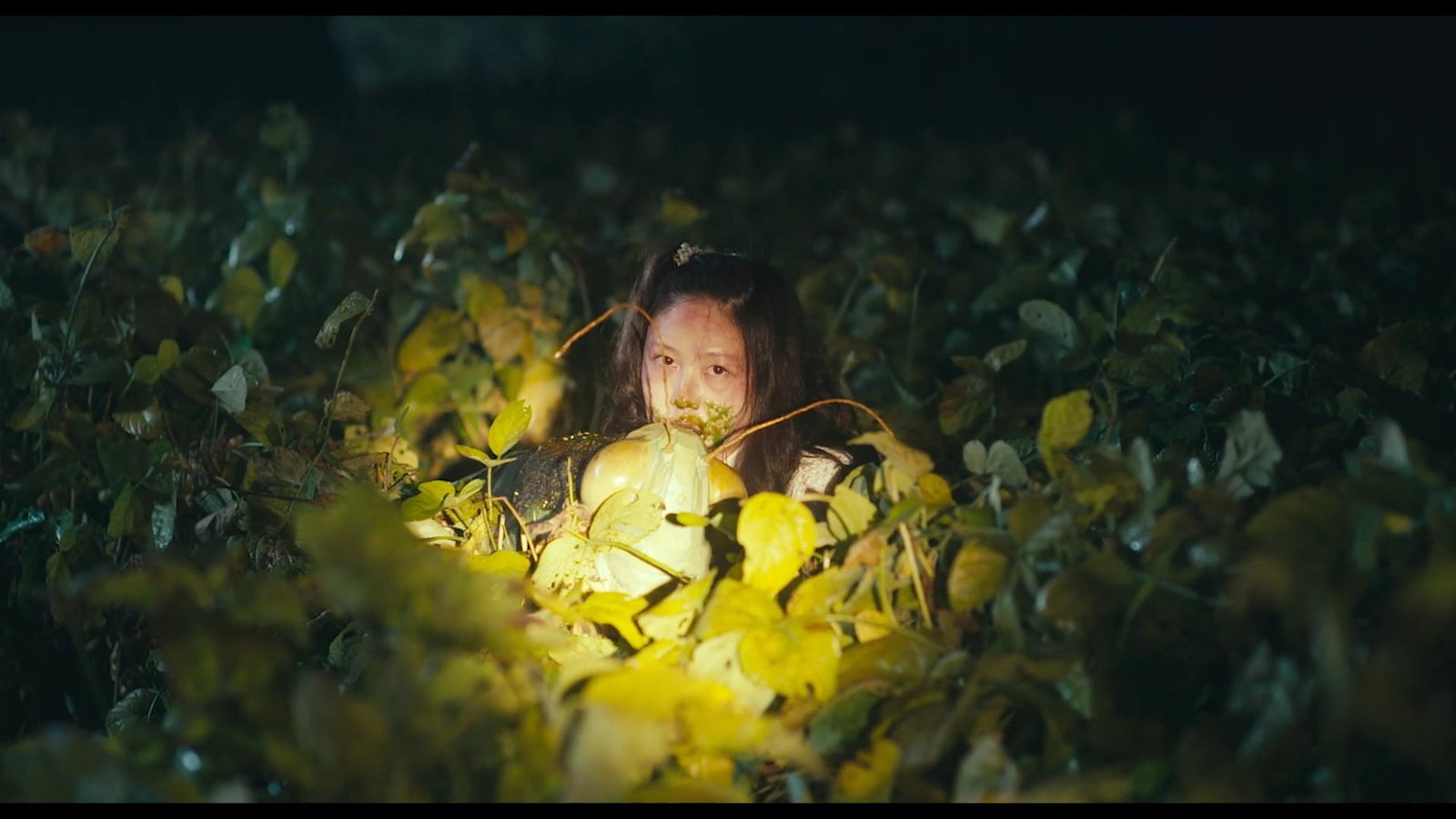
“Brunch with a Depressed Zombie” is the second feature by South Korean director Kim Eun-young, following “Will You Please Stop, Please”. Produced by Hwang Young through Goranibooks, the 105-minute production previously received the SBA Award for Post Production Support at the NAFF Project Market. It is now having its world premiere in the Fanta-scape section of the 30th Bucheon International Fantastic Film Festiva
Byeong-jin takes his wife, Seon-woo, to his grandmother’s house in the rural district of Goeseong, hoping that the quiet environment will help her recover from depression. Their peaceful isolation does not last long, however, as a zombie virus that the government has attempted to conceal spreads across the country and eventually reaches the village. Seon-woo becomes infected, although her transformation is unlike the aggressive behaviour usually associated with the genre. Instead of attacking people, she grows even more withdrawn, stops eating and seems increasingly detached from the world around her.
Byeong-jin initially prepares the dishes his wife once enjoyed, but his efforts only make her angry. While searching through the house, he discovers the recipes his grandmother used when caring for his grandfather, who had lost the ability to speak. Inspired by the affection embodied in those meals, he begins developing new recipes intended specifically for Seon-woo. When she finally starts eating, traces of her former personality gradually reappear. Meanwhile, other villagers are becoming infected, and Bok-hee, the owner of the local supermarket, eventually asks Byeong-jin to share what he has learned.
The central idea is certainly unusual. Instead of presenting the infected as enemies to be killed or escaped from, Kim Eun-young focuses on the possibility of continuing to live with them. Zombiehood becomes an illness that alters a relationship without necessarily ending it. Byeong-jin does not attempt to cure Seon-woo in the conventional sense. Instead, he tries to understand her new needs, adapt to her altered behaviour and find a way of caring for her within the life that remains available to them.
This approach allows “Brunch with a Depressed Zombie” to connect the zombie condition with depression, emotional withdrawal and the difficulties of communicating with someone whose interior world can no longer be easily accessed. The parallel with Byeong-jin’s grandfather is evident. Like the infected, the elderly man could not communicate verbally, leaving his wife to interpret his needs through routine, observation and food. Cooking therefore becomes a language used when ordinary speech has failed.
Trauma also permeates the narrative. Frequent flashbacks return to Byeong-jin’s childhood and the period he spent living with his grandparents, gradually revealing the painful circumstances that brought him into their care. Other shifts revisit the earlier stages of his relationship with Seon-woo, showing the couple before illness, infection and emotional distance reshaped their everyday life. The intention is to connect present caregiving with memories of being cared for, suggesting that warmth can be inherited in much the same way as a recipe.
The emphasis on local and traditional food adds another layer to this concept. The movie is divided into chapters according to the dishes Byeong-jin prepares, allowing individual recipes to function as emotional markers. Food preserves family memory, regional identity and knowledge passed between generations. In its strongest moments, the production understands that preparing a meal for someone can be both an ordinary household act and a profound declaration of commitment.
Unfortunately, the various parts rarely come together convincingly. The transitions between Byeong-jin’s childhood, the couple’s past, the present outbreak and the culinary chapters are frequently awkward. Instead of allowing one timeline to illuminate another, the editing often interrupts the emotional momentum of the preceding scene. The constant movement backwards and forwards consequently makes the narrative feel fragmented rather than layered. At the same time, the lack of tension is painfully obvious on occassion.
The chapter structure could have provided a clear organising principle, but even the dishes eventually seem like separate episodes rather than stages in a steadily developing story. Each segment introduces another memory, theme or emotional problem, yet relatively few are allowed enough time to achieve the necessary impact. The result increasingly resembles a collection of loosely related ideas built around the same central couple.
The presence of a researcher specialising in supernatural phenomena is somewhat amusing and initially suggests that the story may expand its treatment of the outbreak in a more eccentric direction. However, this character and the associated subplot remain disconnected from the emotional and culinary focus. The same applies to several of the broader village elements. They might have worked as the basis of separate shorts, but within the feature they contribute to the impression of a collage whose pieces have not been properly joined.
Although this is not Kim Eun-young’s first feature, “Brunch with a Depressed Zombie” still falls into a trap frequently encountered when a director expands several short-form concepts into a single longer narrative. The movie contains enough ideas for multiple productions, including a relationship drama about depression, a family story about inherited trauma, a culinary exploration of regional culture, an unconventional zombie dramedy (?) and a mock investigation of supernatural phenomena. However, it lacks the compact narrative needed to make these elements feel like parts of the same whole. What remains is an intriguing collection of concepts and several touching observations about care, but not the cohesive feature they might have formed.



