
If Florida voters approve a referendum in November to greatly cut property taxes, Clearwater will need to close a gap of more than $20 million in the first two fiscal years of the ballot measure’s adoption.
That could mean cutting nearly 140 full-time employees, according to a contingency memo prepared by city staff.
Property taxes are the largest contributor to the Clearwater’s general funding account, which pays for the police department, parks and recreation, fire and rescue, public works, libraries, planning and development, and administration.
The Pinellas County Property Appraiser’s Office estimates Clearwater would lose $12.4 million in property tax revenue in fiscal year 2028 and an additional $7.9 million in fiscal year 2029.
State legislators in June approved a constitutional amendment that would largely cut property taxes in Florida. It needs 60% of votes to pass in the November general election.
In the contingency memo, which the City Council received last week, the city is estimating it may have to lay off roughly 75 full-time positions in 2028 and 64 positions in 2029.
The city is currently under a soft hiring freeze and will have around 1,900 full-time employees next year.
The memo outlines a number of cuts made in the first year, including permanently closing the city’s Beach Library, reducing parks and recreation services, such as landscaping and irrigation, and lowering the annual budget for technology the police department uses for investigative assistance and writing reports.
Layoffs would be spread among various city departments that fall under the general fund, with parks and recreation losing roughly 35 positions. The city has other sources of money charged for specific public services, such as garbage pickup and stormwater management.
The city may also stop funding annual grants and payments to the Clearwater Historical Society, the nonprofit Keep Pinellas Beautiful and the Wood Valley and Kings Highway recreation centers.
City staff identified $1.6 million in revenue generating opportunities for 2028, including renegotiating ticket revenue sharing at The BayCare Sound amphitheater, increasing the cost of items at the Pier 60 Bait House and raising the price of recreation passes.
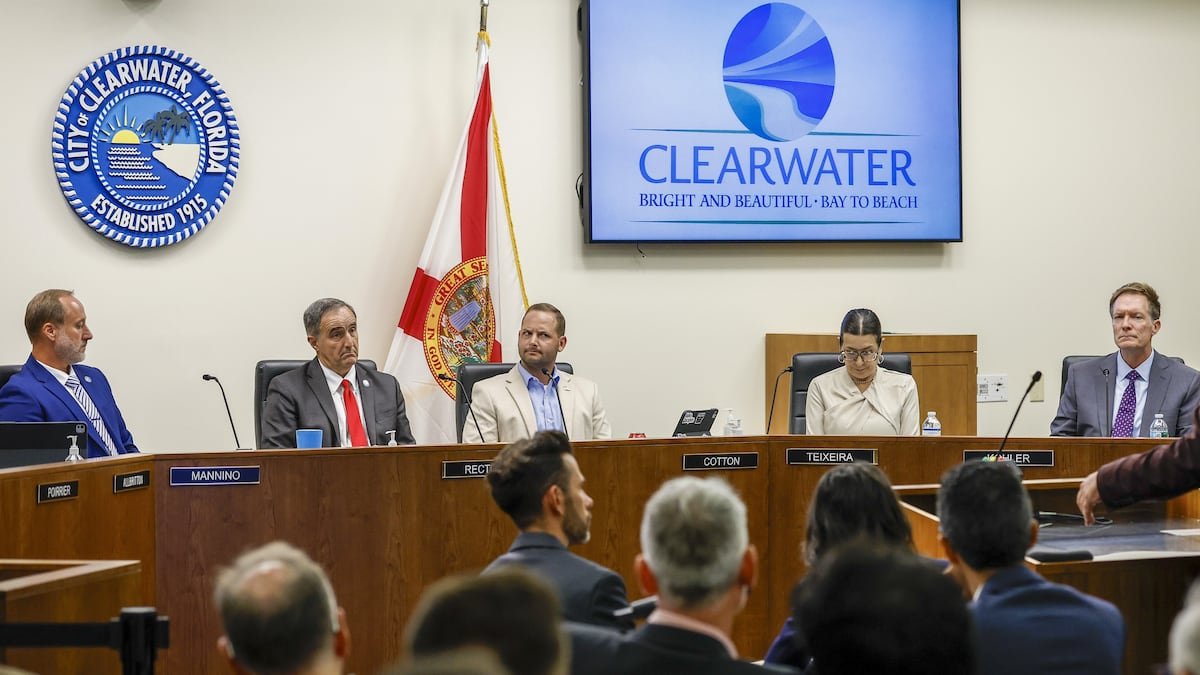
“It’s so easy to just dismiss this as just numbers on a graph or on a piece of paper,” Council member Lina Teixeira said during a budget work session Tuesday. “It actually affects not only our staff but our residents. So, every decision we make impacts humans.”
In the second year of the property tax reduction, the city would reduce the city manager’s operating budget and eliminate the public art grant fund.
The city also identified $745,000 in construction and renovations projects to cut, which include planned site work at Stevenson Creek and road upgrades apart of a separate resiliency project.
If the City Council decides not to reduce its spending, the city’s millage — which determines property tax bills — would need to increase, according to the memo. The city’s current millage is 5.8850 cents for every $1,000 of taxable value. Under the proposed budget for the upcoming fiscal year, it would stay the same.
The proposed city budget is $800.2 million.
The potential loss of property tax revenue recently contributed to the City Council’s decision to enter a new contract with Duke Energy to continue providing service for Clearwater.
“There’s some municipalities that won’t come out of this,” council member David Allbritton said Tuesday. “They don’t have the hotels, the commercial properties, the second homes, all that that we have in Clearwater that is going to carry us through.”
The city is scheduled to hold a public hearing on the proposed millage and budget Sept. 15 at 6 p.m. The final public hearing to adopt the millage and budget is slated for Sept. 21 at 6 p.m.



