
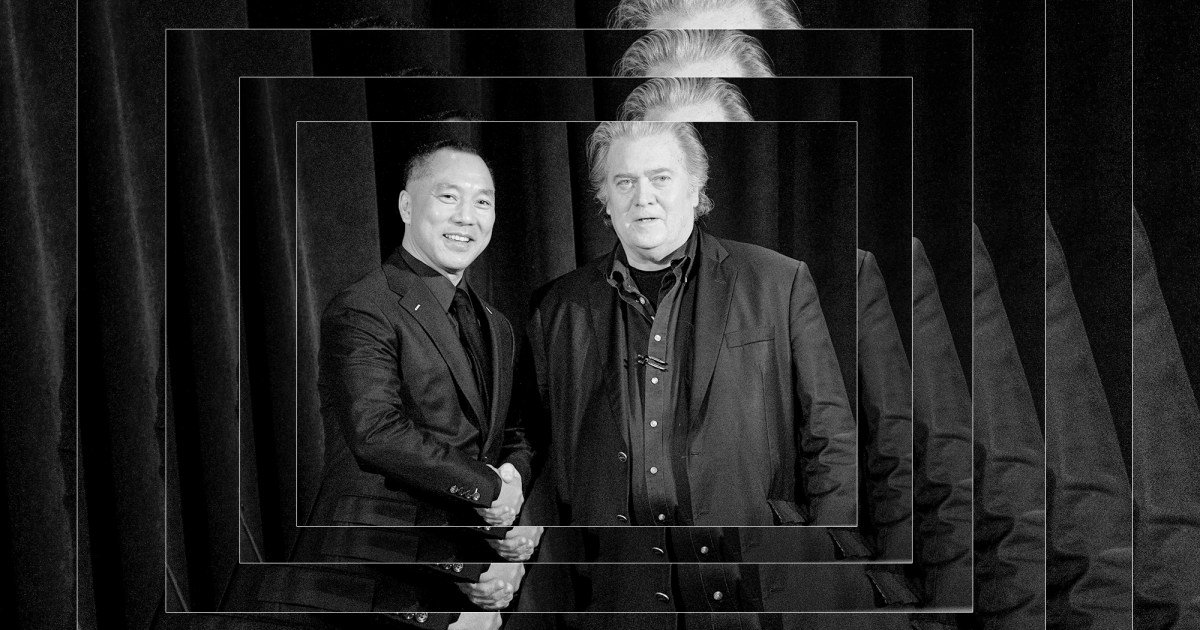
Mother Jones illustration; Don Emmert/AFP/Getty
On July 4, 2020, Guo Wengui stood next to Steve Bannon on a bobbing boat in New York Harbor, with the Statue of Liberty as a backdrop, to announce the launch of the “New Federal State of China.”
Guo—a supposed billionaire Chinese dissident who claimed to know secrets of corruption among China’s leaders—had amassed a large, ardent following among that country’s diaspora.
“This case destroyed everything I had—my family’s savings, our ability to support each other, and even our emotional connection.”
The new organization was wildly ambitious. Guo and Bannon called it a “government-in-waiting,” prepared to step in and run China following what they claimed was the imminent collapse of ruling Chinese Communist Party, or CCP. At the same time, Guo was also seeking investments in GTV, an online streaming site he claimed would compete with companies like Amazon and TikTok, make investors rich, and air reporting that would fulfill his oft-stated goal: “Take down CCP.”
On the boat, Guo joined Bannon in reading a declaration of principles, told the former Donald Trump aide he loved him, and kissed him. Then Guo bit his own index finger and signed the declaration with his blood.
That was, in retrospect, one of many signs of how weird 2020 got. But it was also a high point for the “whistleblower movement” Guo and Bannon touted. Nearly six years later, federal prosecutors are asking Judge Analisa Torres, at a hearing Monday, to sentence Guo to more than 30 years in prison for overseeing one of “this nation’s worst and most rampant frauds.”
In 2024, a jury convicted Guo of stealing hundreds of millions from his followers. The New Federal State of China, the harbor ceremony, the nonprofits, and the media companies were all part of an elaborate con Guo used to “lock in” those supporters before hitting them up for investments, prosecutors said a sentencing memo last week.
Guo, who has been jailed as a perceived flight risk since his March 2023 arrest, continues to deny guilt. His lawyers argue, in their own sentencing memo, that his conviction was the result of the Chinese government’s “relentless and overwhelmingly powerful targeting of him.” The memo also suggests, without evidence, that Guo’s support for Trump, in particular his role in the publication of explicit pictures of Hunter Biden prior to the 2020 election, contributed to his prosecution.
“My family and I were defrauded of around $500,000.”
Guo has created a fashion line, secretly funded a pro-Trump social media company, starred in his own music videos, and once bought a $67 million apartment with a reference from Tony Blair. Last year, he publicly vouched for his former cell-block mate, Sean “Diddy” Combs, as “a very kind, sensitive, genius person.” He bankrolled bogus claims that covid is a Chinese bioweapon and clandestinely wired money to Trump backers trying to overturn the 2020 election results. While promoting himself as the world’s leading anti-China dissident, Guo has faced allegations, which he denies, that he has actually worked as a Chinese spy. In 2019, he faced an FBI counterintelligence probe. (In a ruling in a lawsuit two years later, a judge wrote: “The evidence at trial does not permit the Court to decide whether Guo is, in fact, a dissident or a double agent.”)
But behind the flamboyance and international intrigue was a straightforward scam. In China, Guo became rich through real estate development. He fled the country in late 2014 to avoid arrest there in a corruption scandal, and Chinese authorities ultimately seized most of his assets. Prosecutors argue that when he began launching anti-CCP organizations from the United States in 2018, his intention was to rebuild his wealth by fleecing his fans.
In the government’s telling, Guo, with Bannon’s help, launched a nonprofit, the Rule of Law Foundation, shortly after that seizure to cultivate donors in the Chinese diaspora community. Guo claimed he was putting $100 million of his own funds into the group, but never did. He instead relied on money from his followers, who prosecutors said ultimately put up $36 million.
Those funds were raised in part through an international network of clubs, which Guo followers called “farms.” These well-organized groups also worked to amplify claims Guo made in lengthy daily video broadcasts, with followers translating his remarks into various languages. At times the farms also carried out his directives to attack Guo critics or other Chinese dissidents he quarreled with, somtimes via aggressive in-person protests at their homes.
In 2020, as I have reported, Guo took new steps to monetize his network of political supporters. GTV was the first in a series of “investment opportunities” that Guo offered his backers. After a Securities and Exchange Commission probe curtailed his sale of GTV stock, Guo launched a scheme in which his fans “loaned” money to organizations tied to him in exchange for the chance to buy more stock. He followed that with a “club” in which fans paid tens of thousands of dollars for the chance, again, to invest in Guo companies at a discount, and then with cryptocurrency offerings and other financial vehicles.
Guo promoted these schemes in videos in he which told supporters their funds would help defeat the CCP and guaranteed that investors would not lose money.
“My entire moral compass, built around truth, compassion, and community, was manipulated and shattered.”
In fact, prosecutors say, “thousands” of investors, nearly all of them ethic Chinese fans of Guo’s anti-CCP politics, lost their shirts. The companies that Guo touted barely existed. And Guo moved money put up by his fans into bank accounts her controlled, then used the funds on luxury homes, an $832,000 Lamborghini, a $3.5 million Ferrari, a $4.4 million Bugatti, a $2 million yacht, and upkeep on a separate $30 million yacht—the same one Bannon was living on when federal agents arrested him in 2020 for an unrelated fraud scheme. (Trump pardoned Bannon before he faced trial.)
Guo’s schemes appeared to have benefited from his claims to have close ties to Trump advisers. His organizations paid or employed various MAGA figures, including Rudy Giuliani, Michael Flynn, and current White House press secretary Karoline Leavitt. Peter Navarro, between stints as a trade adviser to Trump, served as the New Federal’s State’s “Ambassador-at-Large.”
Bannon, who court records indicate was paid millions of dollars by Guo for consulting services, regularly promoted Guo’s companies in broadcasts watched by Guo fans, and privately advised Guo on how to pitch investors on the ventures that prosecutors later said were scams. In a court filing prior to Guo’s trial, prosecutors called Bannon a co-conspirator in Guo’s fraud scheme. But Bannon has not been charged with a crime in connection with Guo’s ventures. And while the gist of what Guo was up to was hard to miss by 2021, prosecutors have not presented evidence that Bannon knew the details of Guo’s fraud.
Bannon has had relatively little to say about Guo over the last few years, but has at times defended his former patron, arguing prosecutors targeted Guo due to his anti-CCP statements.
Some of Guo’s victims, too, continue to support him, taking up his argument that the government, by freezing his assets, caused their losses.
But according to prosecutors, 225 victims have provided impact statements to the government. Prosecutors quote extensively from those statements in their sentencing memo, though the filiings are sealed and the victims unnamed. Several victims also testified during Guo’s 2024 trial.
“[M]y family and I were defrauded of around $500,000, most of which came from selling our home,” one victim wrote. “Now, this entire amount has been lost. This has pushed us from a stable middle-class life to living on borrowed money.”
“This case destroyed everything I had—my family’s savings, our ability to support each other, and even our emotional connection,” another victim said. “I involved my mother and brother, thinking I was helping them, only to see all of us dragged into financial ruin.”
“When the truth became undeniable, I was overwhelmed with shame, guilt, and despair.”
Another person wrote that the fraud “stripped away” much of the savings their mother had worked to pass on to her family and “exacerbated her health conditions, robbing her of peace in her final years.”
Many of the victims reported experiencing anxiety and depression as a result of the fraud. A half-dozen of the victims quoted by prosecutors said they thought about suicide.
“My entire moral compass, built around truth, compassion, and community, was manipulated and shattered,” one victim wrote. “I had trusted blindly. When the truth became undeniable, I was overwhelmed with shame, guilt, and despair. I struggled with recurring suicidal thoughts. I lost my will to live, to hope, to believe in anything again.”
These victims are Chinese immigrants, in the US and around the world, who Guo claimed to champion. They are people who Bannon likes to call the “laobaixing,” a Chinese term for “ordinary folks.”
Prosecutors call what Guo did “affinity fraud,” a scheme where a con artist uses apparent membership in a particular community to win trust and supposed investments, often to finance a Ponzi or pyramid scheme.
Federal prosecutors and some of Guo’s victims argued that this particular scam, by targeting Chinese immigrants who wanted to believe Guo’s claims that their savings would help “take down CCP,” hurt not only their finances but their political movement.
“While loudly proclaiming his goal to defeat the CCP, he actually served their interests by discrediting the very cause he claimed to support,” one victim wrote. “By betraying us—the true believers in ending the CCP’s tyranny—he has tarnished the fight against the CCP itself.”
If you or someone you care about may be at risk of suicide, contact the 988 Suicide and Crisis Lifeline by calling or texting 988, or go to 988lifeline.org.



