
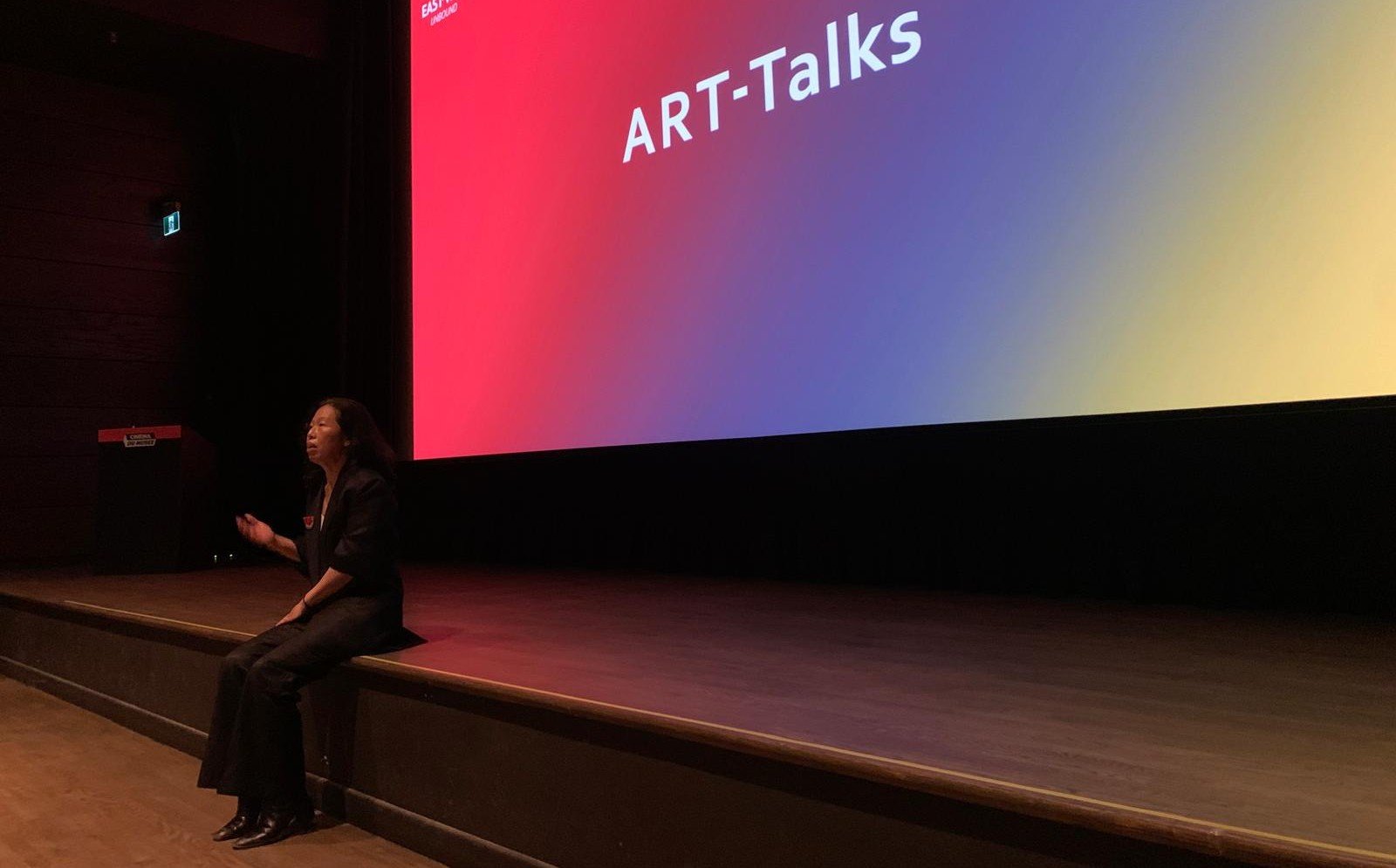
Min Sook Lee is a political activist and an award-winning documentary filmmaker, known for films such as “Tiger Spirit” (2008) and “Migrant Dreams” (2016). She was born in South Korea and immigrated to Canada with her family at the age of three. Currently she teaches at the Ontario College of Art and Design University focusing on the relationship between art and social change.
On the occasion of the screening of “There Are No Words” at the Montreal Asian International Film Festival, she talks about Korea, unreliability of memory, and her family.
“There Are No Words” is very personal, exploring your relationship with your father and the memories of your mother. Why did you decide to make a film based on such an intimate part of your life?
I’ve been making films for almost 26 years, and this is my ninth documentary. It took me a long time to approach this subject because it is so personal, so close to my entire nervous system. It’s connected to my deepest memories, emotions, and experiences. My mother’s death is the formative event of my life. The idea for this project came to me while I was taking care of my father during the COVID pandemic. I thought about how, if he dies, he takes my mother, memories and information about her, with him. I wanted to make sure what happened to her wasn’t forgotten. I know that if we don’t talk about these stories, not only would her life disappear from any archive, but all stories by women like her, with their lives narrated by the perpetrators.
As to why I decided to make a movie about this… In many of my previous films, I worked with people going through difficult situations. They trusted me with their stories, often taking great personal risks by appearing on camera. For example, if a migrant worker became known as an outspoken troublemaker, their employer might cut their contract. That trust always made me think carefully about ethics, representation, and the responsibility that comes with documentary filmmaking. Eventually, I started asking myself when I would be willing to take that same risk. If I was asking others to be vulnerable, perhaps I needed to do the same. That became one of the reasons for making this film.
There are a few people, including your father, uncle, friend, who appear in the film. How difficult was it to convince them to participate, and how did they react to the movie?
One of the most important people in the film is my childhood friend Megan. We are not especially close nowadays and hadn’t spoken much in recent years, but after my sister died we had a meaningful phone conversation. When I later called her and told her I was making a film about my mother, she said, “I’ve been waiting for you to make this film my whole life.” That response stayed with me and confirmed that this was a story worth telling. So, it was rather easy to get her involved.
At first, I thought the film would involve more members of my family, but one of my siblings didn’t want to participate. That made me narrow down the idea for the film to be specifically about me and my parents. My father was very enthusiastic about the project. He even feels that making the film was partly his idea. Finding my uncle was much harder. I hadn’t spoken to him for years and didn’t even know how to contact him. I travelled to my hometown in Korea and simply started asking local shop owners if they knew him. Eventually, someone pointed me in the right direction and that’s how I found him. When the film was finished, I showed it to both my father and my uncle before releasing it publicly. It was important for me that they felt comfortable with how the story was told. My uncle seemed satisfied that his sister’s story had finally been treated with respect.
One of the most striking aspects of the story was the language barrier between you and your father. How has language shaped your relationships within your family, both growing up and today?
I don’t speak Korean fluently, and that has always created distance between us. Without language, it can feel as though an important connection has been cut. That’s why interpreters became such an important part of the film. I wanted viewers to be aware that our conversations were always mediated through another person. What’s more, my father’s Korean is very specific. He speaks in a way that feels frozen in time, using expressions and language from the 1950s. His speech reflects not only his age but also the region he comes from, Jeolla Province, which has a strong history of political activism and resistance in Korea. Koreans, as soon as they hear his voice, immediately understand where he is from, who he is. They place him in the context of what happened in Gwangju in May 1980, the events that gave birth to the democratic movement that we have today. And it’s a little unsettling, because he’s such a fascist, so aligned with the authoritarian regime.
As mentioned in the movie, your father is now 90 years old, yet he recalls many events with remarkable clarity. Do you think his memories can be trusted? Can humans even trust their own memory?
I think that’s one of the central questions of the film, and I don’t think there is a clear answer. My father has always had an extraordinary memory. However, there are moments when his stories contain contradictions. Sometimes he would describe events one way, and later tell them differently. Yet I think that his stories about my mother can be trusted, because other people who knew her have said similar things, as you can see in the movie. At the same time, I don’t fully trust my own memory either. It’s terrible, I have so many gaps in my memory. During the film, Megan reminded me of things I had completely forgotten, like being with me when my mother died. Memory can disappear like a dream. You wake up, try to hold onto it, and it slowly fades away.
In the film, you say that the aim of the movie is to understand your mother. Did you find the answers you were looking for or did this process leave you with even more questions?
I discovered many things about her that I never knew before. When I visited Korea and spoke with people who remembered her, they described her as incredibly strong, fearless, and independent. Several people even said that she behaved in ways that women were not expected to at the time. She came from a difficult background, worked hard, and sacrificed a great deal for her family. Learning these things helped me understand her as a person.
Given all the new information, how much do you identify with her? How similar you think you are to her?
I want to feel connected to her, of course. But for much of my life she was almost a mystery to me, it’s almost like I have to ask myself if I have the permission to be close to her. One thing I know for sure is that I look very much like her. I remember visiting one of my aunts years ago, when I was in my 20s, and she was shocked when she saw me because I looked so much like my mother. It was almost as if she had seen a ghost. Making the film gave me a stronger connection to my mother.
What do you hope audiences take away from “There Are No Words”?
The film has both a personal and a political purpose. Personally, I wanted to remember my mother better. Looking back, I realize that what I really wanted was to feel closer to her. Whether I have fully achieved that, I’m not sure. I think the answer will take time. But the film allowed me to begin that journey. On a larger level, I hope people recognize familiar experiences in it and think about issues such as domestic violence, authoritarianism, family dynamics, and resistance. Families are not separate from politics, they are deeply shaped by political forces.



