
Thai genre cinema has frequently distinguished itself through its willingness to combine elements that other national industries might prefer to keep apart. Horror can suddenly turn into comedy, martial arts can exist alongside supernatural fantasy, zombies can become vehicles for historical commentary, and familiar action formulas can be placed within distinctly Thai social and cultural environments. During the period between 2024 and 2026, this tendency became particularly pronounced, resulting in a series of productions that embraced spectacle while retaining some interest in class inequality, political corruption, war, religion, bullying, trauma and the tensions between rural traditions and metropolitan life.
The films examined here do not constitute a single movement in the strictest sense. They vary considerably in scale, ambition and tone, moving from the historical horror of “Operation Undead” and the urban dystopia of “Bangkok Breaking: Heaven and Hell” to the black magic of “Panor”, the culinary revenge of “Morte Cucina” and the videogame aesthetics of “God Skin”. Nevertheless, a number of recurring patterns emerge. Genre mixing is the most obvious one, followed closely by a tendency towards maximalism. Thai filmmakers repeatedly seem determined to provide audiences with as many attractions as possible, combining action, horror, comedy, melodrama, romance, folklore and political commentary within the same production.
Violence is another recurring element, although its presentation changes considerably. In some films, it is visceral and brutal; in others, it becomes almost cartoonish. Martial arts choreography remains central, but it is no longer confined to conventional action cinema. Muay Thai is deployed against zombies, black magic influences gun-fu, and nanotechnology allows fighters to acquire the powers of animal spirits. The influence also extends beyond Thailand itself.
The strongest films in this group understand that genre cinema does not need to choose between entertainment and meaning. Even when the commentary is imperfect or eventually overwhelmed by spectacle, these productions reflect contemporary anxieties regarding authoritarianism, inequality, medical costs, displacement, exploitation and the survival of local communities. At the same time, they highlight an increasingly confident technical infrastructure. Cinematography, production design, action choreography, practical effects and editing frequently reach international standards, even when screenplays struggle to maintain coherence.
What emerges is a cinema defined less by discipline than by energy. These films are excessive, occasionally incoherent and frequently melodramatic, but they are rarely timid. They demonstrate that Thai genre cinema remains capable of drawing from its own history while absorbing international influences and reshaping them through local traditions, humour, political concerns and visual sensibilities.
Directed by Kongkiat Komesiri, “Operation Undead” revisits the heavily explored zombie genre through the perspective of Thai history during World War II. Instead of merely reproducing familiar international formulas, the filmmaker combines historical drama, military action and body horror, using the undead as part of a broader examination of warfare, occupation and the destruction of individual identity.
The story begins in Chumphon Province, where the lives of two brothers are disrupted by the arrival of Japanese forces. Mek, a recently appointed sergeant, has learned that his girlfriend is pregnant, while his younger brother Mok serves in a Youth Soldier unit. The Japanese secretly test a biological weapon on local soldiers, transforming them into superhuman, zombie-like creatures who retain varying degrees of intelligence and emotional awareness. Thai and Japanese troops subsequently agree to a ceasefire against the new threat, and Mek is assigned to a covert operation without knowing that Mok may be among those he is expected to eliminate.
The conscious and organised nature of the infected provides the film with its most distinctive genre element while reinforcing its anti-war message. The conflict between the brothers turns the outbreak into a metaphor for civil division, and the Japanese experiments evoke historical atrocities associated with wartime human experimentation. Nonkul and Awat Ratanapintha effectively embody the opposing positions of Mek and Mok, while Supitcha Sangkhachinda strengthens the dramatic dimension. The frightening creature design, brutal action, frantic editing and forceful sound work make the film highly entertaining, although the increasingly heavy melodrama of the final passages weakens some of its impact. Despite this excess, “Operation Undead” remains an intelligent and technically accomplished combination of zombie spectacle and historical commentary.
Adapted from Netflix’s first Thai original television series, Kongkiat Komesiri’s “Bangkok Breaking: Heaven and Hell” expands the property into a large-scale action feature filled with explosions, chases and elaborate stunt work. The production demonstrates considerable technical ambition, although its crowded narrative and extended running time suggest that the material might have functioned more naturally as another television season.
Wanchai is a compassionate Bangkok paramedic whose dedication to saving lives draws him into the kidnapping of a billionaire’s daughter. Accompanied by the inexperienced nurse Meiji and a professional killer, he becomes trapped inside a violent public housing estate controlled by competing criminals. As multiple groups pursue the kidnapped child, Wanchai attempts to protect her, treat the wounded and escape the district while its residents face displacement by developers and wealthy investors seeking to demolish their homes.
The action is the film’s clearest achievement, with the camera following speeding vehicles, gunfights and explosions through technically impressive extended shots. The housing estate is presented as a dystopian wasteland, allowing the production to contrast the savagery of the criminals with Wanchai’s humanitarianism. His refusal to fight gives the film an unusual non-violent action hero, although his one-dimensional characterisation leaves Sukollawat Kanaros with little to do beyond appearing kind and concerned. Attitaya Tribudarak’s Meiji is similarly limited by a damsel-in-distress stereotype, while Nay Myo Thant provides a more memorable presence as Darlie. The social commentary concerning inequality, forced eviction and capitalist exploitation is visible but repeatedly overwhelmed by the action and the confusing number of characters. Nevertheless, the spectacular camerawork, stunts and production design establish the film as an impressive action feature.

Director and co-writer Taweewat Wantha returns to the supernatural world of “Death Whisperer” with a sequel that is darker, more action-oriented and even more excessive than its predecessor. Drawing openly from the combination of horror, grotesque comedy and kinetic violence associated with Sam Raimi, the production mixes regional mythology with the energetic spirit of 1980s supernatural adventure cinema.
The story begins in 1854, when a dying soldier named Puang is saved by a witch-like creature that places its severed tongue inside his throat. Years later, the same entity is identified as the creature responsible for killing Yam in the first film. Yam’s brother Yak assembles a group that includes Luechai, his two nephews, the necromancer Sem and a northern porter named Khom. Together, they travel into the spirit-infested forest of Dong Khomot to locate Puang and destroy the ghoul, only to encounter a succession of increasingly dangerous supernatural forces.
Taweewat Wantha’s film thrives on invention, shifting confidently between emotional sincerity, camp humour, jungle adventure and graphic supernatural violence. Nattaya Chaopa’s mobile cinematography moves through the grey and ominous forest environment while capturing inventive deaths, grotesque creatures and energetic action. Nadech Kugimiya gives Yak the machismo and reckless confidence of a Thai variation on Ash Williams, while Manita Chobchue’s tongueless ghoul embraces the camp qualities of classic practical monsters. The grief motivating Yak provides an emotional foundation, but the film never allows seriousness to restrain its outrageous dialogue or B-movie imagination. Although its international influences are recognisable, the rituals, jungle setting, spirits and humour remain distinctly Southeast Asian.

“Attack 13” is the debut feature from Thailand’s 13 Studio, led by “Death Whisperer” filmmaker Taweewat Wantha. Combining high-school drama, bullying, supernatural revenge and violent horror, the production was promoted through a cast of rising Thai performers, including former BNK48 member Tarisa Preechatangkit and “The Face Thailand” participant Nichapalak Thongkham. Despite its substantial marketing campaign, the film underperformed domestically before receiving international exposure at the New York Asian Film Festival.
Jindahra is a transfer student who joins her new school’s volleyball team and immediately attracts the hostility of Bussaba, a popular but vicious bully protected by her friends and even admired by some teachers. The conflict becomes more intense when Bussaba’s boyfriend Gunn shows an interest in Jindahra. Bussaba is subsequently discovered hanging from a basketball hoop in the school gym, but her death does not end her influence. Her spirit returns to punish those who wronged her, leaving Jindahra and the other students only three days to discover who awakened the ghost before they are killed.
The film begins as a school and sports drama before shifting smoothly into supernatural horror, with fast editing and energetic pacing helping connect its different genres. Beneath the ghost story lies a critique of bullying, parental absence and teachers’ inability or unwillingness to recognise psychological distress. Nichapalak Thongkham is chilling and unexpectedly complex as Bussaba, while Korranid Laosubinprasoet anchors the narrative as Jindahra. The cold school interiors, dark night-time palettes, convincing effects and carefully positioned jump scares strengthen the atmosphere, with a horizontally filmed home-invasion sequence standing out. The plot does not always survive close examination, but the combination of social concerns, strong performances and stylish horror makes “Attack 13” an engaging genre production.

“Panor” returns to the world associated with the “Art of the Devil” series, one of the defining properties of Thailand’s early-2000s horror renaissance. Putipong Saisikaew, a member of the Ronin Team filmmaking collective that shaped the second and third instalments, directs this loose reboot, reconnecting contemporary Thai horror with the graphic black-magic cinema of Hong Kong and Southeast Asia.
Born on a day marked by ominous events, Panor Boonsuk is treated by her village as the source of every subsequent disaster. Crows gather at her birth, people close to her suffer violent deaths, and anyone who befriends her appears vulnerable to supernatural punishment. Ostracised by classmates, distrusted by adults and abandoned by the authorities, Panor begins investigating the origin of the curse. Following the deaths of her mother and her friend Piak, she discovers that a black-magic practitioner has manipulated events around her and that confronting the curse may require her to use the same powers that have ruined her life.
The screenplay successfully builds sympathy for a protagonist whose suffering is intensified by communal superstition and institutional indifference. Its strongest passages patiently establish the mythology surrounding Panor before escalating into grotesque supernatural set pieces involving bleeding bodies, animals emerging from human flesh, spreading veins, forced self-mutilation and violent ritual. The practical effects provide a convincing physicality that distinguishes the horror from more anonymous digital spectacle. The main weakness is Panor’s abrupt transformation from victim into capable practitioner, as her supernatural skill and foresight arrive without sufficient development. Even so, the combination of an emotionally grounded central figure, imaginative curses and visceral effects makes “Panor” a strong continuation of Thailand’s black-magic tradition.
Directed by Arak Amornsupasiri and Vuthipong Sukanindr, “The Stone” takes the familiar one-against-many structure into the unusual world of Buddhist amulet trading. The film uses a commercial network built around sacred objects, authentication, speculation and promises of good fortune as the setting for a contemporary comedy-thriller with touches of film noir and Hong Kong popular cinema.
Ake is a young graduate unable to find stable employment while his father, a former police officer, remains in a coma. Searching through his father’s possessions, he discovers a box containing old amulets and takes them to a busy exchange in the hope of covering the hospital bills. The influential dealer Seng appears ready to purchase the collection, but Muay, an apprentice authenticator and the daughter of a leading expert, interrupts the transaction. When one amulet appears to be exceptionally valuable, Ake and Muay become targets within a criminal network already connected to the professional murder shown at the beginning of the film.
The religious-artifact setting gives the film a refreshing identity, while its treatment of sacred objects as speculative commodities introduces a quietly satirical dimension. Korranid Laosubinprasoet is the production’s strongest asset as Muay, bringing enough charisma and contemporary energy to transform the apprentice influencer into a modern variation on the femme fatale. Jinjett Wattanasin is less forceful as Ake, although his softness arguably fits the filmmakers’ conception of a kind and discreet young protagonist. The light tone makes the violence feel strangely weightless, preventing the thriller elements from producing sustained tension, and occasional pacing drops introduce repetition. Nevertheless, the original milieu, amusing character dynamics and elaborate final standoff make “The Stone” a pleasant and distinctive directorial debut.
Released through Netflix, Kulp Kaljareuk’s “Ziam” combines zombie horror with Muay Thai action inside a dystopian vision of Thailand. The screenplay places the outbreak against a background of food shortages, authoritarian control and economic exploitation, restoring the political undertones traditionally associated with zombie cinema while attempting to give the genre a specifically Thai physical identity.
Singh, a former boxer, hopes to build a more stable life with his girlfriend Rin, who works as a nurse. During a hospital shift, Rin encounters a patient infected with a mysterious virus that rapidly spreads through the building and transforms the victims into flesh-eating creatures. Singh enters the sealed hospital to rescue her, joining another survivor named Buddy and fighting through wards, stairwells and corridors before the military imposes complete containment. A separate extraction team is also sent to retrieve Patient Zero, adding another group to the chaos.
The hospital provides an effective claustrophobic arena, while the infected move quickly enough to generate urgency without becoming implausibly superhuman. Singh’s martial arts sequences are the film’s defining element, with Muay Thai determining how he navigates confined spaces and turns medical equipment, hallways and staircases into extensions of his fighting style. Strong makeup and gore effects give the encounters satisfying impact, while the relationship between Singh and Rin supplies a conventional but functional emotional centre. The military-retrieval subplot adds little beyond disposable characters, and the finale allows spectacle to overwhelm the gritty atmosphere established earlier. Nevertheless, “Ziam” successfully integrates Thai martial arts into zombie mechanics rather than treating them as an arbitrary gimmick.

“Morte Cucina” marks Pen-Ek Ratanaruang’s return to feature filmmaking after “Samui Song” in 2017. His subsequent episodes of the Eric Khoo-helmed anthology series “Food Lore” and “Folklore” appear to have informed this combination of culinary imagery, psychological thriller, horror and revenge. Christopher Doyle serves as cinematographer, M.L. Pattamanadda Yukol handles the editing, and Akritchalerm Kalayanamitr provides the detailed natural sound design.
Sao was expelled from her traditional Muslim community as a teenager after being blamed for an incident in which she was actually the victim. Years later, she has established an independent life as a respected chef in an expensive Bangkok restaurant. When Korn, the man responsible for her ostracisation, enters the restaurant without recognising her, Sao begins a calculated revenge that uses food, seduction and his own appetites against him. The present-day plot is interwoven with flashbacks to her youth before the story eventually returns to a rural northern environment for its darkest phase.
Ratanaruang treats food as refuge, livelihood, sensual object and weapon, turning Sao’s culinary skill into the foundation of both her recovery and retaliation. The critique of a community that condemns a vulnerable girl rather than protecting her gives the revenge a strong social basis, while the sexual material is defined by the contrast between Korn’s desire and Sao’s controlled performance. Doyle gives each period a distinct texture: grainy 16mm for the traumatic past, colder neon and monochromatic surfaces for Bangkok, and diffused greens for the uncertain rural conclusion. Yukol’s nonlinear editing keeps the multiple strands coherent, while the sounds of chopping, sizzling and chewing turn the kitchen into an intimate and threatening space. Thanatphon Boonsang is excellent as the outwardly submissive but calculating Sao, and Kris Srepoomseth convincingly charts Korn’s unravelling. The Tadanobu Asano subplot is not always organically integrated, but the film remains a formally refined and unsettling work.

Following its international premiere at the International Film Festival Rotterdam, Kongkiat Komesiri’s “4 Tigers” received its North American premiere at the New York Asian Film Festival. The 138-minute production expands the universe of the “Khun Pan” trilogy and continues the director’s fascination with combining political commentary, historical settings, fantasy, violence and extravagant popular entertainment.
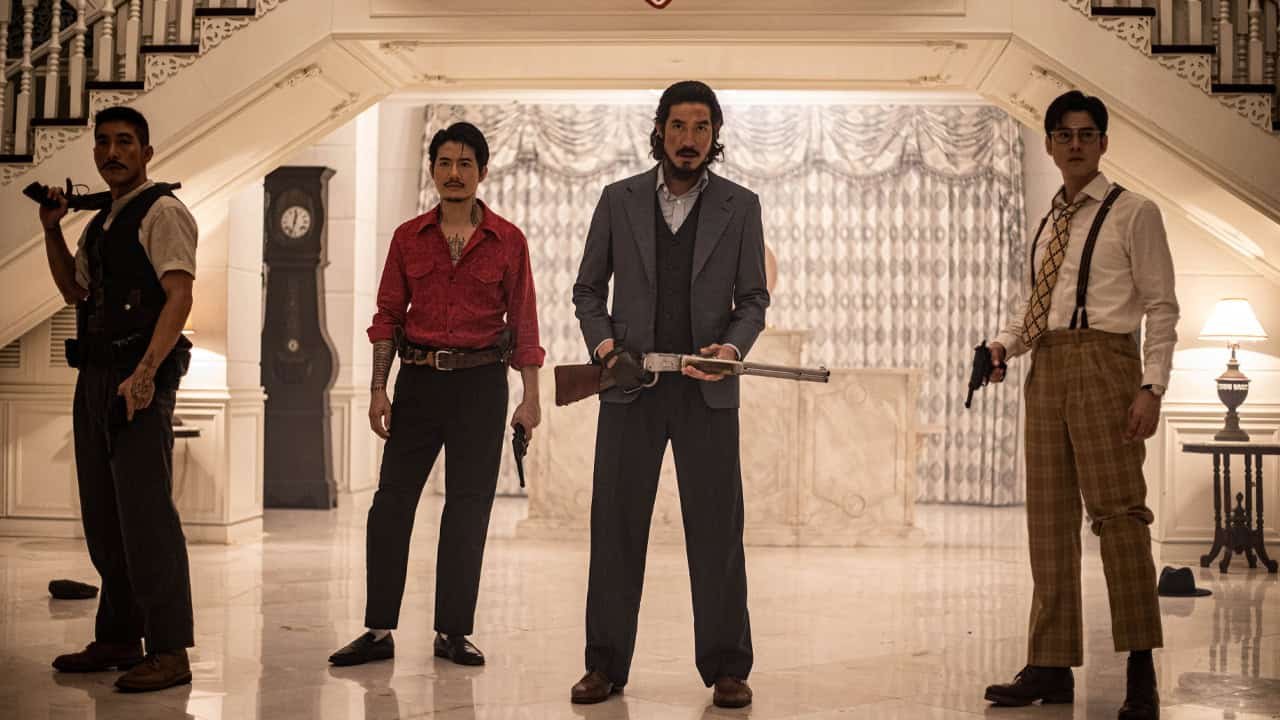
Shortly after World War II, a fortune in Japanese gold disappears in Thailand’s central plains. Field Marshal Lert uses the theft to justify a nationwide purge of legendary bandits and encourages the outlaws to destroy one another. Four men become central to the conflict: Fai, a master of spells; Bai, who can bend bullets; Dum, who possesses extraordinary strength; and Mahesuan, whose amulet makes him almost impossible to kill. Rosarin, a glamorous actress with concealed motives, attempts to unite them against the increasingly authoritarian military leader.
The film embraces action, fantasy, spaghetti Western imagery, political satire, martial arts, romance, comedy and even musical interludes without showing much concern for restraint. Field Marshal Lert embodies an elite that manufactures emergencies to consolidate power, while the bandits are reconstructed as folk heroes whose violence becomes acceptable when directed against a corrupt regime. The plot grows increasingly convoluted, and the accumulation of betrayals, magical rules and climaxes becomes exhausting. However, the cast’s star personas, particularly those of Sukollawat Kanaros, Mario Maurer, Arak Amornsupasiri and Phakin Khamwilaisak, suit the operatic tone, while Mashannoad Suvalmas dominates as the manipulative Rosarin. The combination of firearms, martial arts and supernatural abilities produces inventive gun-fu, supported by polished landscapes, saturated interiors and clear action editing. “4 Tigers” is chaotic and frequently nonsensical, but its confidence and visual energy remain difficult to resist.
“God Skin” is a Thai action-fantasy feature directed by Paween Purijitpanya, whose previous credits include “Body”, the “4bia” anthology and “Ghost Lab”. Written by Jirawat Watthanakiatpanya, Purijitpanya, Kittikun Chattongkum and Pat Pataranutaporn, it was produced by Jungka Studio in association with Karman Line and M Studio. The Panna Stunt Team, whose members worked on the “Ong Bak” productions, designed the martial arts sequences.
Marwin is a Bangkok delivery rider struggling to cover his mother’s hospital expenses. His former school friend Itt introduces him to Mirage, a clandestine arena where wealthy spectators gamble on brutal fights. Each competitor receives a tattoo called the God Skin, allowing audience-controlled technology to inject nanorobots that restore strength and summon the powers of different animal spirits. As Marwin rises through the tournament under Itt’s management and reconnects with his former girlfriend Praewa, the rewards become greater, the physical consequences become more severe and the secrets behind the arena begin to emerge.
The film initially connects its fantasy action to poverty, medical costs and the ability of the wealthy to manipulate desperate people. Marwin’s gradual corruption by power adds another potentially significant layer, although the social commentary is increasingly buried beneath videogame mechanics, slapstick transformations and escalating spectacle. The bridge battle is the strongest action passage because its comparatively grounded staging allows the stunt work to register more clearly. Sutthirak Subvijitra has enough charisma to convince as both fighter and victim, and his chemistry with Phantira Pipityakorn gives the romantic strand some weight. Itkron Pungkiatrussamee and Tanawat Cheawaram embrace the story’s excess, while Tatchai Eakkhattiyakorn’s cinematography and Wisarut Deelorm’s frantic editing follow contemporary action conventions. The ending abandons proportion almost entirely, but the variety of fighters, animal powers, humour and physical combat ensure that “God Skin” remains entertaining for most of its running time.
Genre Without Restraint
Taken together, these films reveal a Thai genre cinema that has become increasingly confident in its ability to move between traditions, genres and markets. The strongest pattern is not simply the presence of horror or action, but the refusal to present either in isolation. “Operation Undead” is simultaneously a zombie film, a war drama and a historical critique. “Bangkok Breaking: Heaven and Hell” is an urban action spectacle whose hero is a humanitarian rather than a fighter. “Death Whisperer 2” mixes grief, jungle adventure, supernatural horror, camp and comedy.
“Attack 13” turns bullying and institutional negligence into the foundation of a ghost story, while “Panor” revives the history of Thai black-magic cinema through practical effects and grotesque folklore. “The Stone” transforms Buddhist amulet speculation into a noir-influenced comedy, and “Morte Cucina” uses food, sex and revenge to create something simultaneously sensual, political and horrific.
Action cinema is undergoing a similar process of transformation. “Ziam” does not merely place a Muay Thai fighter inside a zombie movie; it allows his physical abilities to determine the entire design of the hospital-set action. “4 Tigers” combines Thai folklore, spaghetti Western imagery, magical abilities, martial arts and political satire. “God Skin” pushes this development into the future by structuring fights according to videogame mechanics, nanotechnology and animal spirits.
The main weakness across these productions is equally consistent. Many of them struggle with proportion. Narratives become convoluted, climaxes accumulate, runtimes expand and social commentary is frequently overwhelmed by action. “Bangkok Breaking: Heaven and Hell” feels bloated, “4 Tigers” barely holds its plot together, and “God Skin” goes completely overboard in its ending. “Panor” rushes its protagonist’s transformation, while “Ziam” introduces a military subplot that adds scale without providing depth.
However, this lack of restraint is also partly responsible for their appeal. These films are not cautious exercises in genre imitation. They are frequently excessive attempts to provide audiences with spectacle, emotion, humour, violence and social relevance at the same time. Even when they fail, they tend to fail energetically.
The technical standards are also difficult to ignore. The action choreography of “4 Tigers”, “Ziam” and “God Skin” demonstrates the continued strength of martial arts filmmaking in Thailand and the wider region. “Attack 13” and “Panor” highlight the quality of the practical and visual effects available to contemporary Thai horror. “Bangkok Breaking: Heaven and Hell” includes large-scale camera movements and action set pieces designed with remarkable confidence.
At the other end of the spectrum, “Morte Cucina” shows that Thai genre cinema can also be deliberate and formally refined. Christopher Doyle’s shifting textures, the careful sound design and the nonlinear construction demonstrate how genre can exist inside an auteur framework without losing its ability to shock or entertain.
Most significantly, local culture is not treated as a decorative surface. Buddhist amulets, village superstition, Muslim communities, Muay Thai, Thai history during World War II, folk bandits, black magic and the social geography of Bangkok are integrated directly into the stories. International influences remain visible, from Hong Kong action comedy and Japanese horror to spaghetti Westerns, “The Raid”, Sam Raimi and videogames, but they are filtered through specifically Thai concerns.
Thai genre cinema during this period is therefore best described as a cinema of synthesis. Its filmmakers borrow without becoming derivative, comment without abandoning spectacle and experiment without entirely rejecting commercial formulas. The results are uneven, but the energy, ambition and technical ability are undeniable.
From the conscious zombies of “Operation Undead” to the technologically enhanced warriors of “God Skin”, these productions suggest a national cinema unwilling to remain inside the boundaries of any single genre. Horror becomes action, action becomes comedy, comedy becomes social commentary, and folklore becomes science fiction. The stories may occasionally lose their way, but Thai genre cinema continues to move forward with confidence, imagination and an admirable disregard for restraint.
SEO title: Thai Genre Cinema: Horror, Action and Excess
Focus keyphrase: Thai genre cinema



