
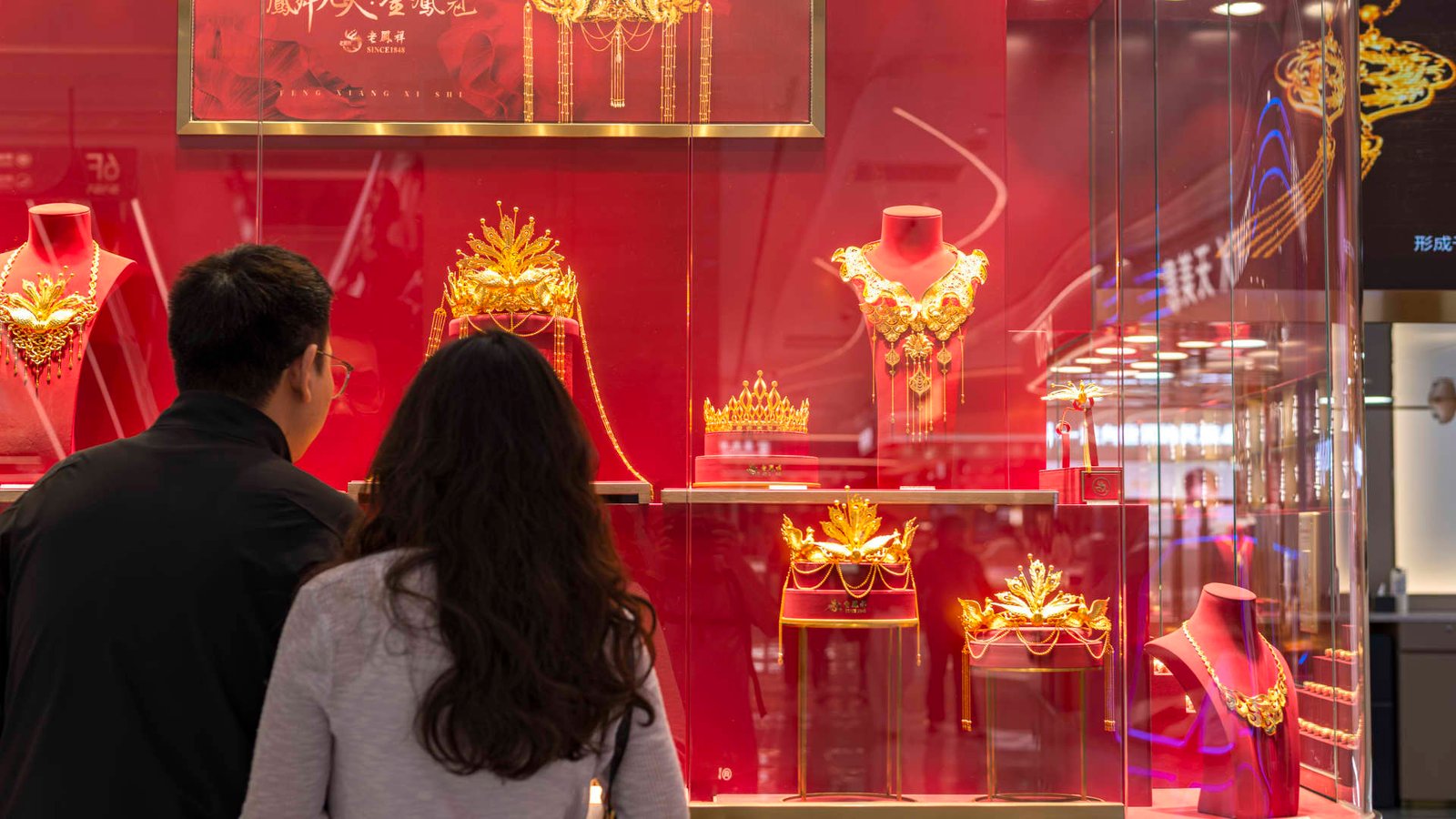
Gold jewelry sold at a counter in the gold jewelry area of a large shopping mall in Xi’an, Shaanxi Province, China on September 29, 2026.
Cfoto | Future Publishing | Getty Images
Hi, this is Evelyn, writing to you from Beijing. Welcome to the latest edition of The China Connection — a snapshot of what I’m seeing and hearing from local businesses.
Buying gold every month for nearly two years is just part of China’s plan to narrow a gap with the U.S. on holdings of the precious metal. What does that do to the yuan?
The big story
China’s decades-long push for yuan internationalization is getting a lift from the buildout of Hong Kong as a gold trading center — denominated in the Chinese currency.
“As those trading volumes grow, there would be a growing volume of the physical gold trade that is denominated in RMB and not linked in USD,” said Charles Chang, managing director and Greater China country lead for corporate ratings at S&P Global Ratings.
The Chinese yuan, also known as the renminbi, accounts for a fraction of international transactions in a global financial system dominated by the U.S. dollar. Analysts I spoke with don’t expect major changes to that dynamic anytime soon, but Beijing’s gold purchases and Hong Kong trading platform are just the latest steps toward supporting greater use of the yuan globally.
“The challenge with internationalizing the RMB it’s somewhat more challenging to find places where you can use the RMB,” Chang said. “In terms of gold particularly, if the RMB that the buyer receives can be converted to gold, then it gives more channels for the spending to be done.”
Hong Kong, home to one of the world’s largest stock exchanges, last month confirmed its efforts to develop a yuan-denominated gold market.
In a major move last year, the special administrative region of China linked its gold vault with one in Shanghai, allowing physical gold delivery to international institutions in Hong Kong denominated in yuan.
Over the next three years, Hong Kong plans to expand the capacity of its Shanghai-linked gold vault from 150 tonnes to over 2,000 tonnes, S&P’s Chang pointed out.
That’s nearly as large as all the gold reserves in China, he added. “If Hong Kong is able to complete this transaction, then it would become of the largest gold trading centers in the world.”
U.S. dollar challenge
The U.S. still has the largest gold reserves in the world at over 8,100 tonnes, according to World Gold Council figures for the second quarter. China held about one-third of that at over 2,300 tonnes.
“China’s 23-month gold buying streak reinforces the credibility of the renminbi’s internationalization drive,” said Hao Zhou, head of research and chief economist at Guotai Junan International in Hong Kong.
“By steadily increasing gold reserves, Beijing is strengthening the long-term backing of its financial system and reducing reliance on dollar-denominated reserve assets,” he said. “While gold alone will not determine the RMB’s global role, it enhances…
Source: www.cnbc.com



