
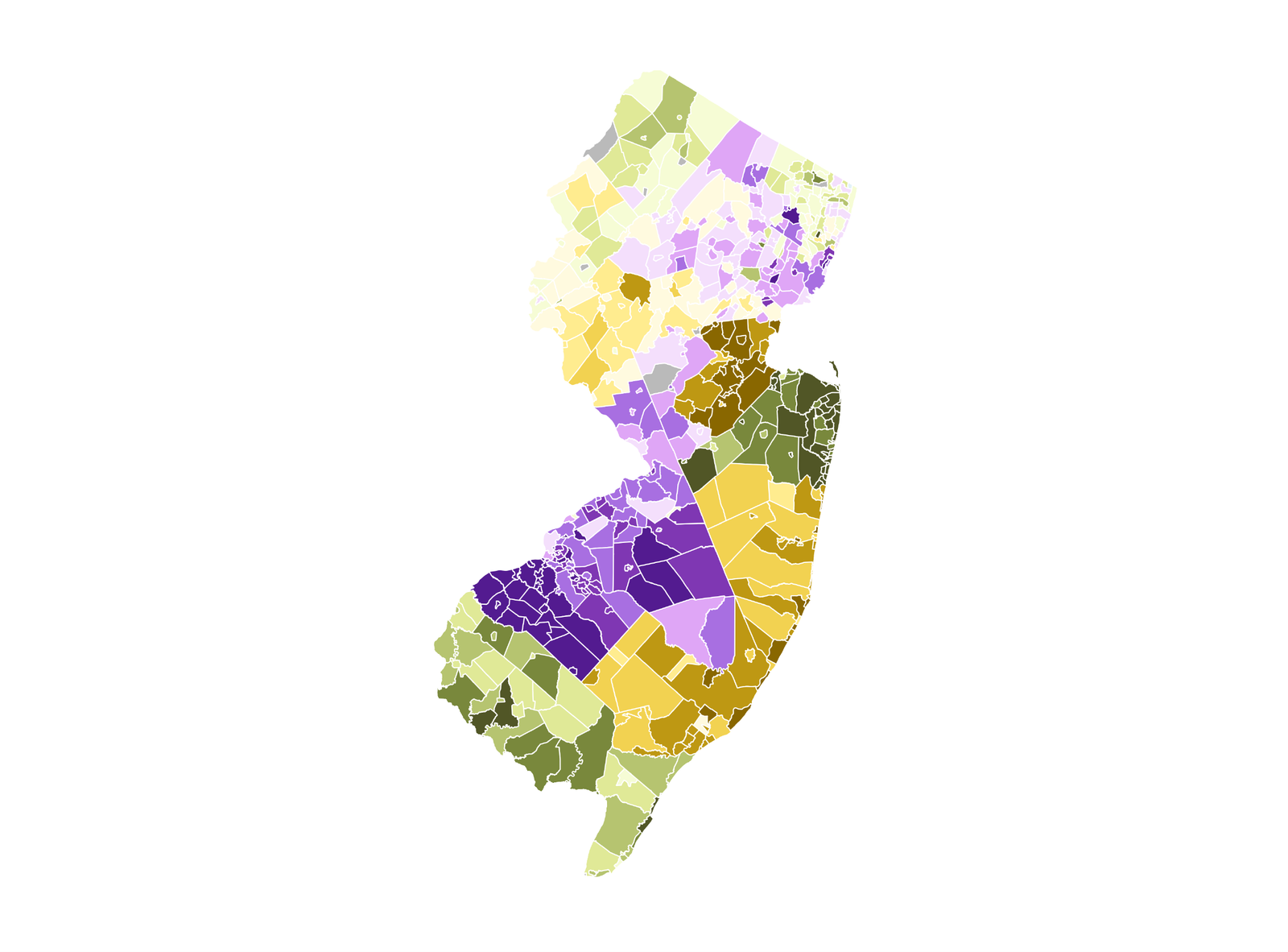
In New Jersey’s most closely watched primaries, like the expensive Democratic contests for the 7th and 12th congressional districts, voters had lots of ways to learn about the candidates running: through mailers, TV ads, campaign events, and fairly thorough media coverage.
But what about in the state’s more obscure contests, ones where no candidates were spending huge amounts of money and interested reporters were hard to come by? What were the tens of thousands of voters in those races basing their votes on?
The winners of three such contests – Justin Murphy for the GOP U.S. Senate nomination, Rosie Pino for Republicans in the 9th district, and Zack Mullock for Democrats in the 2nd district – all had plenty of compelling arguments to make to voters about why they’d be the best choice in their races. Pino and Mullock in particular put together solid campaign efforts, and both have real shots at winning upset victories in November.
But in such a low-information environment, it’s clear that all three races were also affected by what voters saw on their physical ballots. The county line may be dead, but the slogans awarded by party endorsements still clearly swayed many voters; so too did the completely arbitrary factor of ballot order, which seemingly steered many voters towards the candidate who was lucky enough to snag the first slot on the ballot.
The latter factor represents a new wild card in New Jersey politics, since – at least in theory – ballot positions are randomly awarded, making them a completely unpredictable factor in every primary election from here on out. Here’s a closer look at all three races.
U.S. Senate: Fourth time’s the charm for Justin Murphy
Murphy, a former Tabernacle Township committeeman who last held office in 2003, has been trying for a while to break into federal politics, having lost House primaries in 2008 and 2010 and a primary for New Jersey’s other Senate seat in 2024. This year, though, presented Murphy with his best opportunity yet, since his primary opponents were just as unknown as he was.
All four of the Republicans running against Senator Cory Booker raised barely any money for their campaigns, limiting their ability to reach even small numbers of voters, let alone build a statewide coalition. None of them had held elected office within the last 20 years, depriving them of any organic regional bases of support. County GOP leaders, who could have worked together to find a consensus candidate, instead were divided among three of them.
And primary voters delivered a result exactly as fractured and chaotic as all of that would indicate. Murphy finished in first place with 33%, followed by state trooper Richard Tabor with 29%; former News 12 reporter Alex Zdan got 27%, and physician Robert Lebovics brought up the rear with 11%.
 How did Murphy, who raised barely $15,000 in total for his campaign, do it? Primary ballots may hold the key.
During convention season in February and March, Murphy won endorsements from GOP organizations in Camden, Gloucester, and Mercer Counties; those endorsements no longer physically reshape ballots the way they did in the era of the county line, but they still allowed Murphy to appear on the ballot as, say, the “Official Gloucester County Republican Endorsed Candidate.” Murphy won all three counties by significant margins.
That alone probably wouldn’t have been enough to win, since Tabor and Zdan both won more party endorsements than Murphy. But Murphy had another factor working in his favor: of New Jersey’s 21 counties, his name appeared first on the ballot in eight of them and second in another seven.
Lo and behold, Murphy won six of those eight counties where he appeared on the ballot first, and finished just 115 votes behind Tabor in a seventh. In the lone county where Murphy was both listed first and had the party endorsement, Gloucester, he got an astounding 74% of the vote.
Murphy wasn’t the only one who benefited from party endorsements, to be clear, and Zdan and Tabor also did far better on average in counties where they had favorable slogans or ballot positioning. Tabor had both the party slogan and the first slot in Middlesex County, for example, and got 61% of the vote there; Zdan had both in Monmouth ballots and got 60%.
Even Lebovics, who won neither a single county endorsement during convention season nor a single county’s electorate on primary day, seemed to get a boost from good ballot placement. His best county was Camden County, where he got 22% of the vote, followed by Ocean and Atlantic Counties with 17%; none of them are anywhere near his home in Englewood, but he was listed first on the ballot in all three.
Attributing Murphy’s win to ballot quirks alone may be giving him too little credit. There is evidence that, when presented with every candidate as equals, a disproportionate share of voters opted for Murphy; Morris County Republicans, for example, were neutral in the Senate race, and Murphy narrowly won the county despite appearing last on the ballot. Better-informed voters may have been swayed by Murphy’s old-fashioned, principled style of conservatism, or his life story as a Navy veteran from the Pinelands, or simply the fact that he had appeared on their ballots as a Senate candidate just two years ago.
County parties, too, have a role to play beyond just awarding slogans. Zdan’s 60% in Monmouth County and Tabor’s 50% in Ocean County likely would not have come about were it not for the support of the two most powerful GOP organizations.
But on the whole, the primary results paint a picture of a GOP electorate that wasn’t too sure who to vote for, and went with candidates who were made more prominent on the ballot either via their slogan or their placement.
Without the county line, voters are no longer given a clear “slate” of candidates to support, and thus have to find other ways to distinguish between their options. That’s a minimal issue in high-profile races where candidates and the media are actively making an effort to educate voters – hence why party endorsements didn’t seem to matter too much in the Democratic primaries for the 7th and 12th districts this year – but it becomes a much bigger factor in races where every candidate is equally unknown.
Now, though, Murphy is in for an uphill fight against Booker, whom no one in either party believes is vulnerable this year. As of the most recent campaign finance reports, Booker, who has won all three of his Senate campaigns by double digits, had $23 million in his campaign account; Murphy had -$24. Even getting the top ballot spot in all 21 counties in November won’t be enough to overcome that.
CD-9: Rosie Pino wins a battle of the counties
 The GOP primary for the 9th district, where Republicans are vying to unseat Rep. Nellie Pou (D-North Haledon), was quite a bit more straightforward, but a lot of the same factors were at play.
Tiffany Burress, an attorney and the wife of former NFL star Plaxico Burress, had the support of the Passaic County Republicans. Pino, a councilwoman in the Passaic County suburb of Clifton, won the Bergen County Republican convention – a result that was a substantial upset, since Burress had been endorsed by the Bergen GOP chairman on the first day of her campaign.
Last Tuesday’s results basically bore out those endorsements. Burress won Passaic 62%-38%, carrying Pino’s hometown of Clifton by 27 points, while Pino won Bergen 61%-39%. Since Bergen made up around 55% of the electorate, that was enough for a win, albeit a narrow one that wasn’t called by the Associated Press until just yesterday.
Burress and Pino also each had the good fortune to appear first on the ballot in their respective endorsed counties. In the district’s far smaller Hudson portion, though, Pino appeared first while Burress had the endorsement – and Pino won 55% to 45%.
Had Burress been able to more successfully leverage her day-one support from party leadership, things might have turned out differently. Particularly fatal was her inability to fundraise; as of mid-May, she had only raised around $100,000, far less than Pino and not nearly enough to communicate effectively with the voters of the district.
That reverted the race to something of a generic county-on-county war, one that mathematically shook out in Pino’s favor. Now that Pino’s locked a head-to-head against Pou, it’ll be up to Republicans whether they see enough hope in the 9th district to invest in her campaign from here on out.
“Congratulations to Rosie Pino, who will put New Jersey families first and fight for safe communities,” RNC Chair Joe Gruters said in a statement yesterday. “Meanwhile, Nellie Pou has been a shameless rubber stamp for Democrats at the expense of New Jersey families. Nellie Pou is such a ‘good soldier’ for her party bosses, you have to conclude she’s just a puppet for the far Left.”
CD-2: Zack Mullock’s is lifted by his neighbors
 Finally, in the 2nd district, four Democrats competed for the right to take on Rep. Jeff Van Drew (R-Dennis) – but only one of them proved to be beloved enough by his own neighbors to win.
Mullock has been the mayor of Cape May since 2021, and in the five years since then has evidently become a popular figure across the rest of the county, which is a tighter-knit community than perhaps any other county in the state. When Mullock showed up on 2nd district ballots last week, the response was resounding: he won 70% of the vote in Cape May County, including 93% in the city of Cape May.
The rest of the district, meanwhile, was much more splintered. Mullock won Atlantic and Cumberland Counties by modest margins, a critical factor in his win since they accounted for around half of the district’s vote combined. Tim Alexander, a civil rights attorney and retired detective, won Salem and Ocean Counties, and former USAID official Bayly Winder won Gloucester County.
That all combined for a 40% to 28% win for Mullock over Alexander, while Winder came in third with 22%; a fourth candidate, Terri Reese, got 11%.
Once again, basic ballot factors proved to be key. In Gloucester, for example, local Democrats opted not to make an endorsement, and Winder happened to be listed on the ballot first; Mullock’s wins in Atlantic and Cumberland, meanwhile, were likely boosted by his own top ballot position even though Alexander had the party endorsement.
But for voters who were paying closer attention, Mullock also had a number of strong arguments in his favor. He was the only one of the four candidates who had won an election before, and he could credibly argue that he’d give Democrats their best chance (or even maybe their only chance) at defeating Van Drew; that pitch definitely held sway in his home county, and it seemed to successfully bleed northward as well.
Alexander, on the other hand, tried to make the case that he knew the district best from his prior campaigns and his long record of service in the community, but not everyone bought it; even his own hometown of Galloway voted for Mullock by 14 votes. As in the past, Alexander’s Achilles heel was his poor fundraising, and some voters may have simply been looking for a new face after years of seeing his name on the ballot. (The one bloc that stood behind Alexander was voters of color, since he won Atlantic City, Pleasantville, Salem, and Bridgeton.)
And Winder was hobbled by the fact that, unlike his two main opponents, he wasn’t really from South Jersey and didn’t have the same kind of connections there. His campaign instead took to focusing on data center development as its cause célèbre, to mixed results: he won Logan Township, where a prospective data center caused waves, but came in third in Vineland, where he spent the bulk of his energies.
Like Republicans with Pino, Democrats now face the choice of how heavily to invest in Mullock in a seat that may just be too red for him to win. At the very least, he’s shown that he knows how to put a districtwide coalition together.



