
Published August 19, 2026 06:00AM
You’ve trained all year, diligently test-driving your perfect nutrition plan, and you’re confident heading into race day, for good reason. That fuel and hydration strategy worked flawlessly through countless 70–75-degree sessions. But on a 90-degree day, it implodes, unraveling a performance built on months of consistent work.
We’ve all either witnessed it or lived it: heat-induced gut failure. And once the damage begins, it’s difficult to unwind.
Why did your perfect nutrition plan fall apart in the heat?
It’s rarely one failure point, and more of a domino effect. The root culprit is heat stress, when your body can’t dissipate heat fast enough, so core temperature rises and strains the cardiovascular, nervous, and metabolic systems at once. Performance can start to decline at core body temperatures as low as 101.3°F (38.5°C), a threshold most athletes aren’t aware of at the time. Once core temperature reaches ~104-105°F (40-40.5°C), athletes risk exertional heat stroke, characterized by central nervous system dysfunction like confusion and loss of coordination.
There’s no specific air temperature or crossover point that flips the switch, but more of a cumulative thermal strain. How much a hot day affects your gut and performance depends on many factors: humidity, dew point, pace, duration, clothing, hydration status, sweat rate, heat acclimation, and individual heat tolerance.
As core temperature climbs, the body shifts toward burning more carbohydrate (carb), and glycogen (stored muscle glucose) breaks down faster than it can be replaced. At the same time, a rising sweat rate speeds up dehydration, blunting your gut’s ability to absorb fuel. The result is a feedback loop that can undermine even a well-rehearsed fuel plan.
Dehydration isn’t the only thing working against your gut; blood flow is the other factor. As core temperature rises, the body redirects blood and oxygen away from the muscles and gut toward the skin to dissipate heat, and that shift causes two separate problems. Less blood reaching the muscles raises cardiovascular strain (heart rate and perceived exertion), saps power, and accelerates fatigue. Less blood flow to the gut increases intestinal permeability (leaky gut), slows gastric emptying, and impairs fluid and fuel absorption.
Why your cool weather plan doesn’t transfer
Here’s where the mismatch occurs. Heat raises your fluid and fuel (carb) needs as your gut’s capacity to process them is declining. In the heat, sweat rate can climb as high as 2+ liters per hour, far outpacing what your gut is trained to absorb in cooler conditions. So, the same gels, chews, and sports drinks that went down easily on a cooler day start wreaking havoc on your stomach in the heat. And leaning on extra fluid to keep pace with sweat losses can skew your sodium and electrolyte balance, not to mention create higher carb concentrations than your gut can handle.
How to design your nutrition plan for hot races
Getting caught off guard by heat on race day can happen to the best of us, and the longer the race (70.3 or IRONMAN distance), the more it compounds. Heat affects both cycling and running, but your core temperature threshold is lower on the run due to higher oxygen consumption, higher metabolic cost, and no wind cooling once you are off the bike. So it’s no surprise heat hits fueling, gut issues, and performance harder on the run than the bike.
- Adjust carbs. Rely less on concentrated fuel and more on a properly formulated, lower osmolality sport drink. If you are fueling at 60+ grams of carbs per hour, switch to a multi-transportable carb source with both glucose and fructose.
- Shift to smaller, more frequent fueling instead of infrequent large boluses. Every 10 minutes or so is a good starting point.
- Maintain hydration throughout the race. But don’t force fluids and concentrated fuel at the same time, as that combination overloads the stomach and invites gut complications. Your first line of defense should be a sports drink that delivers fluid, sodium, and carbohydrate together, not straight water. Repeatedly reaching for water is a big no-no! High consumption of low-sodium drinks raises your risk of hyponatremia (dangerously low blood sodium). Fluid and sodium needs are elevated in hot and humid conditions, and once fluid replacement exceeds 60-80% of losses, you need intentional and individualized sodium supplementation balanced alongside your fluid needs. A Board-Certified Sports Dietitian (CSSD) can help you dial in the numbers.
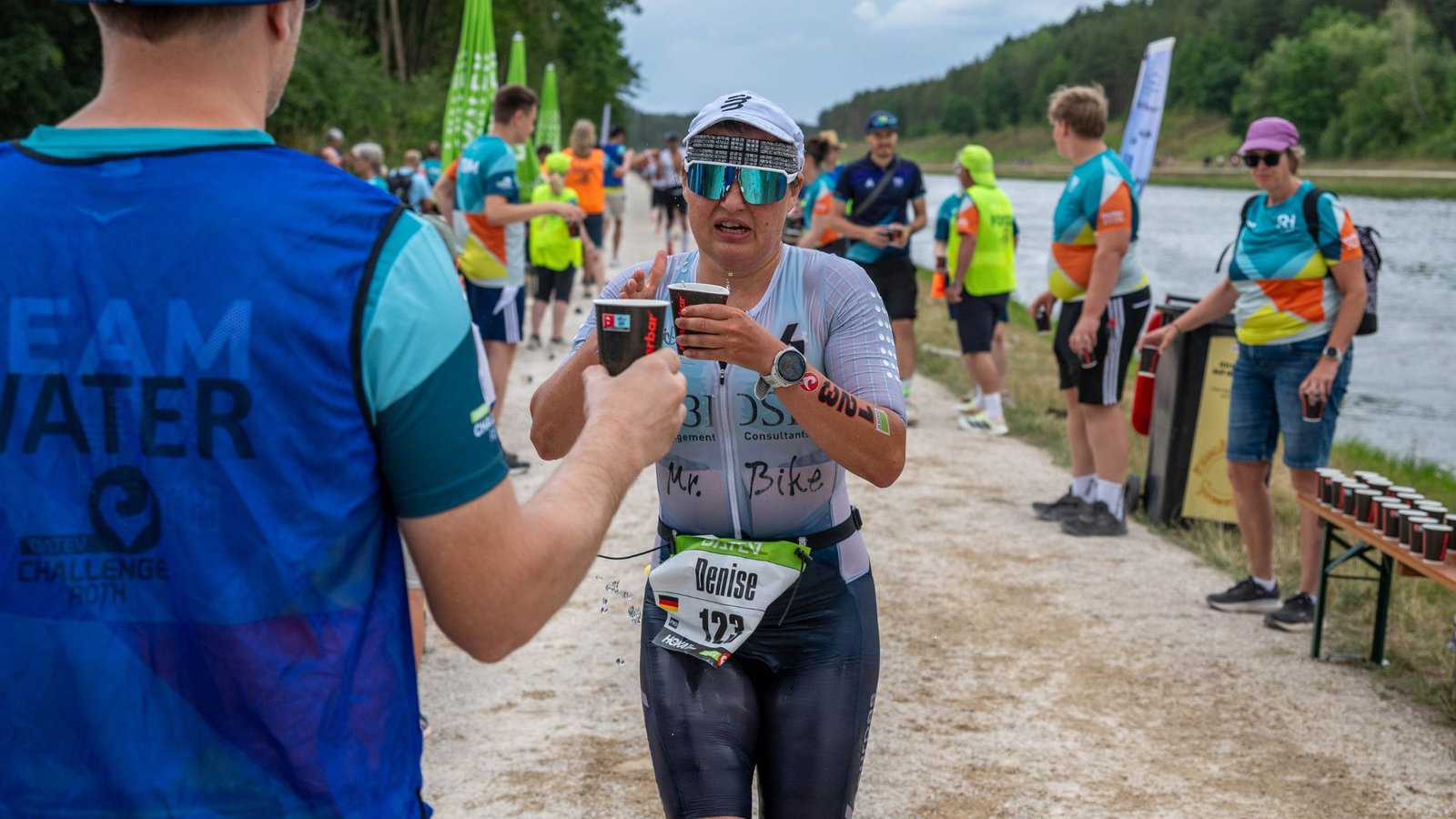
- Reach for cold drinks and ice at aid stations. Cold fluid encourages voluntary intake and offers a small but real offset to thermal strain.
- Know the red flags and have a backup plan. If your typical gels, chews, or sports drink stop sitting well and you experience bloating, nausea, cramps, or burping, that’s your cue to pivot immediately. Dial back carb concentration, slow down or take more frequent walk breaks, and switch to water with electrolytes to dilute what’s sitting in your gut. Give your body time to cool down and your gut time to start emptying before you push fueling again. Once you feel better, it’s best to stick to Coke and water with electrolytes instead of solids.
- Adjust your pace. Slow down proactively before you’re forced to. Lean on perceived exertion rather than pace, since effort will feel harder even as you move slower. Sometimes, on a hot day, you must slow down to speed up.
- On the run, build in frequent, intentional walk breaks to help regulate body temperature and manage heart rate and sweat rate.
Preparing to race in the heat
A historically moderate race day forecast doesn’t guarantee a PR weather day this year; anything can happen. Be prepared for it; don’t give the weather control over your race outcome. Heat training won’t make you fireproof, but it will boost your resiliency and performance while safeguarding against GI complications.
Heat acclimation training drives physiological adaptations: expanded blood plasma volume, earlier and higher sweat response with lower sodium loss, improved cardiovascular efficiency, and lower perceived exertion, all of which add up to better performance under thermal stress. One method is post-workout hot baths, which trigger performance-boosting adaptations. A ~20-minute hot bath (40°C) directly after exercise for 6 days works. Or follow a longer heat acclimation protocol such as sauna or heat-specific sessions for 10-14 days, starting 21 days out from race day.
Also, test your sweat rate repeatedly, across a range of temperatures at race-similar effort and duration, then use that data to predict fluid needs based on the race-day forecast. Recalibrate sodium needs from your actual sweat rate, not by a fixed formula.
Ahead of the race, gut train by challenging your gut in race-similar sessions and temperatures with a higher carb dose than feels comfortable. This improves carb absorption and glucose availability while reducing gut discomfort. Keep in mind, gut training done in cooler conditions doesn’t fully transfer to heat-stressed gut function.
Athletes with a history of exercise-induced GI distress who anticipate heat on race day may benefit from a low FODMAP (fermentable oligo-, di-, monosaccharides and polyols) diet in the day(s) leading up to the race. In training, identify your specific FODMAP triggers through elimination and reintroduction. Avoid unnecessary, extended restriction since the diet is quite restrictive.
And finally, avoid NSAIDs (nonsteroidal anti-inflammatory drugs) like Ibuprofen (Advil/Motrin), Aleve, and aspirin right before and during an endurance event. They raise the risk of GI distress by restricting blood flow to the digestive tract and breaking down the gut’s protective lining.
Your test-driven plan didn’t fail; heat changes the rules. Practice race-day heat adaptations in training and test-drive your fuel, hydration, and pre-race nutrition plan in every session you can. Stay flexible and adjust your strategy as the day unfolds instead of clinging to a fixed plan. The athletes who finish strong in the heat aren’t the ones with the perfect plan; they’re the ones who recognize the red flags early on and pivot.



