
Published July 16, 2026 06:00AM
Recently, one of coach Glenn Poleunis’ athletes suggested to a Triathlete editor that his squad was trying to “outdo the Norwegian Method.” The Belgian coach’s group includes some of triathlon’s most recognizable names, from Marten Van Riel and Vincent Luis to Cassandre Beaugrand and Georgia Taylor-Brown. It was exactly the kind of line that captures the attention of the triathlon world: provocative, competitive, and just a little click-baity.
Poleunis, however, does not take the bait.
“First of all, I want to really emphasize that I’m not trying to outdo anyone,” he says from Font Romeu, where his group is training at altitude. “I just focus on being the best version of myself, first, and on helping the athletes do the same.”
It’s a diplomatic answer, but he’s not being evasive. Poleunis understands why people draw the comparison. He measures, tests, and controls sessions. He uses lactate, power, heart rate, perceived exertion, physiological profiling, heat-response data, power-duration curves, and fatigue-resistance analysis. He is a coach who is clearly part of triathlon’s scientific era.
But while the Norwegian Method became famous as a system built around threshold training, frequent lactate testing, high volume, and careful intensity control, Poleunis is more interested in the parts of athletes that refuse to fit neatly inside a system.
“We have many similarities with the Norwegians,” acknowledges Poleunis, “but maybe it’s a bit more of a fixed method with them, while we do a bit more individual profiling.”
That may be the more interesting question: not whether Poleunis’ squad is trying to outdo the Norwegian Method, but whether elite triathlon’s next step comes from a defined method at all, or instead from accepting that the best method may be different for every athlete.
From cyclist to coach
Before Poleunis became the coach behind one of the sport’s most intriguing elite squads, he was an athlete himself. “I was always a cyclist, and I was racing at the pro-continental level,” he explains. Then came a career-ending injury. Poleunis developed a problem around the ischial tuberosity – the sit bone, as he puts it – and underwent two operations. The issue persisted, however, and he could “never sit comfortably on the saddle anymore.”
He stopped racing and, after a brief period of travel, returned to school to study physiotherapy. “I started studying physiotherapy because I became interested in injuries,” he reflects. “But I really enjoyed the physiology classes. I had always been really fascinated by training methodology, even as a young cyclist.”
As an athlete, Poleunis was not simply following the plan. He wanted to understand why the plan looked the way it did, asking his coach questions and reading books.
After completing his physiotherapy degree, he worked as a physio for two years, but coaching was already pulling him in another direction.
“Even as a physio, I was already coaching athletes on the side,” he says.
Eventually that side hustle became the main thing. He worked with teams at first, and then the Belgian triathlon federation, where he was responsible for the under-23 program. He also made a point of surrounding himself with other sports. He worked with swim clubs and athletic clubs, trying to understand not only physiology but also technique, skill acquisition and high-performance environments.
“I just wanted to get all the insights I could from different sports, especially in the swim,” he says.
He could bring physiology and training structure. Swim coaches could teach him about biomechanics and technical development.
Building a daily training environment
At a certain point, Poleunis reached the conclusion that would shape the next phase of his career: talent and training plans were not enough.
“I realized that for my athletes to get to the highest level, the culture and environment are really important,” he emphasizes.
At the time, he felt there was a gap between what some people in the sport viewed as promising and what the very top of triathlon actually required. A good Continental Cup result might be treated as evidence that Belgium had found its next great athlete. However, Poleunis saw it differently. He recognized how far the athlete still had to go to be competitive at the World Triathlon Championship Series level.
Five years ago, he moved to Girona, Spain, and began building his own training squad. The move was not just geographical; it was philosophical. Girona offered terrain, weather, training infrastructure, and an international endurance culture. It also offered freedom from federation bureaucracy and politics.
Today, that training group is no longer a small experiment. Poleunis works with around 16 athletes (“more than enough,” he jokes). His athletes race across short-course, middle-distance, and long-course formats, which means there is almost always an important event somewhere and realistically, he cannot be everywhere at once.
That is part of why proximity matters so much to Poleunis. “Actually, it’s a requirement that they can regularly be in Girona,” he explains, “and attend one to two altitude camps at a minimum.”
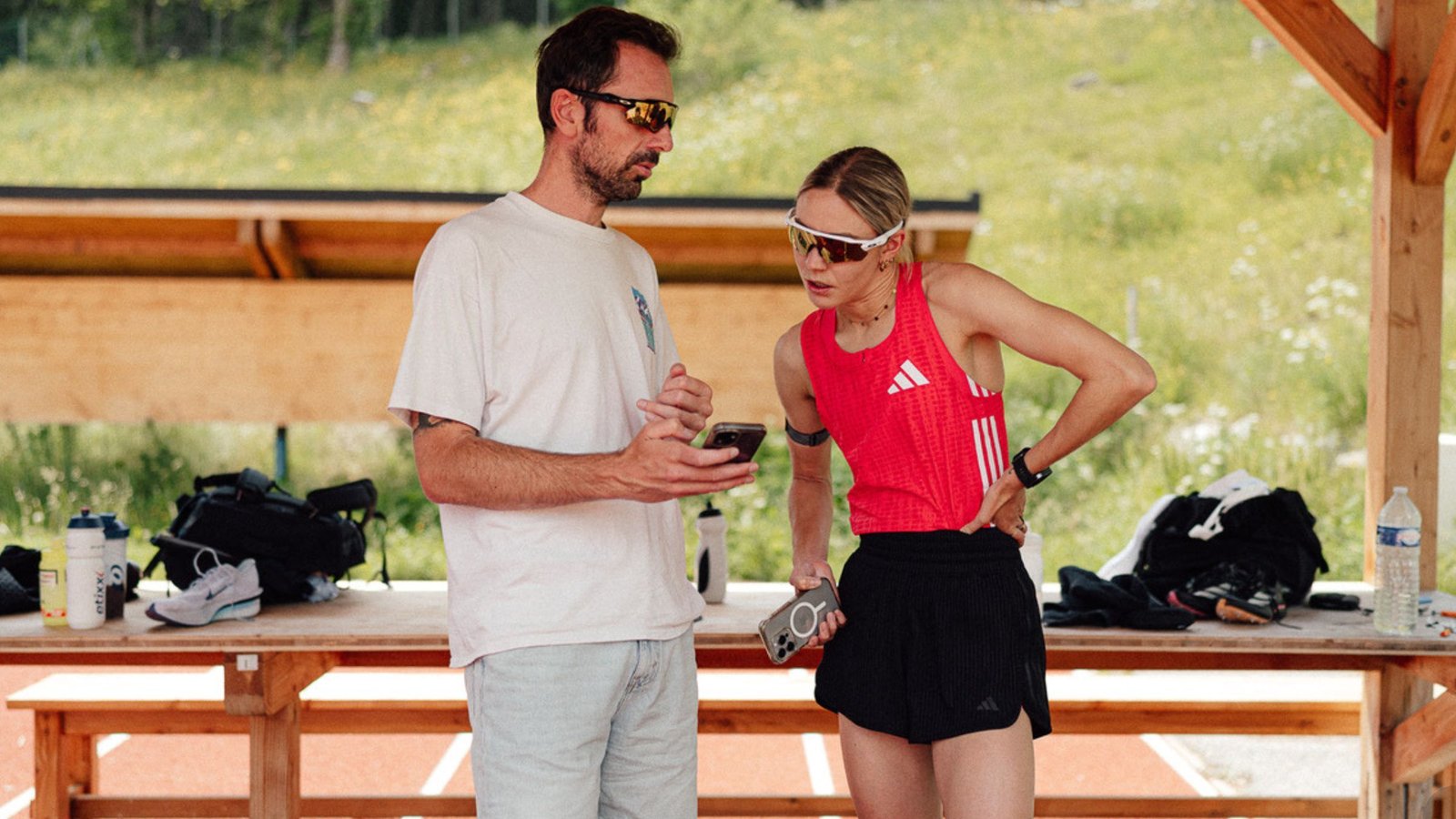
The reason is straightforward: he wants to see them. Of course, he wants to test them. But he also wants to observe them: how they move, how they interact, how they handle load, how they respond when they are tired and how they behave in the daily rhythm of training.
That may sound old-school in an era when endurance performance is increasingly mediated through watches, apps and remote coaching platforms, but Poleunis’ approach is not anti-technology. It is more that elite coaching requires proximity, observation and trust.
Triathlon science without losing the athlete
Asked to define his coaching principles, Poleunis starts with individualization.
“Trying to profile both the mental part and the physiological part of the athletes, see what’s needed for them, and try to fit them in our culture.”
That sentence is basically the operating thesis of Poleunis’ squad. There is the physiological athlete: the one with a particular power-duration curve, lactate profile, muscle fiber tendency, fatigue resistance, injury history, and response to training. There is the mental athlete: the one who may need more structure or more freedom, more patience or more restraint, more confidence or more correction. And then there is the group itself, the culture the athlete has to fit into.
The science matters, and Poleunis is clear on that point. But he is also clear that science can become counterproductive when it overwhelms the person it is supposed to help.
“Trying to make it as scientific as possible,” he notes, “without losing touch with the pleasure and the fun part of training.”
That balance is not always easy. Poleunis admits that he sometimes has to hold himself back. There may be another test he wants to run, another metric he wants to follow or another detail he wants to optimize. But more information is not always better if it leaves the athlete overwhelmed. This is where coaching departs from strictly science-led training. Poleunis doesn’t want athletes who blindly obey numbers. He wants athletes who understand what the numbers mean.
This matters because the athletes in his squad are not interchangeable. Two athletes may be preparing for the same distance, even the same race, but their training is not the same.
“In the base period, it can be quite significantly different,” Poleunis explains.
As race day approaches, some sessions may converge. Athletes targeting the same event may do similar race-specific bike or run work. But even then, threshold sessions are not simply copied and pasted from one athlete to another.
“When we do threshold, for example, it will always be at their individual pace or individual volume they can tolerate,” says Poleunis.
The individualization begins with physiology. Some athletes are more “diesel”. Some are more fast-twitch or anaerobic. Some may need more VO2 max development. Others may already have a naturally high VO2 max and need something else entirely. Some need short sprints with lots of rest. Some need more polarized training. Some can tolerate volume. Others cannot. Some respond to heavy strength work. Others barely touch weights and instead focus on mobility and core.
Testing is treated as a tool, not a religion. Poleunis likes formal protocols and lactate testing, but he also believes a coach can learn a lot from power-duration curves, experience, and just watching the athlete. That’s not a rejection of testing. It is a reminder that data is only useful when you know how to interpret it.
The internal lactate meter
If there is one phrase that captures Poleunis’ approach, it is this: he wants his athletes to develop an internal lactate meter.
“For me, it’s power, heart rate, lactate, and RPE, and trying to find connections between all those things,” he explains. “It’s not one metric; it’s a combination of all those.”
He is also experimenting with newer ways to understand effort in the field. He mentions working with a chest strap that estimates ventilation by measuring chest expansion, allowing him to look at breathing rate alongside lactate, core temperature, and other markers. During a heat wave, for example, he is interested in the relationship between lactate and breathing rate, and whether that could eventually help athletes pace more effectively in hot conditions.
But again, the technology is not the end point.
“For me, it’s always important that the athlete connects the feeling to what we see,” he says.
That connection matters because athletes race alone. A coach can prescribe, test, measure and advise, but in the key moments of a race, the athlete needs to know what an effort means. Is this sustainable? Is this too hard? Is this the right intensity for today, in these conditions, after this swim, on this course, against this field?
“I want my athletes to have an almost internal lactate meter, after a while,” Poleunis says.
He sees it most clearly with athletes he has coached for a long time. Their sense of effort begins to match the intention of the session. They understand when a gravel path, a headwind, or a slight uphill makes pace meaningless. They learn not to fixate on one external number when the real goal is the physiological stress.
That, for Poleunis, is when trust deepens. “That’s when I start to get comfortable with an athlete,” he shares, “when I feel like he knows what he’s doing.”
In other words, the goal of measuring is not dependency; it is autonomy. Poleunis wants athletes who can execute correctly even when he is not standing there with a lactate meter.
Why the squad matters
For all the physiology, testing and individualized programming, Poleunis keeps coming back to something far less technical: people need people.
“That’s also the reason why I still have quite a big group,” he smiles, because sometimes I think I want fewer athletes and my life would be easier.”
The group matters because elite training is repetitive, demanding, and frankly, often boring. The work can be isolating. The days can be long. The sacrifices are real. A squad doesn’t eliminate those costs, but it can change how they feel. And those things cannot be found in a training file.
“Even showing up for a swim, you know, the social part, the little jokes on the pool deck, is such an important factor,” he says.
That human element is also deeply practical. Athletes who enjoy the process are more likely to keep showing up. Athletes who feel connected are less likely to feel consumed by the isolation of chasing results. Athletes who train around other excellent athletes have a living benchmark for what world-class looks like.
Poleunis is seeing that with Vincent Luis and Marten Van Riel. “For Vince, I think it’s been really nice,” he explains, “to have somebody training at the same level again.” That matters in long-course, where the training can become monotonous
The squad is not only about comparison, but also about shared commitment. That process includes sacrifice. Athletes leave home. They miss family and friends. They build lives around training camps, races, travel, and recovery. Poleunis wants the group to fill some of that emotional space, not simply function as a collection of elite training partners. For that to work, the athletes need to care about one another.
“They should make sure that they take care of each other as well and that they build relationships and not look only at the result,” he acknowledges,
Of course, this creates an obvious complication. Some of these athletes race one another. Van Riel and Luis are lining up at many of the same long course events. Beaugrand and Taylor-Brown know each other not only as training partners, but as rivals in the biggest short-course races around the world.
Poleunis is not naïve about that. But so far, he believes the benefits outweigh the risks. “One of the nicest moments,” he says with a smile, “is when I see the post-race hug between my athletes.”
The key is making sure training does not become racing. Poleunis claims the structure of the sessions helps prevent that. Athletes know their paces, their efforts, and the purpose of the work. There may be moments, especially close to a race, when ego appears. But he says it can be managed. In fact, he sees value in athletes training alongside a competitor, if it’s framed appropriately.
“Even if somebody is way better than you,” Poleunis explains, “if you do the work and every time you get a little bit closer to that level, in the end you’ll be very close to the very, very best level.”
The Marten Van Riel proof point
For many observers, Marten Van Riel is the athlete most closely associated with Poleunis’ rise as a coach. The Belgian had already proven himself in short-course racing, competed at three Olympic Games, and then became one of the clearest examples of how quickly the right athlete can find success over the middle- and long-distance.
Poleunis is careful, however, not to turn Van Riel’s transition into something universal. The performance that stands out came at T100 San Francisco in 2024, where Van Riel won in a three-way sprint finish while still largely focused on Olympic distance racing.
“He was quite unprepared for middle distance, in full Olympic training,” Poleunis explains, “so that was quite remarkable.”
That result confirmed something about Van Riel’s profile. Some short-course athletes can move up successfully because their bike profile, durability, and physiology support the demands of longer racing. Others, Poleunis says, will find it much harder. A strong bike ability is now essential in middle- and long-distance triathlon.
The same is true physiologically. Very fast-twitch or anaerobic athletes may struggle to transition and often return to shorter racing. Others may be suited to longer events than they realize, and Poleunis believes timing matters. Nowadays, athletes are moving up earlier.
For Poleunis, Van Riel’s trajectory also highlights a difference between short-course and longer racing. Short-course racing is thrilling, but it is chaotic. Race dynamics, tactics, positioning, and scenarios can alter outcomes dramatically. A perfectly prepared athlete can still lose control of the day.
“On the short distance, so many things can happen,” he explains, “and you’re depending on race scenarios and tactics.”
Long-course racing is not simple, but Poleunis finds it more predictable in one important way. If the athlete is well prepared, there is a greater chance that the performance reflects it. That does not mean the transition is easy. It means that, for the right athlete, the demands may align.
“For me, the transition is, again, athlete-specific,” Poleunis says.
It is a phrase he could repeat after almost every question.
Coaching Vincent Luis
If Van Riel represents the successful transition case, Vincent Luis represents another kind of coaching challenge: the veteran superstar.
Luis has been one of the defining short-course athletes of his generation, with world titles, Olympic experience, and years of elite racing knowledge. Coaching an athlete like that requires a different touch than coaching a developing prospect.
With experienced athletes, Poleunis wants open-mindedness. Past success matters, but it cannot become resistance to change.
“I wanted them to be open-minded,” he says, “and always be learning.”
From the beginning, Poleunis says he was honest about how he worked, what he thought he might try, and what he believed needed to change. With Luis, several priorities stood out: injury prevention, the gym program, and bike development.
The bike position was another early focus. Poleunis did not want Luis chasing aerodynamics at the expense of power production.
“The bike position was something that I really wanted to fix properly and to see how the watts correlated,” he says. “Not only focusing on being extremely aero but also being able to push watts more like on the road bike.”
What has impressed Poleunis most is not simply Luis’ talent, but his professionalism. Luis trusted the process quickly, and that trust mattered. More than that, he acted on decisions immediately.
“When I tell Vince, we want to test this or that, he goes straight into action, and we make a plan for it,” shares Poleunis.
That level of detail showed Poleunis why Luis had already been so successful. Great athletes are not only talented, but they also know how to turn ideas into execution. “I’ve been really impressed with his care and attention to detail,” Poleunis adds.
Run training was handled cautiously. Luis came in with a niggle, so Poleunis avoided rushing intensity and instead focused on building the foundation.
It is another example of his broader philosophy. The answer is not always more intensity, more volume, or more data. Sometimes the answer is restraint.
Can the Glenn Poleunis method revolutionize triathlon?
The Norwegian Method changed triathlon not only because it worked, but because it was easy to understand as a storyline: lactate testing, controlled intensity, huge volume, Olympic medals and world titles, and a group of athletes willing to drag the sport into a more scientific era.
Whether that storyline is complete or oversimplified, it doesn’t matter. The story stuck.
What Poleunis is building feels harder to package. There is no single session that explains it. No one metric. No obvious slogan beyond individualization, which is accurate but clearly not as catchy.
Poleunis isn’t rejecting the scientific method in triathlon. He is deep inside it. He measures lactate. He studies power curves. He looks at ventilation, heat response, fatigue resistance, and the relationship between physiology and performance. He profiles athletes by type. He adjusts strength work, intensity, volume, and race prep accordingly.
But he also insists that the athletes understand the work. The squad has to enjoy the process. The training culture has to support the individual, not just the results. And the coach has to know when the data is useful and when it is too much.
Poleunis does not come across as a coach desperate to attach his name to the next great method. When asked what he hopes people say about what he’s built five or ten years from now, he does not start with lactate or medals.
“What I really want is that the journey is fun for my athletes,” he reflects. Then, because this is elite sport, he adds the obvious. “Of course, medals are the goal on the performance side.” But he does not stop there: “I really hope that I am a person who was an important factor in their life,” he adds, “and that I made them think about life and sport.”
That’s not as punchy as “outdo the Norwegian Method”. It doesn’t fit neatly in a headline, but it may say more about what Poleunis is actually building.
A squad. A culture. A scientific model that is not a fixed method. A place where athletes learn not only what the numbers say, but how to feel them.
Can Glenn Poleunis’ squad outdo the Norwegian Method?
Maybe, but after speaking with him, it seems like the wrong question. The better question is whether triathlon’s next leap forward will come from finding the “perfect method”, or from knowing when an athlete needs something else.



