
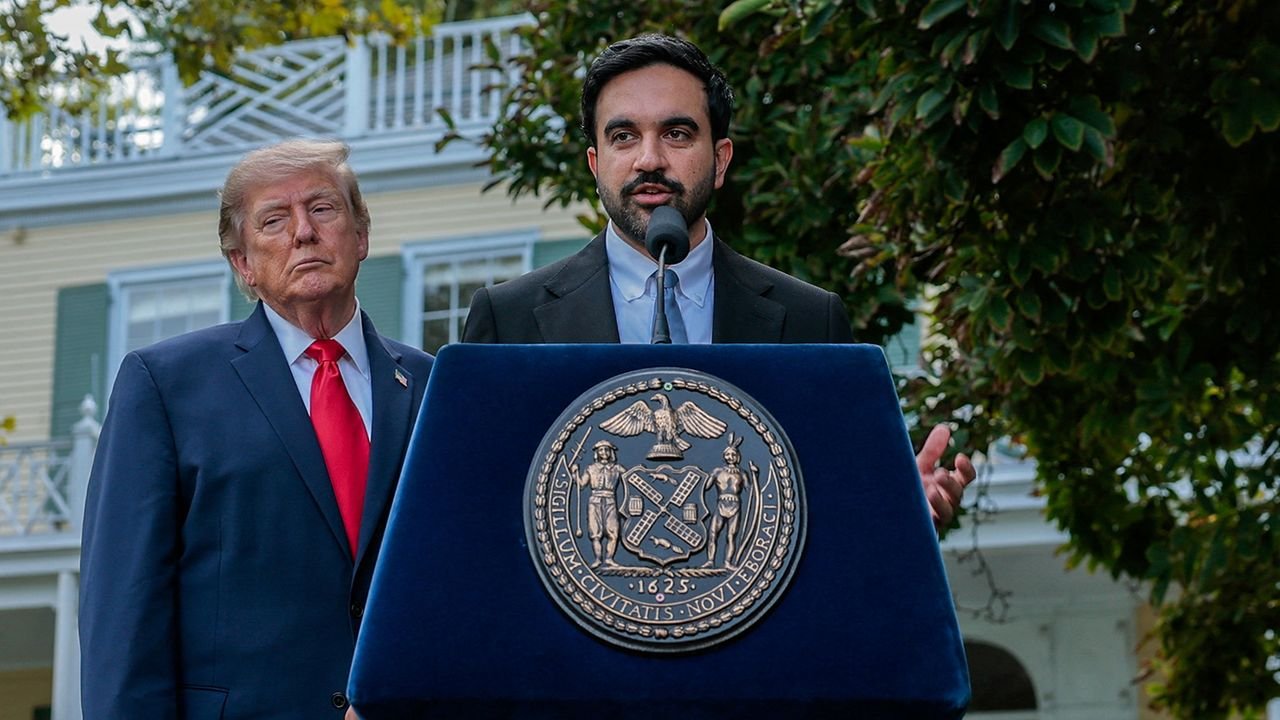
Two of the other mayors interviewed for “Open Mind”—New York City’s Zohran Mamdani and Toronto’s Olivia Chow—met earlier this month in Manhattan, as more than two dozen municipal leaders convened for a summit called the Urban20, which was staged in parallel to the high-level meetings at the United Nations General Assembly. Mamdani and Chow swapped notes on dealing with the constraints placed on them by their state and provincial governors, and on their respective battles over renters’ rights and the high costs of living in their cities. “Sometimes the relationship between our national governments is a little more complicated than we like,” Chow said, referring to the ongoing dispute between Trump and the Canadian Prime Minister, Mark Carney. “But friendship between cities doesn’t need permission from our capitals. We can just do it.”
Mamdani pointed to a burgeoning solidarity. “Global challenges cannot be faced in isolation,” he said during closing remarks for the summit. “The vision of coexistence that our cities so proudly model is evidence of that very point.” He also gave the mayors of Barcelona, Helsinki, and Rome a tour of a wastewater-treatment plant in the Bronx, insisting on the importance of delivering good governance and getting basic things done. Mamdani has described his approach as “sewer socialism,” using the resources and the tools he has to improve public infrastructure and the conditions of the city. He believes mayors, whatever their politics, have to identify and focus attention on what they can tangibly make better. Otherwise, speaking for his own part and referring to how his Republican opponents tend to talk about the failings of cities run by Democrats, he said, “If you are staring at an example of social disorder or social inefficiency, and the left refuses to explain either why it has happened or how they will fix it, then the right gets to point at someone in the immediate area and say, ‘That’s who did it.’ ”
New York City’s mayor may be America’s most obvious example of a metropolitan leader who stands in contrast to his country’s nationalist politics, but he’s hardly alone. Last week, even as Germany’s far right racked up new successes in state elections, voters in Berlin delivered victory to the leftist Die Linke party, led by Elif Eralp, a forty-five-year-old lawyer of Turkish descent whom many are already calling “Germany’s Mamdani.” She’s now the top contender to lead the city’s government, pending coalition talks, and has centered her campaign on making the German capital more affordable, including through a controversial scheme to expropriate tens of thousands of apartments from private real-estate companies seen as responsible for Berlin’s high rents. “This city belongs to all of us, not to the speculators,” Eralp said in a recent speech. Her designs may set up a showdown with the German Chancellor, the center-right Friedrich Merz, who opposes the plan to socialize housing.
Mayors are, of course, limited in what they can do. They can speak in transcendent terms, but they can’t transcend the checks of state and federal power, or the budgetary controls that, in many instances, narrow their scope for action. But their ability to competently run a city, connecting directly with local needs, often sets them up for national politics. The new British Prime Minister, the Labour politician Andy Burnham, honed a sunny, folksy brand of center-left politics for almost a decade as the mayor of Manchester; supporters hope that his broadly successful legacy there can help revive his floundering party. To date, the most serious challenge to Turkish President Recep Tayyip Erdoğan’s increasingly autocratic tenure came from Ekrem İmamoğlu, the popular mayor of Istanbul. But İmamoğlu has been detained, since 2025, on a string of charges of corruption and bribery which are widely believed to be trumped up and designed to bar him from ever competing against Erdoğan nationally.
An alphabet soup of networks and alliances brings together scores of cities into various political campaigns—these include entities such as the C40, which involves dozens of mayors from around the world acting together on climate policies, and the urban alliance for gun safety set up by the former New York City mayor Michael Bloomberg which coördinates anti-gun policy among hundreds of U.S. cities, and the Mayors Migration Council, which brings together Western mayors reckoning with influxes of undocumented migrants alongside mayors in the developing world who administer cities overwhelmed by internal displacements and climate refugees. The Pact of Free Cities, founded in 2019, began with four members—the capital cities of Hungary, Poland, the Czech Republic, and Slovakia—and styled itself in deliberate opposition to the illiberal populists who held national power in Central Europe. There are now forty-five members, including ten American cities. Last year, I spoke with one of the group’s leaders, Gergely Karácsony, the left-leaning mayor of Budapest, who was elected in 2019, and often came into conflict with Hungary’s then Prime Minister, the right-wing nationalist Viktor Orbán. “Thirty years ago, when our countries cast off communist dictatorship, we hoped that a new era had dawned for the peoples of Europe—an era of freedom, peace, rationality, and cooperation. Today, those ideals are being upheld by cities, as islands in a political climate that seeks once again to concentrate all power at the center,” Karácsony told me, talking about the ways that Budapest was trying to buttress civil society, defending the city’s L.G.B.T.Q.+ community and Hungary’s beleaguered independent media.



