
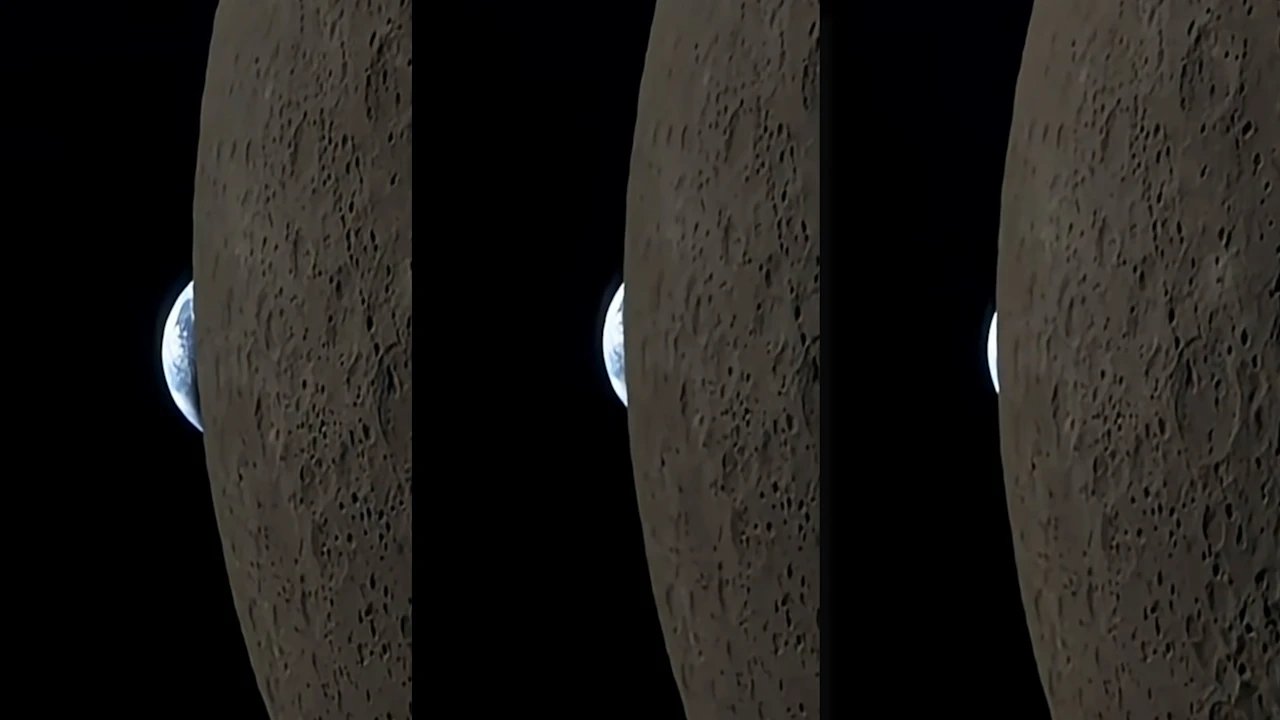
NASA this week released a stunning video of “Earthset,” the humbling moment when the Artemis II crew (now back at home) caught a view of Earth setting behind the lunar surface. From the window of the crew’s capsule, the recording captured the cusp of our bright and blue planet slowly disappearing behind the moon. The camera lens is of high-enough quality that the imaging picked up the wisps of weather systems traveling over our oceans and, in the foreground, the much darker lunar surface, peppered with crevices and craters.
“Dude,” exhales an overcome astronaut on the recording’s audio. “No way.”
This was all filmed on an iPhone 17 Pro Max and was shot by Reid Wiseman, the American astronaut who commanded the Artemis II mission. The video has since gone viral, generating many millions of views and providing NASA with another shareable moon moment amid a crowded and often depressing news cycle. The video is no doubt a humbling reminder of not only how far humanity has gone in space, but how far consumer technology has come, too. Today, a smartphone used by more than a billion people is also powerful enough for astronauts.
NASA only recently changed its rules and allowed astronauts to bring their personal smartphones to space. On the Orion capsule, the four astronauts also brought along other devices, including Nikon D5 and Z9 cameras. Still, it’s hard not to feel like the iPhone recording has sort of become an implicit advertisement for Apple. Indeed, several consumer tech outlets have picked up on the use of iPhones. One even called the “Earthset” video, which hearkens back to a similar “Earthrise” video captured during the Apollo 8 mission, the “best iPhone ad Apple never made.”
“You captured the wonders of space and our planet beautifully, taking iPhone photography to new heights, and we’re grateful you shared it with the world,” wrote Apple CEO Tim Cook in a social media post earlier this month.
Technology companies have long vied for a role in space missions and the positive publicity that comes with them. HP has made much ado about its long-standing work for NASA, which includes building the original computer used in the Apollo program and an ongoing role with the International Space Station. Lockheed Martin has now begun to run ads, including on sites like Wired, commending the success of its Orion crew capsule, which the defense contractor built for Artemis. Space is momentous and humbling, which means it’s also an opportune domain for product placement.
But Apple, if it wants to use the “Earthset” video, faces a slightly tricky situation. The video is created by NASA, but technically, the agency makes it available to anyone. If you want a look at some of the other videos and images captured on the Artemis mission, you can simply peruse the space agency’s Flickr account. NASA’s website also includes a photo repository that, in its metadata, notes the camera, model, and manufacturer used to take particular shots. (Apple did not respond to Fast Company’s request for comment.)
But NASA is also highly protective of its powerful and global brand. The space agency shares media usage and advertising guidelines with myriad organizations, particularly around its logos, and bars entities from implying in any way that they’re formally supported or associated with the space agency. Yes, companies can tout that they’ve been to space, even on NASA missions, but they can’t use NASA materials to imply the space agency is actually endorsing their product.
“NASA imagery can be generally used editorially within published works that are not promotional in nature,” explains agency spokesperson Lauren Low. “If any NASA material is to be used for commercial purposes, including advertisements, it must not explicitly or implicitly convey NASA’s endorsement of commercial goods or services.”
In other words, any company looking to capitalize on the way their products might be used in the Artemis mission must walk a fine line.



