
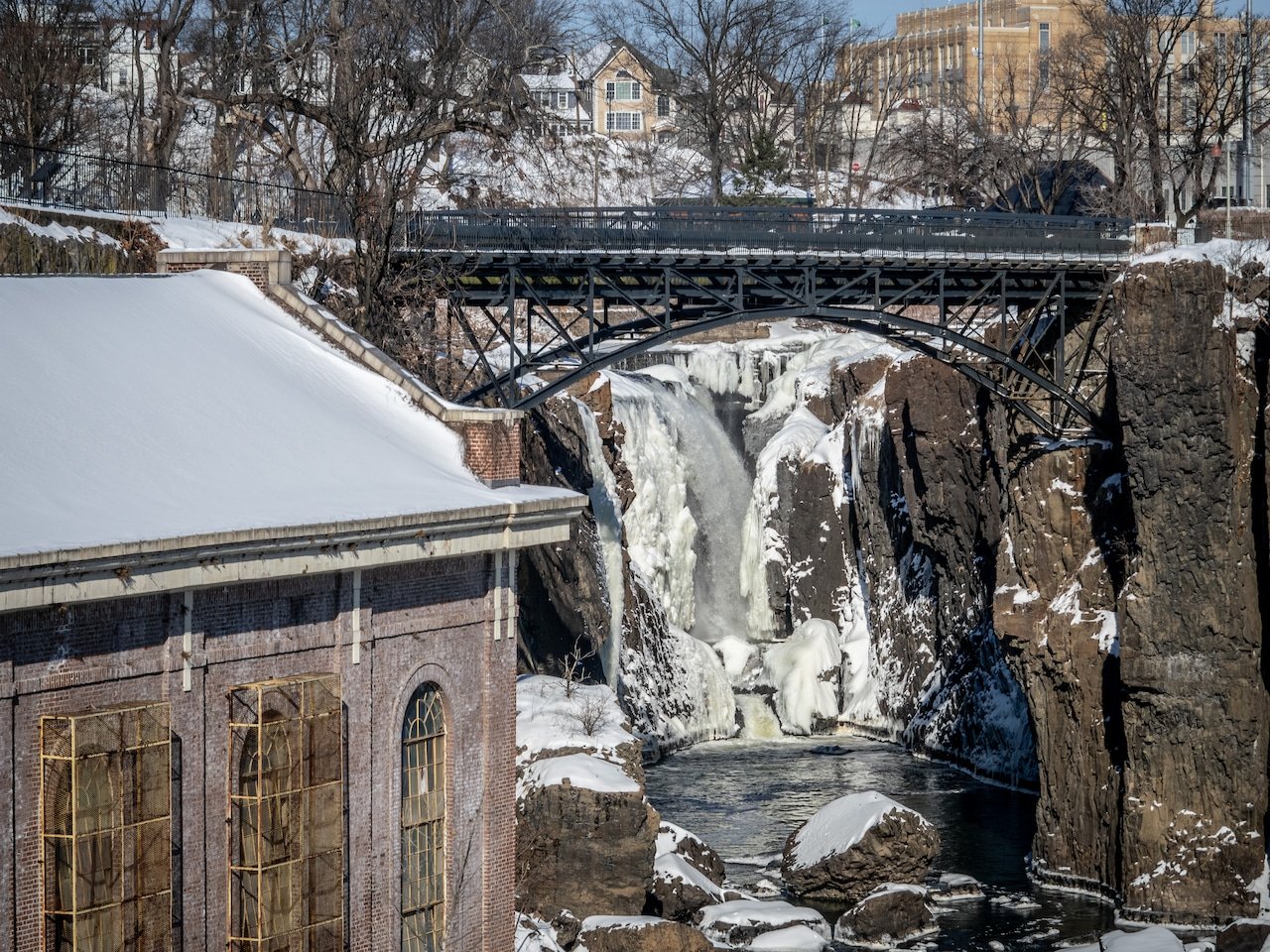
Paterson officials gathered Thursday to open the new pedestrian bridge overlooking the Great Falls, the latest improvement to the national park that will provide visitors with a closer look at the source of power behind America’s first industrial center.
The new bridge replaces the old one that was shut down in August 2021 due to structural deficiencies. Built for $1.5 million with federal, county, and city funding, the new span crosses the 77-foot high chasm and connects one side of the national park to the other.
Paterson mayor Andre Sayegh said the bridge “connects the past to the future” and hopes it will attract many more visitors to what he called “New Jersey’s Niagara Falls.”
Sayegh began his remarks by paying tribute to two political leaders, both native Patersonians, who were instrumental in establishing the national park: Sen. Frank Lautenberg, and Rep. Bill J Pascrell, Jr. Both are now deceased.
Sayegh also credited former four-term Paterson mayor Lawrence “Pat” Kramer and his wife Mary Ellen with having the vision in the early 1970s to create the Great Falls Historic District which evolved into the national park, established by Congress in 2009.
“This is Paterson’s point of difference,” Sayegh said. “And I would argue, this is the birthplace of the American Dream.”
Kramer’s son, Lawrence, commonly known as “Kip,” was grateful for the people who shared his parents’ vision.
“I do stand in the shadows of some people that did some wonderful things and got all this going,” he said. “But when I look out at the people that are here, the people that it matters to, it’s that Paterson is still important and we are building a bridge to the future.”

Sayegh said one side of the national park will be named after Pascrell, and will connect on the other side of the bridge with the section already known as Mary Ellen Kramer Park.
Sayegh recounted the oft-told story of the day in July 1778 when Alexander Hamilton, George Washington, and the Marquis de Lafayette stopped at the Great Falls and envisioned America’s first planned industrial center.
“Hamilton saw the falls and he saw the future,” Sayegh said. “An immigrant with imagination, which led to even more immigration and industrialization, and innovation.”
The park superintendent, Darren Boch, provided a more modern take on the moment.
“I asked A.I. this morning, ‘what is a river without a bridge?’ and A.I. said, ‘it’s a heart without a beat.’ And I thought, I’m going to borrow that, but I’m going to fully source that it was A.I.”

Boch said the park drew an estimated 300,000 visitors last year. The new bridge could push attendance toward the 500,000 mark, he said.
Pascrell’s successor in Congress, U.S. Rep. Nellie Pou (D-9th Dist.), recalled as a teenager walking by the Great Falls on her way to John F. Kennedy High School.
“The best part of my travel was being able to see these beautiful falls, to be able to feel them, and hear them,” she said. Pou, a native Patersonian, said “it’s good to be back home and feel that heartbeat.”
The 100-foot bridge replaces a wooden plank span that was built in 1984. This new edition is a smoother concrete base that is wheelchair accessible, Boch said.



