
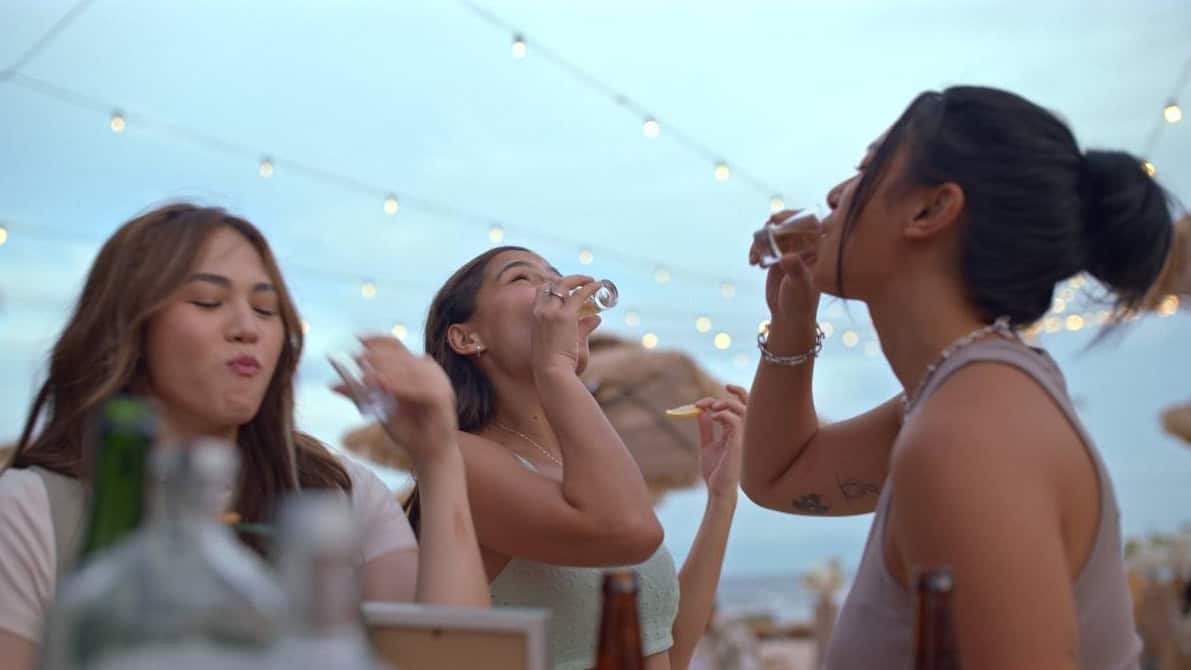
What happens when all your closest friends also happen to be your exes – and each other’s exes, for good measure? That tangled emotional web lies at the heart of “Open Endings”, a sweet and perceptive dramedy shown at the 2026 Queer East festival, where friendships, romances, and unresolved feelings constantly bleed into one another.
Open Endings is screening at Queer East Film Festival
Life can and will be complicated, no matter what. But when you happen to be a queer woman living in Manila, chances are it will be even more so. Not so much because of anti-gay harassment or prejudice, although that definitely exists and happens. The film features one scene on the subject, but it is notable for its refusal to let its characters and story be defined by their queer identity. “Open Endings” only deals with the subject from an indirect perspective, letting its characters breathe and feel like real people confronted with their complicated emotional lives.
There’s Charlie (Janella Salvador), who quickly introduces audiences to these four women who, at one point or another, have kissed, slept with, loved, or ghosted one another, but still hold fast to their friendships. In fact, it seems their bonds are even tighter because of these past intimacies. Is this really viable, though? Isn’t life sufficiently messy as it is?
The big achievement of director Nigel Santos and screenwriter Keavy Eunice Vicente is creating nuanced characters and situationships that do not feel artificial. On the contrary, they offer insightful commentary on love and its many contemporary avatars, from one-night stands, illicit affairs, and ghosting to friends who might still have a spark for one another. Santos never judges, but honestly depicts its characters’ struggles with their own flaws and needs. People can sometimes feel selfish or egocentric, relationships can be acrimonious, but they can also lead to more positive situations and relationships, where people respect each other and are there for one another.
The flaw here is that the film deals with multiple subplots that are never sufficiently developed, like Hannah (Jasmine Curtis-Smith) mourning a loved one while her friends try to support her. That episode is quickly left behind to deal with new situations and issues that will also quickly be forgotten when the time comes. Hannah will again be at the centre of a totally unrelated development, which happens pretty late in the narrative and becomes the centre of attention during the last act. There is a feeling, here and elsewhere, that these subplots could have had much more heft if they had been examined more thoroughly
In fact, “Open Endings” is so episodic that it gives the impression that its true nature is that of a single-camera sitcom, especially as so many scenes are set indoors, most often in a living room, kitchen, or bedroom. As a TV sitcom or drama, it would have had the proper time to deal with its many characters and story arcs, and perhaps Mihan’s (the very solid Leanne Mamonong) self-revelation by the ending would have felt more properly earned.
The fact that so much happens indoors can also be frustrating, as so little of the outside world is shown. Yet, as the movie goes on, more of the outside world appears, and you finally get a feeling of place. One of the characters gives you a clue when she remarks that the world of queer women can be very small when you live in Metro Manila, especially Quezon City. There, queer women can have a freer, more open lifestyle, against the backdrop of a traditional Filipino society where gay marriage is still against the law. This also explains why our characters look and sound so urbane and cosmopolitan, liberally mixing Filipino and English and following a lifestyle international audiences can readily recognize as pretty much their own.
There are also, here and there, elements that point to wider issues. Most notably, a married woman starts an affair with Kit (Klea Pineda), one of our heroines, who also happens to be her son’s teacher. Although she is a side character, you get a clear sense of the difficulties faced by this woman – in a society where divorce is still not a possibility – whose lifestyle is so different from Kit and her friends’.
In the end, the film’s greatest strength lies in its openness – to ambiguity, contradiction, and emotional imperfection. “Open Endings” may wander at times, but its compassionate gaze and refusal to simplify human relationships make it an affecting exploration of love(s) and friendship(s) in all their unstable forms.



