
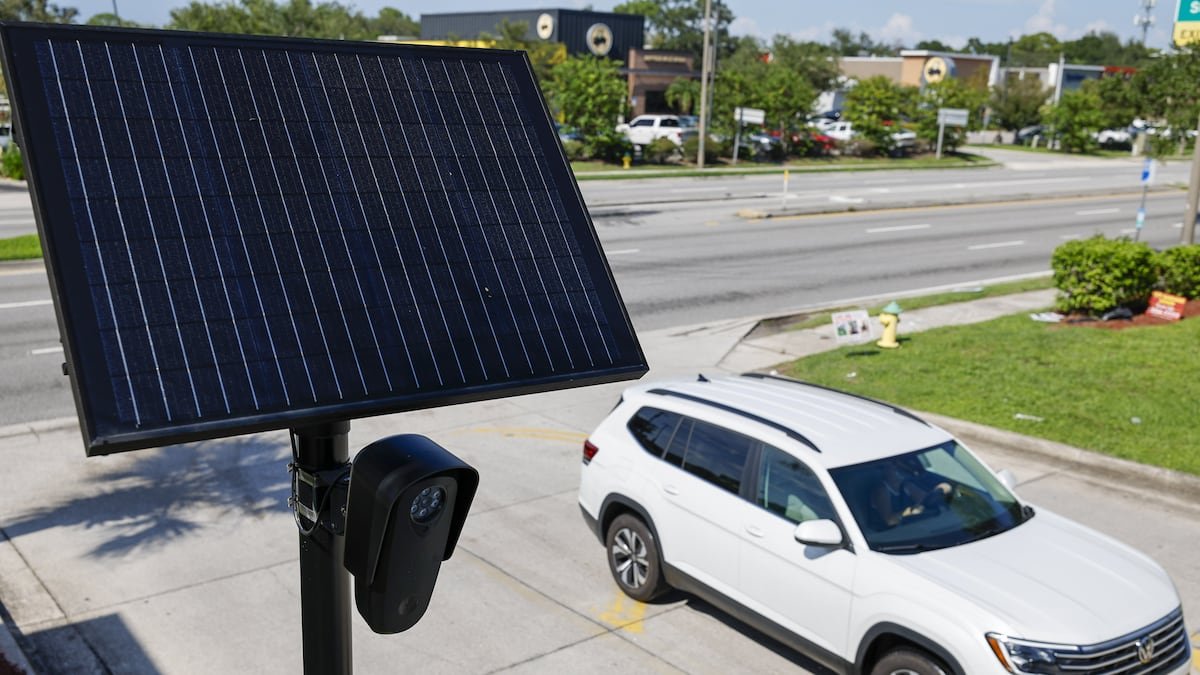
Pinellas County commissioners on Tuesday decided not to take action on a proposed automated license plate reader ban.
Automated license plate readers, commonly referred to as Flock cameras after one of the companies that supplies the technology, have faced growing public scrutiny from people worried about the government tracking their private lives. Pinellas Sheriff Bob Gualtieri defended the use of the readers in a commission work session earlier this month.
This summer, Commissioner Vince Nowicki floated imposing a ban on the technology. Nowicki previously told the Tampa Bay Times he wants to listen to the “overwhelming outcry” from residents on the technology.
“It’s interesting that folks agree that something needs to get done, but nobody wants to do anything,” Nowicki said after the meeting.
Commissioners agreed this summer that they wanted to hear from the sheriff on how the technology is used in the county before considering a ban. And on Tuesday, commissioners instead decided to lobby the state to take up the issue in its upcoming legislative session.
The ban would have only applied to automated license plate readers on county roads. Commissioner Chris Latvala asked the sheriff, who came to the meeting, what he would do if the commission voted to ban the cameras.
“I’ll just move them. Put them up somewhere else,” Gualtieri said with a shrug. “You probably got to start with your own.”
Gualtieri said when the Florida Department of Transportation banned automated license plate readers from state roads, it didn’t say that cameras should be taken down. The Sheriff’s Office moved the cameras elsewhere, Gualtieri said.
The Pinellas County Sheriff’s Office has used the readers since 2006, Gualtieri said when he presented to commissioners earlier in October. The office uses cameras from Axon, Flock and Motorola.
They’re used in dashboard cameras and on stationary road fixtures, Gualtieri said. Some private businesses and neighborhood associations have their own cameras.
Latvala said he wants to see if the state Legislature takes action next year on the technology. If not, Latvala said, the commission could take action after the next legislative session.
Gualtieri said he’s spoken with state lawmakers and that it’s highly likely they will discuss automated license plate readers in the upcoming legislative session.
Commissioner René Flowers said she didn’t support a ban. If she voted to ban the readers in Pinellas, she said, she wouldn’t be able to face people who had crimes solved due to the technology.
There should instead be tighter protocols on when the readers can be used and data accessed, Flowers said.
“Technology is good until somebody utilizes it for the wrong reason,” Flowers said. “And when someone utilizes it for the wrong reason, that’s when it becomes a problem.”
The technology has also received increased public focus after announcements that deputies, including one in Pinellas, misused the readers to track people they were romantically interested in.
License plate readers have been used for more than 20 years across the country. Artificial intelligence used by Flock and other companies have supercharged the technology to be automated, when officers previously would choose which plates to scan.
Today’s cameras feed databases that log enormous amounts of information and can be shared between cities and counties.
There are more than 270 stationary automated license plate reader cameras in the county, Gualtieri said earlier this month, which doesn’t include those deployed by the state. Dash cameras in about 560 patrol cars also use the technology, Gualtieri said.



