
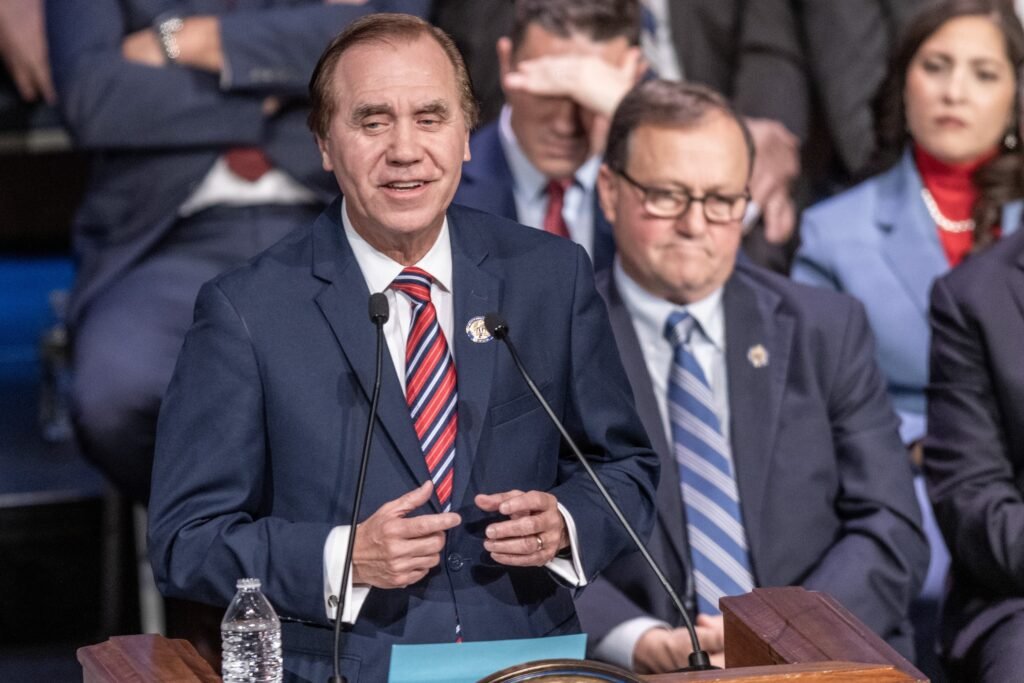
Assembly Speaker Craig Coughlin speaks at the reorganization meeting of the state Assembly in Trenton on Jan. 9, 2024. (Hal Brown for New Jersey Monitor)
A proposal to tax prediction markets that did not clear floor votes in either legislative chamber before lawmakers broke for their customary summer recess will return along with legislators come the fall, Assembly Speaker Craig Coughlin (D-Middlesex) told the New Jersey Monitor.
The bills, which cleared both chambers’ budget committees in party-line votes, would enact a 9% surtax on prediction markets’ net income in a bid to draw more revenue for the state.
“We’re planning on looking at that over the summer and into the fall. I think there’s every chance we’ll pass something out. We’ll make sure it’s right,” said Coughlin, who is the bill’s prime sponsor in his chamber.
Before the June 30 voting sessions that capped this year’s budget season, the bill to tax prediction markets was moving fast, even by the standards of late June, the apex of breakneck lawmaking in Trenton.
But an amended version of the bill proffered by top Democrats in the Senate gave Assembly lawmakers pause, the Speaker said.
“There was some notion that we might be affecting other things, like the stock market or something like that. Clearly that was never the intent,” he said.
Senate President Nicholas Scutari (D-Union), the prime sponsor in his chamber, did not return a call seeking comment.
Before the amendments, the bill would have imposed a 10% surcharge to nearly all contracts offered by prediction markets. Under past text, sports contracts would have been subject to the surcharge and New Jersey’s regular 19.75% internet sports betting tax.
Prediction markets like Kalshi and Polymarket have long faced suits alleging violations of sports betting laws in states across the country, but a divided three-judge panel out of U.S. 3rd Circuit Court of Appeals in April ruled Kalshi’s sports wagering contracts were futures trades that could only be regulated by the Commodity Futures Trading Commission, a federal body.
A spokesperson for Polymarket warned state efforts toward the same end would draw lawsuits alleging the states outstripped their authority.
“Polymarket operates as a CFTC-regulated designated contract market under the exclusive jurisdiction of the Commodity Exchange Act, and state-level efforts to regulate prediction markets will likely face significant federal preemption challenges,” said Olivia Chalos, Polymarket’s deputy chief legal officer.
The surtax’s fiscal impact is unclear. Though the Office of Legislative Services in a fiscal note said it could bring in between $10.3 million and $15.3 million in the current July-to-June fiscal year, they warned against extrapolating those figures out to future years.
Prediction markets were too new for certainty, and the 2026 World Cup could be boosting them, a legislative services analyst wrote. And it’s possible prediction markets would cut into casino and sportsbook revenues, impacting the taxes New Jersey collects from them.
The latter worry echoes concerns expressed by the main union representing casino workers in Atlantic City.
Donna DeCaprio, president of UNITE HERE Local 54, in June warned prediction markets allowed individuals too young to legally gamble in New Jersey to purchase swap contracts that are essentially bets.
Prediction markets require customers to be 18. The legal gambling age in New Jersey is 21.
Further, prediction markets threatened jobs in Atlantic City, an anchor for Atlantic County’s regional economy, she said, and regulating the markets would only entrench them.
“If the state taxes prediction markets, it appears to legitimize them. Jobs in New Jersey have been lost and will continue to be lost as a result of this,” she told the Assembly Budget Committee on June 30. “We understand the sponsors are trying to level the playing field and generate tax revenue, but prediction markets are an existential threat to our jobs. This bill is not the solution.”
The union did not return a request for comment.



