
Updated April 14, 2026 06:44AM
The best triathlon wetsuit might simply seem like a thing to keep you warm when water temperatures drop, but there’s (way) more to it than that. If you want to actually improve your swim split in your next tri (and probably everything that comes after it), you’ll want to invest in a triathlon-specific wetsuit – not something from a surf shop.
What should you look for in a triathlon wetsuit?
In our exhaustive 2025 community survey last year, we asked nearly 1,000 readers a few questions around triathlon wetsuits and learned some interesting facts: First, we learned that the vast majority of respondents (62%) wait at least four years before getting a new wetsuit. While that’s not too shocking, we did learn that 28% of triathletes wait over seven years to buy new neoprene!
Unless you’re being incredibly diligent with repair, cleaning, and care, seven years is definitely on the far end of the spectrum for the lifespan of a triathlon wetsuit – especially (ironically) if it’s a high-end model with delicate neoprene.
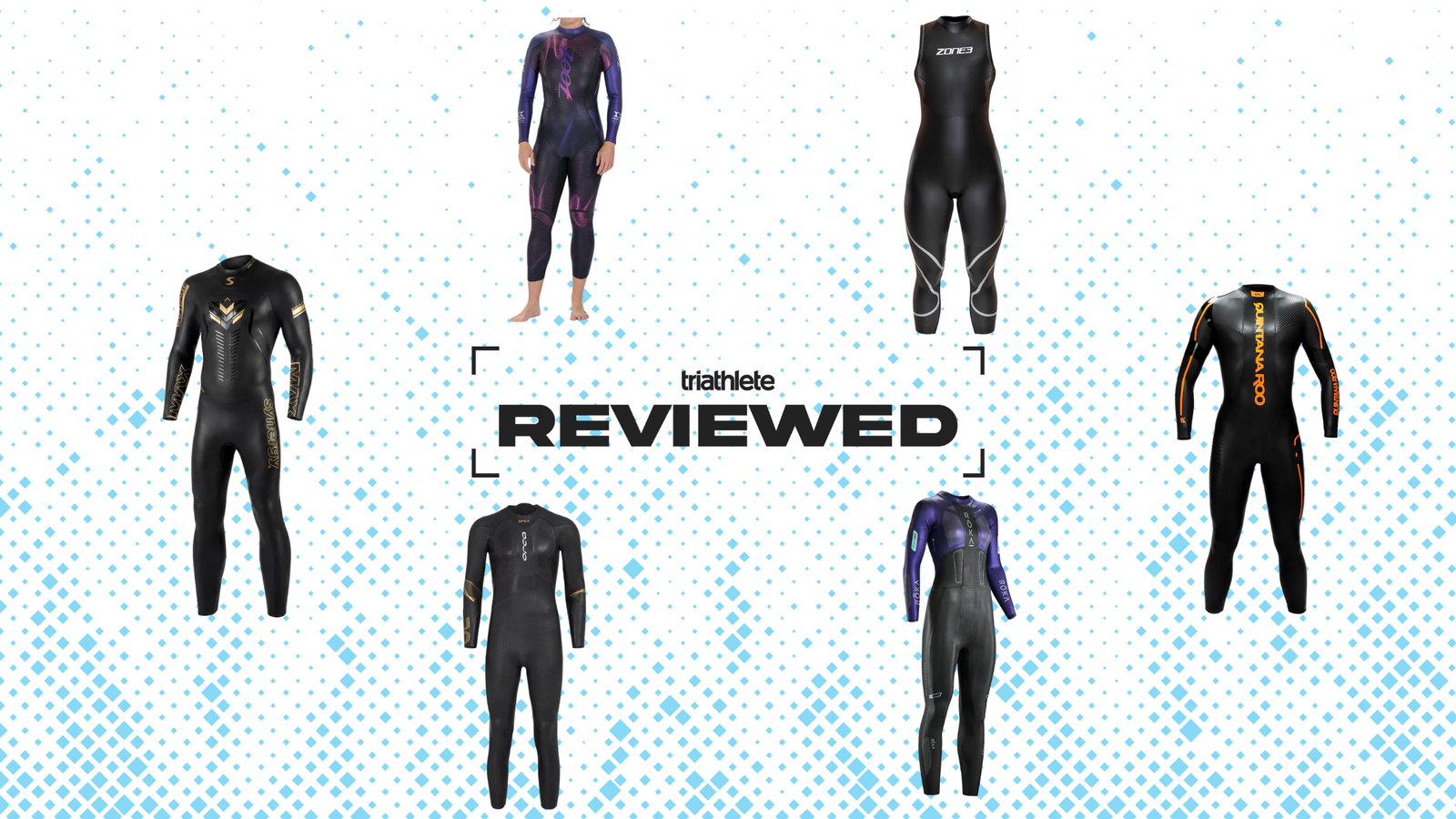
The good news is that there are more options for good, flexible triathlon wetsuits than ever (see the six reviewed below, for example), so you can replace that old, crusty, probably completely unusable seven-year-old neoprene.
We also learned what kind of wetsuit triathletes are buying, and the top six most popular triathlon wetsuit brands from our reader survey are listed below:
When shopping for your best triathlon wetsuit a long list of fancy-sounding features might catch the eye, but it’s also important that you get the right features for your body type, your experience level, and your goals. But of course, none of this matters if the most expensive (or the cheapest) triathlon wetsuit you can afford doesn’t fit well.
With that in mind, we’ve not only highlighted the top features in this year’s crop of new wetsuits, but we’ve also taken the suits out, swam in them, and rated them across a nine-point rating system.
We’ve also broken down which models have more (or less) sizes, their warranty, their return policy, and a quick TL;DR for each suit, and noted if the women’s or men’s version was tested. At the bottom of our detailed reviews, we’ve also created a table to help compare all six at a glance.
Our experienced editors spent hours swimming in a range of this year’s best triathlon wetsuits – from $300 up to $1,700 – to help you find the perfect suit to keep you warm and make you fast, without restricting your movement.
Looking for more guidance before you get started? Check out our explainer on what to look for when buying a triathlon wetsuit.
Best triathlon wetsuits of 2026 at a glance
Wetsuit rating criteria
While the gear below was loaned out by the brands represented, all choices were selected independently by the tester without any promotional consideration or brand input. Also, unlike other “best triathlon wetsuit” websites, our testers actually swim in the wetsuits ourselves – no glancing at spec sheets and rewording marketing terms. Learn more about our gear review process here.
Best triathlon wetsuits of 2026
Zone3 Ascend Sleeveless
Warranty: 1 year
Try-on: 30-day return, “as new”
The Zone 3 Ascend Sleeveless is an entry-level suit that offers straightforward, no-frills performance at a reasonable price. Its mix of 2mm and 3mm neoprene gives it a balanced feel in the water offering solid buoyancy. That said, weaker swimmers or those still working on their body position might benefit from a suit that offers more structural support and thicker (5mm) neoprene through the hips and legs to stay higher in the water.
For an entry-level option, this suit is relatively easy to get on and off, and it feels impressively robust and durable. The blend of smoothskin and nylon-lined neoprene in the lower body certainly adds to that feeling of durability, even if it is a little heavy.
Although the sleeveless design should bring greater freedom of movement throughout the chest and shoulders, it did create a problem in our testing. One tester was wearing a women’s large, which, based on the size guide, should have been an ideal fit. But it was far too loose in the chest and was consistently letting in water through the neck (which obviously hampered swim speed too). There was also an excess of material bunching up behind the neck that was not only uncomfortable and distracting, but also led to some nasty chafing before we’d even done any significant sighting.
While this suit is a good option for entry-level triathletes or those on a lean budget, be sure to size down and/or aim to test a few sizes to find the right fit for you. Get the sizing right and this suit could be a great option for your first season of racing or for anyone who wants a solid sleeveless option for warmer race days.
The best triathlon wetsuit for:
Anyone starting out in tri who’ll be racing in warmer water and doesn’t want to spend a fortune
Roka Maverick ProMax
Warranty: 2 years
Try-on: 30-day return, unused

With the Maverick ProMax, Roka has taken its highly popular Maverick Pro, improved its buoyancy and warmth, and tricked it out with plenty of top-end features that make it an absolute pleasure to swim in. From our first swim, the fit, feel, and buoyancy of this suit were impressive. What struck us first was our body position: we were riding high in the water with almost effortless body rotation, and it felt fast, very fast.
While technically this is Roka’s mid-range suit (the Maverick X.3 being its top-of-the-range suit), it still boasts many of the key features that make this a stealth suit: the patented “Arms Up” technology, centerline buoyancy, quick-release ankle panels, and floating neckline (which makes for a highly comfortable fit around the neck and zero chafing, even when sighting with high frequency).
The “Arms Up” technology is intended to reduce any feelings of restriction through the chest and shoulders, and it absolutely delivers; swimming in this suit feels free and easy. That is also, in part, thanks to the centerline buoyancy.
If you’re a triathlete who needs to improve body position and/or sinking legs, you’ll particularly enjoy this (and the 5mm Yamamoto SCS neoprene used in this section of the suit).
We also noticed how easy hip drive and rotation were. As weird as it sounds, it almost feels like the suit is swimming for you – that’s how easy rotation felt in the opening strokes of our first swim: “Wait, is this suit swimming for me?”
One tester completed a standardized test set to see how the suit performed in terms of speed, effort, and feel. Across a main set of 8 x 100 at 70.3 effort, this suit was, on average, an impressive 7 seconds faster per 100m than the tester’s regular speed (in just a swimsuit).
The ProMax was definitely a “performance fit” – very snug and it took time to get it on right – but once it was on, we could swim with full shoulder extension and rotation, which isn’t always easy or possible in a mid-range suit. With an impressive 10 size options available for men and 10 for women, you should be able to find the right fit for you.
When it comes to swim exits, for anyone who’s ever struggled to flick a wetsuit off the legs/over their ankles, the quick-release panels in the legs of this suit will delight you. One tester admitted that it had been a while since she’d done this, so confidently hopping out of the pool at a popular Boulder swimming spot and stripping this suit was always going to be a gamble, but the ProMax passed with flying colors.
At $995, the Roka ProMax isn’t cheap, but it is a good investment when you consider you’re getting an unmistakably fast, almost top-end suit that delivers great buoyancy, warmth, and durability.
The best triathlon wetsuit for:
Anyone serious about their swim who wants added speed, warmth, and (especially) buoyancy and has the budget to pay for it
Orca Apex 30
Warranty: 2 years
Try-on: 14-day return, unused

The Orca Apex 30 is Orca’s “best of the best” wetsuit, in which they’ve taken the most successful features from their top-end wetsuits over the past three decades and rolled them all into one limited edition 30th anniversary suit.
From the moment of unboxing it to first wear, one thing is clear: It’s undoubtedly a premium suit, crafted with meticulous attention to detail, speed, and performance.
Orca describes it as its “fastest, most elastic, and balanced suit yet,” and there’s plenty of truth in that marketing hype. The fact that it was designed with the help of two-time Olympic medalist Hayden Wilde perhaps tells you all you need to know.
One tester has been swimming in triathlon wetsuits for more than 20 years, and she made a bold statement: “I’ve never swum in a suit that fits and feels like this. It fits like a second skin, with the elasticity of the suit enabling you to rotate, reach, and pull exactly like you would when swimming in just a swimsuit.”
That second-skin feeling is thanks to Orca’s 0.88 Free technology in the arms, shoulders, and sides of the torso, which feels and looks different from “regular” neoprene (it feels like a slightly thicker version of swimskin material).
When it comes to buoyancy, the panels in the legs, core, and chest help ensure optimal body position and rotation, but there’s not the same level of structural support you can feel while swimming in the Roka Maverick ProMax.
This was noticeable while swimming a test set of 8 x 100m: While times were a couple seconds faster than the Roka over the first few 100m reps, I dropped more time per 100m with the Roka later in the set. Overall, our primary tester was 5 seconds per 100m faster than her regular speed in this suit.
Perhaps this suit’s biggest undoing is its price tag. At $1,700, it is a premium wetsuit that comes at a premium price. While it is a limited edition suit that features elite-level R&D, for some it’s hard to justify that kind of spend when a mid-range suit like the Roka is outperforming it and costs half the price.
The best triathlon wetsuit for:
An already-strong (and affluent) swimmer looking to maximize speed and performance, no matter the cost
Quintana Roo HYDROfive2
Warranty: 2-year warranty
Try-on: 14-day return, used (“use for a swim”)

Quintana Roo is all about fit with its wetsuit line. The HYDROfive2, using a body-shape-based sizing system, offers more options than most brands. But sizing comes with a bit of guesswork. Our primary tester wore the Medium-Long-Tall, and while he had multiple options to choose based on QR’s sizing chart, the result was a lucky guess that actually fit really well. The obvious workaround here is to get to a local retailer and find a knowledgeable gear specialist.
Getting into the suit took a little more effort than usual. The HYDROfive2 required more adjustment through the arms, hips, and groin to sit right. Quintana Roo includes thin fabric gloves to help with donning, which proved useful when handling the neoprene without risking tears or cuts.
Once it was on and in the water, it was quite snug and we did not have to deal with any water entry. We were also very warm in the San Francisco Bay in springtime.
The suit delivers a balanced, no-frills experience. Buoyancy is standard for this mid-tier wetsuit, but not aggressive. It keeps you high enough to maintain position and sight comfortably.
That said, the overall feel never quite meshed with one tester’s swimming needs. While arm turnover was smooth and fatigue-free, the connection between his catch and hip rotation felt slightly disjointed. It never felt fully synchronized at higher tempos. But he definitely swam faster with it than I would have without it.
Flexibility reflects that same middle-ground performance. The Yamamoto neoprene through the shoulders and arms is thin and stretchy as one should expect, but it lacks the responsiveness of higher-end suits. In the suit, our primary tester preferred to let his legs and feet relax, occasionally performing a one-beat kick while letting his upper body do most of the work.
His final take: “Don’t get me wrong, the suit is perfectly raceable, but not something I would necessarily reach for as I personally prefer to utilize my kick.”
Chafe prevention was a highlight. We are happy to report that there was no irritation anywhere throughout testing. Removal was less seamless, and the arms came off without issue, but the thicker neoprene through the hips and legs required extra effort to clear in transition. Given the suit’s thickness in the lower-half, we half-expected this.
The best triathlon wetsuit for:
Triathletes looking for a simple, well-built (and reliable) wetsuit that blends training and race days
Zoot WikiWiki Aurora Float
Warranty: 2-year limited warranty
Try-on: 30 days unused

The Zoot WikiWiki Aurora Float feels purpose-built in its design, geared toward the experienced swimmer. Getting into it was straightforward, and the suit fit easily with minimal adjustment. The high ankle openings make that process even easier.
On land, we noticed some tightness through the chest, enough to question the size (medium), but in the water, we never felt constricted with breathing. In fact, the sensation disappeared completely once we got in.
Our size skepticism continued when a small amount of water entered the suit early on. It never affected our stroke, but a thin layer of water was present and never fully cleared. Our sense is that someone with a slightly fuller chest would fit better in it. Our recommendation: Try a size down before purchasing.
In terms of buoyancy, the suit settles nicely in the water. Driven by Aerodome and AQUAlift panels, it lifts the hips and keeps your body high in water, but without feeling overly exaggerated or über propped-up. We could engage our kick or let our legs relax entirely, and we felt very balanced. Translation: You will have options for different speeds.
Where the suit really stands apart is in the arms. The 1.5mm Yamamoto neoprene delivers superb freedom of movement with no resistance through the stroke, no interruption to rhythm, and no shoulder or hip fatigue, even over longer efforts.
Warmth is balanced through the core, but with added mobility from the thinner arm panels, it can feel very cool if you’re not moving. Make sure you are plenty warmed up before your race.
Transitioning was excellent! Taking the suit off was very quick and efficient. It releases cleanly, with no sticking points. We definitely had one of the faster transitions we’ve had in this wetsuit.
But buyer beware: No seam tapes along the inside stitching raises some questions for longevity with this model; to help it last, leave this wetsuit for racing only.
Sighting was also easy to execute, but it came with a downside. The neckline caused noticeable chafing by the end of the swim, and while the back panels have a microfiber layer that prevents irritation along the zipper, it did not extend to the neckline where it was needed most.
At $600, the WikiWiki lands in that mid-range price for premium wetsuits. With the right fit, this is a strong option for the purist swimmer looking for a balanced, performance-oriented wetsuit that prioritizes mobility without overdoing the buoyancy.
The best triathlon wetsuit for:
Purist swimmers looking for a balanced, performance-oriented wetsuit that prioritizes mobility without overdoing the buoyancy
Synergy Vantage Pro
Warranty: 1 year
Try-on: 30 days unused

The Synergy Vantage Pro, the company’s new pro model, is ambitious, sharing similar flexibility traits to that of the Hybrid EFX4, but with a focus toward added buoyancy.
First impressions were mixed. The suit slides on easily, settling into place without any hassle, and the sizing is dialed in (one athlete tested the M1). We had no surprises in the water: no air pockets, no flushing. But before we even got started in the water, unwrapping the wetsuit and the smell of chemical off-gassing was hard to ignore. Although it dissipated over the days used, it made us question what we were wearing and breathing.
In water, the clear and defining characteristic of the Vantage Pro is its buoyancy. The lower half of the suit keeps you riding high to the point where you feel propped up. This will be an advantage to any swimmer, as it further translates into a supported kick, minimal lower-body fatigue, and an overall balanced position. Kicking feels encouraged with the added buoyancy, whether it was at a low or high tempo.
Flexibility is another obvious strength of the wetsuit. Our shoulders moved freely, with no restriction through recovery or extension. The suit adjusted well to all paces without fighting our stroke. Removal in transition was quick and clean, despite the thicker lower-body panels.
Durability seems promising (and I hope so, given the price tag). Warranty information is limited, but will likely fall within 1 year like other high-end Synergy models. Rest assured, throughout the arm panels, stitching is reinforced with seam taping, and it doesn’t interfere with mobility. However, we did experience some underarm chafing on longer swims.
The wetsuit comes with some trade-offs. On land, foam panels run past the knee, into the calf area leaving a stiff, limiting stride when running through transition. Also, over time, the neckline – cut low in the front and high in the back – starts to push back slightly with sighting. It became an annoyance on longer efforts.
The best triathlon wetsuit for:
Triathletes with deep pockets looking to break PRs at any cost



