
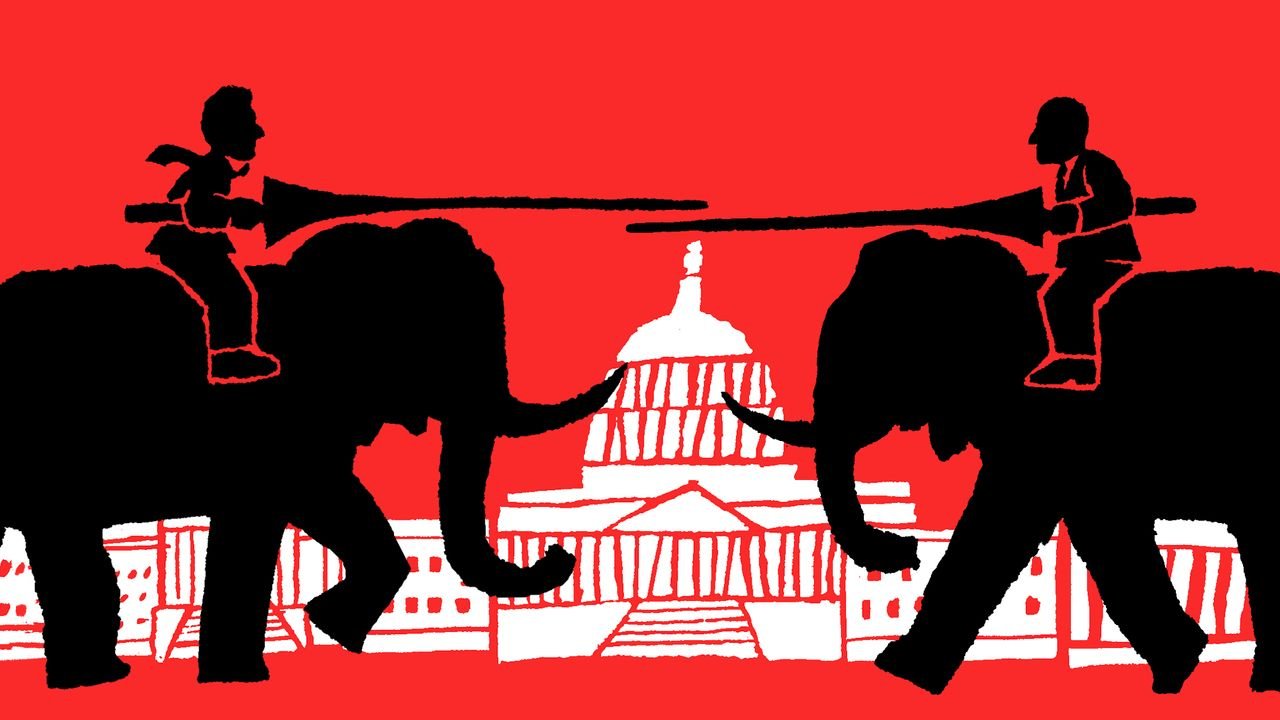
An intern at the event this summer asked Roberts what he thought about Carlson and Fuentes. “Never heard of them,” Roberts joked, to laughter. Then he acknowledged that their appeal was something “we have tried to grapple with here.” He said that it was a reaction to “what is perceived to be the inauthenticity of institutions, that institutions can’t be trusted.” He mentioned colleges, churches, and the government—not think tanks, but perhaps it was implied. “The way some people, a few people, make sense of that is a burn-it-all-down mentality,” he said.
Once the midterms have passed, the conservative movement will have to reckon with its impending post-Trump reality. Different factions want vastly different futures—and, in recent years, these factions have been fighting for control of Heritage. One important dividing line is whether you’re under or over the age of forty-five. Roberts’s hope is to influence the next generation: to disciple them, to direct their anger, to correct their excesses. “This is a civilizational moment for this republic,” he told me recently. “Whatever battles exist out there, whether they’re political battles, ideological battles—God forbid, more real battles—let them be in my lifetime, right now, so my kids don’t have to fight them.”
Heritage was founded in the nineteen-seventies—an age of relative institutional stability, when it was taken for granted that experts could shape history. For decades, it was the clubhouse of the conservative movement, and its alumni took powerful positions across D.C. “It’s almost like we were missionaries,” one former staffer told me. “We were so driven by the belief that what we were doing was important and meaningful.” In 2010, the organization launched Heritage Action for America, a lobbying group that enforced ideological purity on Capitol Hill by shaming apostate Republicans. “There was a consensus, in the 2000-to-2012 era, of what principled conservatism stood for,” Tim Chapman, a former head of Heritage Action, told me. It was more or less the Heritage mission statement: limited government, free enterprise, individual freedom, traditional values, and a strong national defense.
When Donald Trump gained political prominence, in 2016, Heritage leaders recognized his potential—yet the organization slumped during his first term. Kay Coles James, who took over the foundation in 2018, was an uninspiring fund-raiser, and her politics were, as one senior think-tank leader put it, “bog-standard Republican establishment.” During the protests of 2020, James, who is Black, called racism “a fatal wound” in America’s history. Tucker Carlson helped lead a push for her ouster.
The board of trustees wanted Heritage to be relevant again, and Roberts seemed to offer MAGA credibility. He had been the president of a Catholic college in Wyoming and the head of the Texas Public Policy Foundation—an “America First” guy who understood the grass roots. He came up in the populist wing of the Republican Party; as a young man in Louisiana, he organized a rally for Pat Buchanan, the nationalist Presidential candidate. For a time, Roberts changed course, cheering for the Iraq War, but now he describes himself as a “recovering neocon.”
The details of Roberts’s policy preferences weren’t necessarily that important to Heritage’s supporters. The foundation has a lot of small and mid-tier donors: the Midwestern plumber who sold his business to private equity, or “retired parents who got involved because of their woke grandchild’s public school,” as one former Heritage analyst said. They know what they believe: Reagan was good. Free markets are good. Trump is good. They do not follow baroque conflicts online, or “sit around and think about the ultimate questions,” the former member of Heritage’s management team said. As long as you could mail out pictures of Roberts with Trump, it seemed, the donations would keep flowing.
D.C. Republicans, however, were watching Roberts for signs of his true loyalties. One of the leading New Right groups is National Conservatism, or NatCon. After taking over, Roberts declared at a NatCon conference, “I come not to invite National Conservatives to join our conservative movement but to acknowledge the plain truth, that Heritage is already part of yours.” His book “Dawn’s Early Light,” from 2024, reads like a tribute to the Party’s restless young populists, full of scornful references to “wax-museum conservatives.” He insists that American life has become rigged against working people. “The U.S. economy today bears the same resemblance to a system of free enterprise as a movie set does to a real stock exchange,” he writes.
In 2023, Roberts invited Carlson to give the keynote speech at Heritage’s fiftieth-anniversary gala. Carlson spoke on the importance of political bravery. “You look with disdain and sadness as you see people you know become quislings,” he said. “You see them going along with the new new thing, which is clearly a poisonous thing, a silly thing, saying things you know they don’t believe, because they want to keep their jobs.”



