
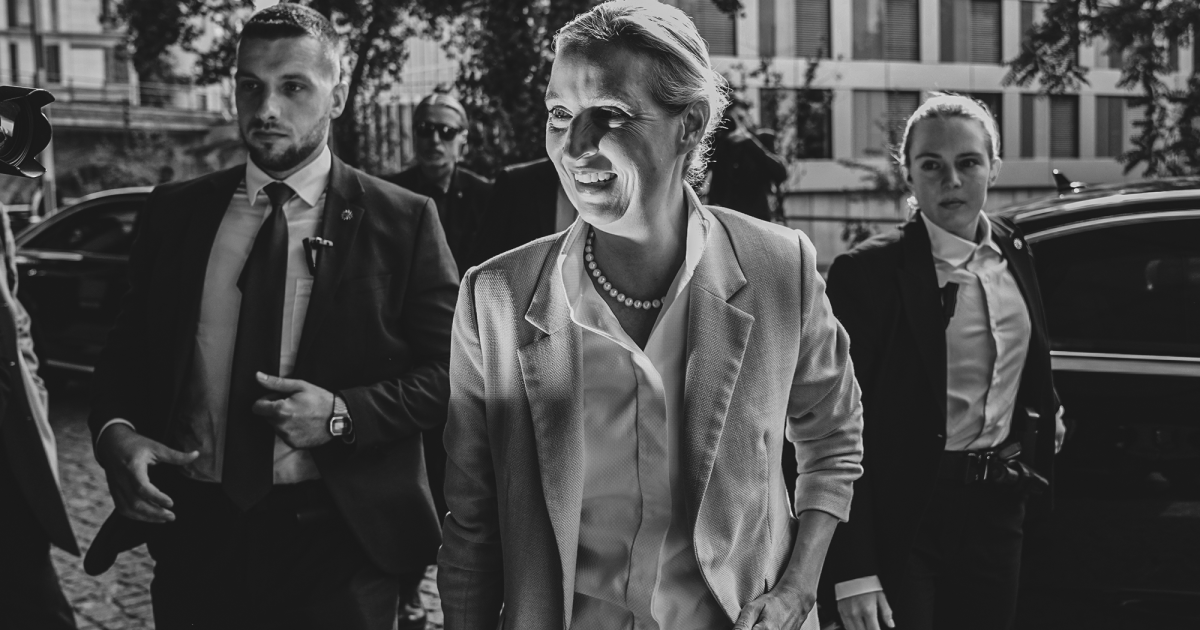
Alice Weidel, the co-leader of Germany’s AfD, denies her party is far right.Ebrahim Noroozi/AP
On Sunday, the German far-right party Alternative fur Deutschland (AfD) won a resounding—and disturbing—victory in the state of Saxony-Anhalt. While falling short of the majority it needed to control the government without other parties’ cooperation, the result is the latest sign that AfD’s ultranationalist politics are surging in parts of the country. If other states follow suit, the result could be a brewing crisis for German democracy, and a further signal that authoritarian, xenophobic politics are ascendant in Europe.
But AfD’s defenders in Germany and abroad, meanwhile, have spent the days since the election responding to a different threat: people using the term “far right” to accurately describe AfD’s policies and positions.
“AfD is not far-right,” the party’s co-chairwoman and parliamentary leader, Alice Weidel, tweeted on Tuesday, responding to a CBS News headline that used the term. AfD enthusiast Elon Musk agreed, embarking on a tweeting spree this week attempting to delegitimize the phrase, calling The Wall Street Journal “knuckleheads” for using it in reference to AfD, and opining that “legacy media” views “normalcy” as far right because they are “far left.”
“‘Far right’ is a propaganda term that became especially popular in recent years,” he tweeted on Monday night. On Tuesday morning, he accused CBS of “lying” by using the phrase. He also reposted and agreed with a tweet that claimed that “far right is just whatever was considered being normal in the early 2000s.”
Other people associated with the far right were quick to attack use of the term. Tommy Robinson, the British anti-Islam activist, quote-tweeted Weidel, adding, “Far right is codeword for ordinary decent citizens.” People in the MAGAverse also joined in: Sen. Mike Lee (R-Utah) tweeted “Leftists identify themselves in many ways, including a pattern of referring to any conservative movement, policy, or politician as ‘far right.’” And Donald Trump Jr. opined that the “far right” is now simply mainstream: “When a party wins 45% of a vote and the second place guys win 17,” he tweeted, “is the 45 really far right or are they just right?”
“The term is accurate.”
Here, somewhat despite himself, Trump Jr. was making a salient point. “Far right” is an umbrella concept used to refer to several ideas once outside the political mainstream: xenophobia, ultranationalist policies, virulently anti-immigrant sentiment, and a sympathy and support for authoritarianism. In some places, though—including the United States—policies that would once have been clearly and accurately branded as “far right” are now ascendant in mainstream politics. This isn’t a trend other countries are eager to repeat: German Chancellor Friedrich Merz warned that AfD’s support for “remigration,” a phrase and concept now championed by the U.S. government, would, if carried out in Germany, constitute a form of “ethnic cleansing.”
Aside from their politics on immigration, several AfD politicians also have ties with previous authoritarian movements. Frank Ronald-Bischoff, for instance, who will now serve as an AfD parliamentarian in Saxony-Anhalt, was, according to reporting by German news outlets, a secret officer in the Stasi, East Germany’s brutally repressive security service. AfD politician Björn Höcke has been fined twice for using a banned Nazi phrase, “Alles fur Deutschland” (everything for Germany), and has criticized Berlin’s Holocaust memorial, declaring in 2017 that Germans are “the only people in the world who planted a memorial of shame in the heart of their capital.” Dario Seifert, another AfD parliamentarian, is a former member of the youth wing of the neo-Nazi National Democratic Party of Germany, now known as Die Heimat (the Homeland). An array of AfD politicians have also made comments minimizing the crimes of the Nazis; two AfD politicians were even briefly sidelined for comments they made related to Nazism before being welcomed back into the party.
Cas Mudde, a Dutch-born political scientist, extremism expert, and research professor at the University of Georgia, told me via email that the far right objecting to the label “far right” is a long standing tactic.
“The far right has always challenged the terminology,” he wrote. In the 1980s, for instance, “several far-right parties and politicians, like Jean-Marie Le Pen and the National Front (FN), claimed to be ‘neither left, nor right.’ They have also long claimed that they are not ‘far’ right, but just ‘the voice of the people’ presenting ‘common sense’ solutions.”
In the last decades, Mudde wrote, “they have added that there is nothing ‘far’ or ‘extreme’ or ‘radical’ about their positions. There is actually something in that claim, given the radicalization of the political mainstream, particularly on the issue of immigration. The far-right’s position on immigration is indeed not that much more ‘radical’ than that of many mainstream parties, from the mainstream-right to some mainstream left (notably the Danish Social Democrats).”
Scholars, however, “don’t use the term ‘far right’ in a purely relative way,” Mudde added. “Rather, the far right stands for a core ideology of nativism and authoritarianism. Nativism is a xenophobic form of nationalism and authoritarianism emphasis the crucial importance for the state to enforce discipline and order (simply stated). In this sense, the term is accurate for the parties and politicians mentioned here.”
Sam Jackson, an associate professor at the University at Albany and an expert on right-wing extremism in the U.S., says right-wing objections to the term are animated by an element of branding and publicity management. There is, he told me, “a strategic view that if something is portrayed as the far right then most people wouldn’t agree with or would reject it.” Therefore, he added, rejecting the label “far right” is a tactic used by people who are saying, in essence, “‘I want to make it sound like my ideas are common and widespread. If I accept the framing of ‘far right’ that inherently positions me as being more marginal.’” The label carries a special stigma in Germany, where, he pointed out, “to be far right is to be associated with the Nazi regime, which is still problematic for many reasons—even if that’s starting to change.”
Jackson has seen other American political projects reject the far-right label, including “constitutional sheriffs,” who believe they hold unique authority to interpret state and federal law, and to arrest federal authorities they believe violate it. In that movement, Jackson told me, figures like Richard Mack say that they’re neither left nor right, but, as Jackson put it, “someone who loves freedom or liberty.”
“It’s an argument they make over and over again,” he added.
Some of this, Jackson says, is basic human nature: a desire to reject labels affixed by others. “We have to reduce the complexity of the world around us in order to be able to function,” he said, “and that includes collapsing people who have nuanced and complicated ideologies and identities into categories that we can make sense of. Almost all of us are quicker to object to being put into those categories ourselves than we are to object to other people being put into those categories.”
However they’d prefer to be described, the AfD already has support from the U.S. government. When the German government classified AfD as “extreme right” in 2025, Secretary of State Marco Rubio blasted the classification as “tyranny in disguise.”
The German Foreign Office had a clear reply. “This is democracy,” they responded to Rubio. “This decision is the result of a thorough & independent investigation to protect our Constitution & the rule of law. It is independent courts that will have the final say. We have learnt from our history that rightwing extremism needs to be stopped.”



