
Kent Nishimura/AFP/Getty
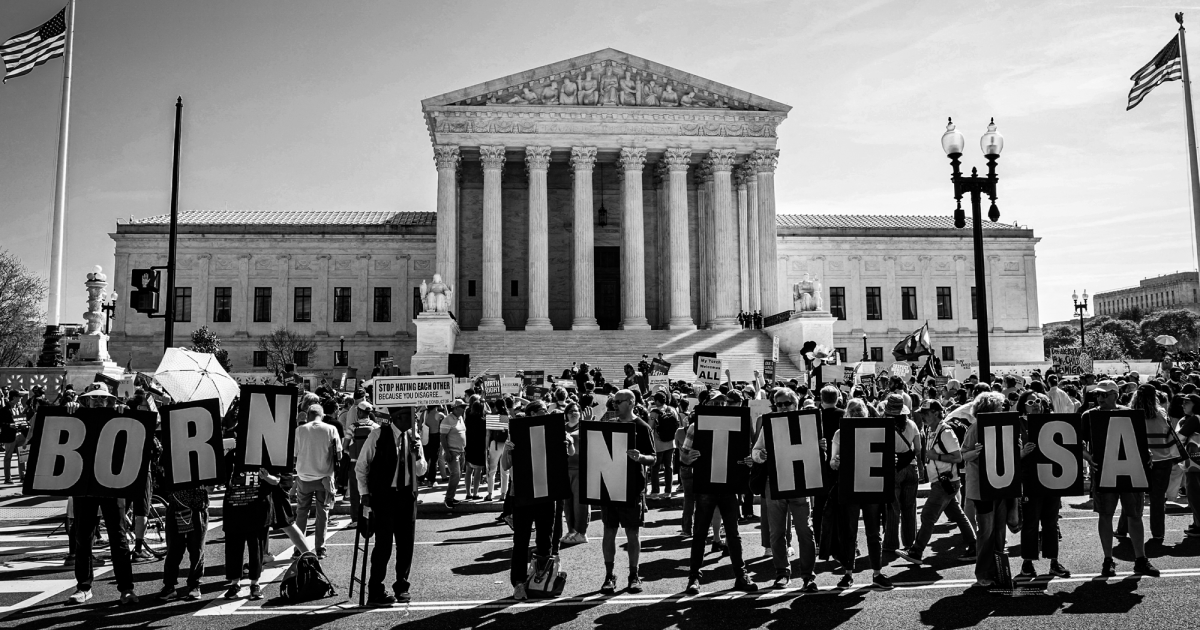
The Supreme Court affirmed on Tuesday that that birthright citizenship is the law of the land. The decision, by Chief Justice John Roberts, upholds the clear meaning of the Constitution and knocks down the Trump administration’s attempt to deny citizenship to thousands of newborns every year. It’s no exaggeration to say that the case was a test of whether this would remain a nation where everyone is born on equal legal footing, or whether the country would revert to a caste system in which one’s place in society is determined by the status of one’s parents. And the decision was scandalously close.
“Citizenship, then and now, was the right to have rights—to freely participate in our political community,” Roberts wrote in his 5-4 majority opinion. “The Framers of the Fourteenth Amendment extended that promise to ‘every free-born person in this land.’ We keep that promise today.”
But Roberts’ sweeping ruling commanded only a bare 5-4 majority on the meaning of the Constitution’s citizenship clause. Justice Brett Kavanaugh would have struck down Trump’s executive order based on Congress’ previous codification of birthright citizenship, but does not believe it is required by the Constitution. Justices Clarence Thomas, Neil Gorsuch, and Samuel Alito dissented. That math is too close for comfort.
Court-watchers generally expected an overwhelming rebuke for Trump in this case, with perhaps one or two dissenters. Instead, birthright citizenship—and with it the promise of a casteless society of equals—hangs by a thread. To be clear, if one Democratic appointee leaves the court while Trump or another Republican is president, the promise of equality for all under the law may fall.
On his first day back in the White House, President Donald Trump signed an executive order attempting to deny birthright citizenship to the children of temporary visitors and undocumented people, claiming that such a policy is the proper interpretation of the citizenship clause. But the first sentence of the 14th Amendment, added to the Constitution after the Civil War, states: “All persons born or naturalized in the United States, and subject to the jurisdiction thereof, are citizens of the United States and of the State wherein they reside.” The only exceptions, carved into the jurisdiction requirement, are the children of ambassadors, invading armies, and, at the time, American Indians under tribal authority. Today’s decision upholds this long-held understanding of the Constitution.
This isn’t the first time the court has ruled that the citizenship clause means what it says. In a landmark decision in 1898, United States v. Wong Kim Ark, the court found that birthright citizenship is the rule for virtually everyone born in the United States. Today’s court upheld all of Wong Kim Ark. “We see no reason to depart from that view today,” Roberts wrote. While the decision is a rebuke of Trump, the majority didn’t need to take this case in order to shut down Trump’s executive order—as the majority acknowledged today, it was already unconstitutional under the plain meaning of the 14th Amendment and Wong Kim Ark. Today’s ruling, Trump v. Barbara, didn’t change that. Some may nonetheless credit the court for striking down Trump’s order and point to it as evidence that the court is not overly obsequious to the president—though it has used recent terms to grant him vast new powers and reserved rebukes for rare occasions. But this case is too close to give the court any credit—instead, it portends a dark future, despite Roberts’ fulsome defense of birthright citizenship.
The very fact that the country came within one or two votes of undoing our system of birthright citizenship is a sign of how far the Trump administration has succeeded in throwing into contention the country’s most basic freedoms. The 14th Amendment’s citizenship clause was added to the Constitution after the Civil War to overturn Dred Scott, the 1857 Supreme Court decision that denied citizenship to Black people. But the amendment’s drafters went further in writing a broad rule for the ages, ensuring that no future politicians could discriminate against a disfavored minority by taking away their citizenship and consigning them to a permanent underclass. Roberts’ majority opinion affirms this: “The Fourteenth Amendment was intended to repudiate Dred Scott,” Roberts wrote. “However, the goal was even grander—to put the ‘great question of citizenship’ ‘beyond the legislative power’ altogether, to settle the issue once and for all.”
Nevertheless, the Trump administration tried to undo that final decision. If Trump had succeeded, thousands of newborns each year would grow up deprived of the social welfare benefits and opportunities afforded to citizens—a permanent, stigmatized subclass unable to escape their lack of legal status. Restrictions could have also applied retroactively, ultimately ensnaring millions.
The Trump administration’s arguments were legally absurd. Solicitor General John Sauer argued that the term “jurisdiction” implied a compact of allegiance in exchange for the government’s protection, and that this can only be achieved if the parents have permission to stay indefinitely in the country. But the allegiance-for-protection rule is nonsensical because it would have excluded the emancipated people whom the amendment was explicitly intended to grant citizenship. Moreover, the requirement of permanent residence—what Sauer termed “domicile”—would hand politicians the right to deny citizenship to classes of people because the legal definition of domicile can be changed by Congress or, possibly, the president. It’s a theory that would have essentially nullified the citizenship clause.
Birthright citizenship, and with it the idea that anyone born here has a shot at succeeding in this country, is deeply ingrained not only in American laws and institutions, but also in our national identity. The very notion of the American dream is that once here, you and especially your children can succeed. If legal status is inherited, the dream is shattered. That is the real import of the Trump administration’s attempt to restrict birthright citizenship; not just to launch a cruel and chaotic experiment in sending federal officers into maternity wards, but to rewrite the fundamental character of the country, from a society of legal equals to one of inherited caste.
The dissenters would have given Trump all or nearly all of what he wanted.
But the citizenship clause doesn’t mention parental status, it refers to “all persons born or naturalized in the United States.” By arguing that a child’s citizenship depends on the immigration status of their parents, the administration’s arguments departed from the text of the 14th Amendment and the history of its creation. “That’s part of the understanding of the birthright citizenship clause—that whatever the sins of the parents are, the clause breaks that connection,” Cristina Rodríguez, who is now dean of Yale Law School, told me last year. “What matters is where the individual was born.” Rodríguez has called the citizenship clause our “constitutional reset button,” ensuring that “each generation starts fresh, and we don’t worry about status because of what’s in our past.”
In a concurrence that spotlights the role Black people played in shaping the 14th Amendment, Justice Ketanji Brown Jackson hammers this point. “The Reconstruction Amendments were an anticaste, antisubordination reset for the Nation,” she wrote, “not a mere spot treatment for the dark stain of slavery.”
To bolster his weak arguments about the past, Sauer also relied on the assertion that the government needs power to restrict birthright citizenship for national security concerns. “We’re in a new world now, where eight billion people are one plane ride away from having a child who is a US citizen,” he told the justices at oral arguments. Chief Justice John Roberts responded with a zinger that signaled that the court wasn’t buying it: “Well, it’s a new world. It’s the same Constitution.”
Kavanaugh, however, bought Sauer’s contention that the 14th Amendment didn’t constrain the political branches from responding to modern-day immigration challenges by exempting the children of undocumented immigrants or temporary visitors.
Three dissents presented fractured ideas about why some or all of Trump’s executive order is legal. Thomas, Gorsuch, and Alito all believe that the 14th Amendment does not give citizenship to the children of temporary visitors, which would include people who have lived in the US for years as, for example, students, doctors, or professors. Alito and Kavanaugh think Trump can likewise bar the children of undocumented immigrants from birthright citizenship. Thomas and Gorsuch reserved judgment on the status of an undefined group of undocumented immigrants who have been in the country of a long time—though they don’t specify how much time. Taken together, the dissenters would have given Trump all or nearly all of what he wanted.
Thomas, in a long dissent joined by Gorsuch, launches into an alternative history of citizenship since the founding. Whereas the majority recognizes that the framers of the 14th Amendment were incorporating the long-tradition of citizenship by place of birth, jus soli, imported from British common law, Thomas argued that the Americans never adopted what he derisively referred to as a “feudal” principle. Instead, he argued that the US only gave citizenship to the children of people “domiciled” in the country. To Thomas, the 14th Amendment applied only to the freed people after the Civil War because they were domiciled in the US and owed no allegiance to a foreign power—interpreting the rule as limited to one period and one population. “The Court adds to the sad history of the Fourteenth Amendment, which was designed and understood to secure equal rights for the freed blacks but has instead been repurposed for political projects that the Reconstruction Congress did not support,” he wrote.
Thomas’ dissent is littered with references to bunk scholarship hastily put forward over the last year by a small band of radical scholars who tried to give academic cover to the executive order. As my colleague Isabela Dias and I have detailed, they spent the past year attempting to muddy the historical record. Despite their tortured arguments, they helped move the Overton window, as one Trumpian scholar boasted after oral arguments, and Thomas approvingly cited two of those professors’ work.
Perhaps Alito’s solo dissent is the most shocking, not only how far it would go in undoing our system of citizenship but also for the racial animus that jumps out of the language. Alito argues that “subject to the jurisdiction” excludes anyone subject to another power, and thus excludes children who would also be afforded citizenship in the home country of their parents. He names some of those countries, including Mexico, El Salvador, and Guatemala. Alito despairs at the “problem” of undocumented immigration, describes American citizenship as “precious,” states that the current rule “degrade the concept of United States citizenship,” and frets that today’s ruling invites more undocumented immigration. In upholding birthright citizenship, Alito warns that his colleagues have “made a mistake that will seriously affect the country’s future.” It does not take much parsing to see the racial anxiety animating Alito’s dissent.
The 14th Amendment is the cornerstone of our democracy. It was supposed to provide equality under the law, to ensure rights to all, and to preserve those rights through a casteless system of birthright citizenship. Not long after ratification, however, the Supreme Court began chipping away at the meaning and enforceability of the amendment. The Roberts Court has picked up where its predecessors in the 19th century began, from rolling back programs and laws aimed at racial equality to allowing insurrectionists to run for office. On Tuesday, the court held back from dismantling the fundamental right to birthright citizenship, but with a slim majority that makes the reprieve not just a relief, but a warning.



