
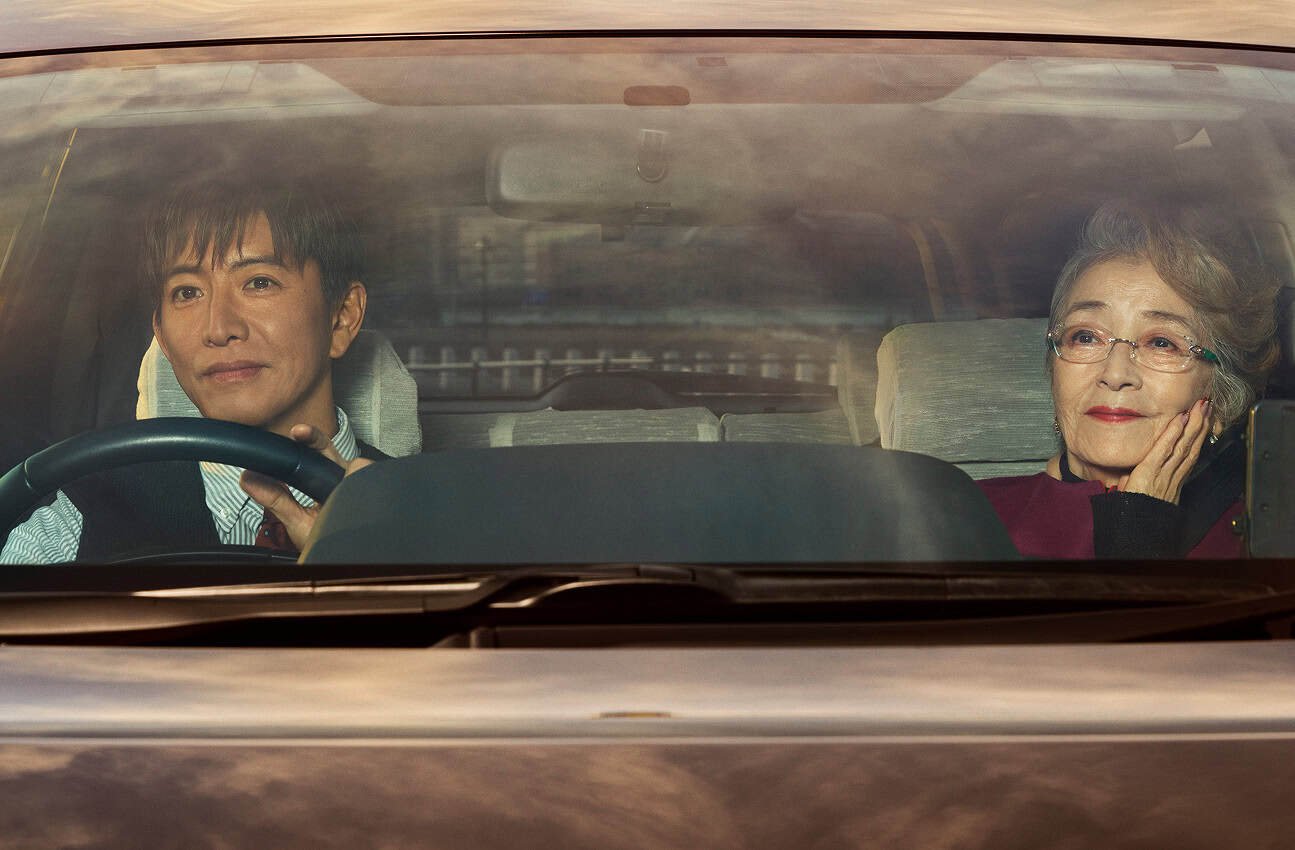
Yoji Yamada’s newest film, “Tokyo Taxi,” reimagines Christian Carion’s French-Belgian feature “Driving Madeleine” for Japanese audiences, telling a story that bridges two generations. Much like the original, it balances harshness and coziness as an unlikely bond forms during an otherwise mundane journey of a taxi driver transporting a passenger to their destination. As a remake, it offers a fresh interpretation of the original while securing its own unique place in Yamada’s decades-long career.
Koji Usami, a cab driver, struggles to make ends meet while supporting his family. One day, after working the night shift, he is called in to cover for a colleague. He arrives in Shibamata to pick up Takano Sumire, an older woman bound for a nursing home in Hayama, Kanagawa. Along the way, the two converse and get to know each other as Sumire requests a detour through parts of Tokyo and Yokohama, reminiscing about her past as she nears the end of her life while bonding with someone from the generation that followed her own.
The story of the original remains largely intact here but is reinterpreted through a Japanese cultural lens and Yamada’s directorial style, including his signature blend of humor and drama. As a result, “Tokyo Taxi” is sentimental but without feeling manipulative in its storytelling, and the dramatic moments feel genuinely earned. There is an emotional authenticity to the bond that forms between our leads, even in how their dialogue unfolds as they converse and reveal themselves to each other. This particularly applies to Sumire, who emerges as the heart of the film. She knows her time left to live is limited and chooses to make the most of the journey while cherishing the meaningful connection she forms with Koji.
The generational perspectives of our protagonists offer valuable insight into their distinctive personalities and shared vulnerability. Sumire represents Japan’s older generation, having lived through the prewar and postwar eras. A series of flashbacks highlights her loss, resilience, and bravery in an age defined by survival and navigating a patriarchal society, making her a feminist figure. From her first love with a Zainichi Korean resident named Kim Young-gi to raising her son as a single mother, enduring her abusive husband, Takeshi Ogawa, and surviving the trauma of the 1945 Tokyo firebombings, her life has been marked by brutal hardships and quiet perseverance.
Conversely, Koji belongs to Japan’s modern working class but is struggling to make ends meet for his family while also facing pressure to fulfill traditional expectations as a father. Adding to his work-related exhaustion is anxiety about his daughter’s acceptance to a prestigious but expensive music school, prompting him to turn to his sister for financial support. Ultimately, as the two leads confide in each other, it helps them both feel heard and heal from the psychological burdens they have carried for a long time.
Yamada’s longtime collaborator, Chieko Baisho, delivers an impressive performance as Sumire, balancing assertiveness with warmth, making her a rather enjoyable presence. Yu Aoi, who plays her younger counterpart, is also great and convincingly sells that they’re the same character. As Koji, Takuya Kimura is more restrained but gradually lets his guard down, allowing his emotions to surface. Together, Baisho and Kimura have deeply human chemistry.
Masashi Chikamori’s cinematography is visually pleasing while effectively distinguishing shifts between past and present, particularly through lighting and color palettes. The flashbacks, shot on sets, are rendered in warm, desaturated tones that evoke nostalgia while conveying the emotional complexity these memories hold for Sumire. In contrast, the present-day Tokyo sequences, shot on location, feature richer, more natural colors that reflect the city’s transformation and where memories are preserved for decades. Taisei Iwasaki’s music score is fittingly pleasant but also more melancholic when it needs to be.
“Tokyo Taxi” is a bittersweet but very heartwarming film about memory that highlights the beauty of human connection. Besides demonstrating how Yoji Yamada continues to impress artistically, it reminds us that life, despite its hardships, is worth celebrating.



