
Moneywise and Yahoo Finance LLC may earn commission or revenue through links in the content below.
American workers are getting a smaller slice of the economic pie — and some people blame it on a decision made more than 50 years ago.
A Kobeissi Letter chart (1) based on Federal Reserve Bank (FRED) data (2) has been making the rounds online (3). It shows wages and salaries at roughly 43% of U.S. gross domestic income in the first quarter of 2026. Taken from a government data series going back to 1929, that share is nearly the lowest since the Great Depression began.
Must Read
But it doesn’t mean Americans suddenly took a 57% pay cut. The figure only counts wages and salaries. It leaves out benefits that employers pay for workers, such as health insurance and retirement plans.
Americans are still getting raises, too. The latest Employment Cost Index (4) from the U.S. Bureau of Labor Statistics (BLS) found wages and salaries rose 3.2% over the 12 months leading up to June 2026.
However, when you zoom out, there remains a problem. Workers are producing much more than they did decades ago — but their pay hasn’t kept up, to say the least.
So, what happened?
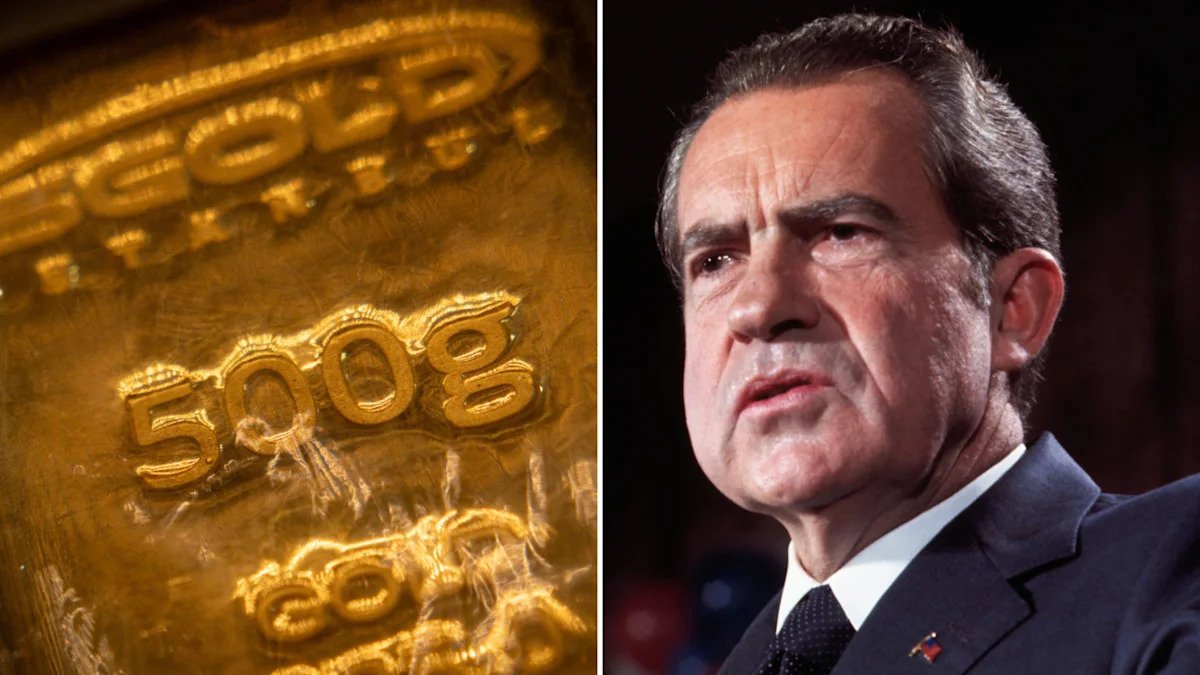
One popular theory points to a decision made on Aug. 15, 1971 — the day when President Richard Nixon cut the U.S. dollar’s last tie to gold.
Cutting all ties to gold
For years, the U.S. dollar had a link to gold through the Bretton Woods system (5), which was established at the tail-end of World War II to regulate the global monetary system with a series of new rules and institutions, including the creation of the International Monetary Fund (IMF).
Among other things, it required foreign governments and central banks to guarantee the convertibility of their currencies into U.S. dollars, which could then be traded for gold bullion at a fixed price of $35 an ounce.
By the late 1960s, though, that system was under pressure. There were more dollars held overseas than the U.S. had gold to back them. Inflation was also rising.
Then, on Aug. 15, 1971, Nixon stopped allowing dollars to be converted into gold (6), helping bring the Bretton Woods system to an end.
Source: finance.yahoo.com



