
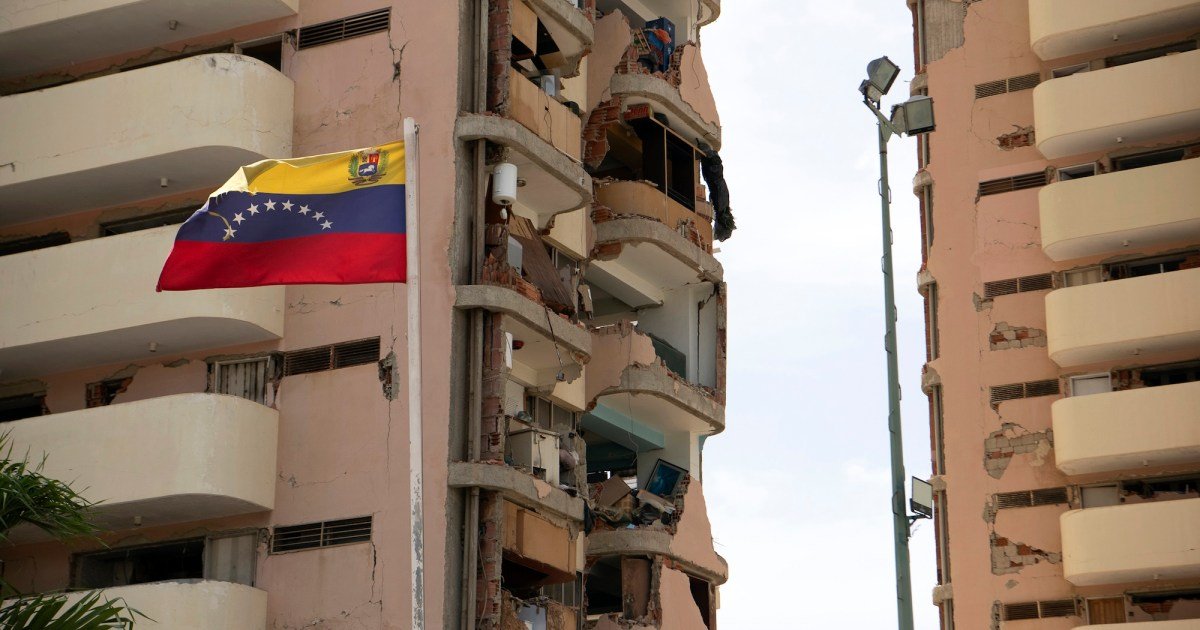
Buildings in Catia La Mar, La Guaira, Venezuela on Thursday June 25, 2026. Los Angeles Times/Getty
It’s been a very long week for Beatriz Armada, the Venezuela operations manager for the humanitarian nonprofit Humanity and Inclusion. Hers is just one of many non-governmental organizations that have been responding to the devastation of two massive earthquakes that struck Venezuela last week, which have left, by a conservative estimate, some 1,700 people dead and thousands injured, with more than 15,000 displaced from their homes.
Many survivors who were pulled from the rubble needed amputations, Armada told me, a further challenge for Venezuela’s health care system—and health care workers in Caracas were affected as well, making it “very complicated to be able to give medical attention,” she said.
Armada told me that around 38 structures related to health care infrastructure had been decimated by the earthquakes, including one that specifically provided help for disabled people, who are disproportionately impacted by earthquakes.
“There was nothing left of the entire building, and so many people with disabilities who lost their lives in this, in this particular space,” Armada said.
One disabled man and his family that Armada spoke to lost everything in their home, including hard-to-replace equipment “that he would normally need to be able to have dignity.”
“We’re mobilizing resources to be able to more directly support people with disabilities,” Armada said, including with mobility devices and rehabilitation, “which is also quite a main need at the moment.”
Armada says she’s heartened by the responses of people across other parts of Venezuela, where people are also being transferred for medical care, and by international support. She hopes it doesn’t end prematurely.
“We need this [support] to continue in the upcoming months, because I think it’s going to take months, or even years, to be able to fully recuperate from,” Armada told me.



