
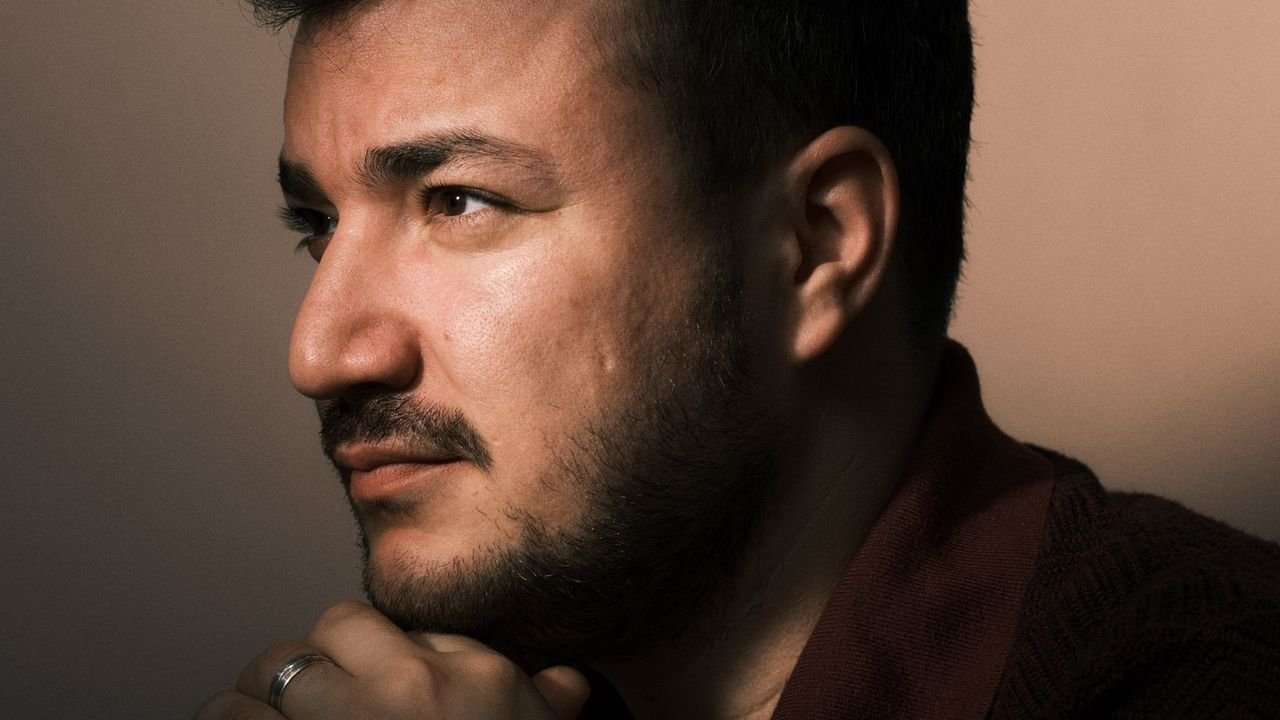
On top of a low-lying bookshelf were art works that fans had sent him, including a hand-painted piece reading “Free Mahmoud Khalil.” (“We usually keep this one more hidden,” he said, placing it behind a ceramic cup that the artist Nan Goldin had given him.) He sat with Deen on the living-room floor, and Abdalla served grapes—whole for the adults, mashed for the baby. Khalil was writing a memoir, drawing in part on the diaries he’d kept during his time in ICE detention; he handed me a box of the diaries and let me flip through them. “There’s noise around me like a school cafeteria—Spanish, Hindi, broken English,” he’d written in one entry. In another, the phrase “kangaroo court” was scrawled in English and Arabic.
Khalil is unfailingly polite, in a way that can come across as mannered, almost aloof. He has his master’s degree from Columbia, but not a full-time job. “I spend time with my baby, and on calls with my lawyers,” he said—it felt like a setup for a Borscht Belt joke for which he couldn’t quite find the punch line. He also speaks publicly (on Twitch streams, onstage at South by Southwest), exhibiting what a politician might call consistent message discipline. And yet disciplined messengers do not always make for the most entertaining content. One afternoon, Khalil took a car to a small studio in the Flatiron district to tape an episode of “The Adam Friedland Show,” an interview program that combines earnest leftism and absurdist cringe comedy. With Khalil, Friedland struggled to find a comedic angle. Before they started rolling, Khalil walked in with a “posse” of legal advisers, and Friedland deadpanned, “You’ve got more reps than Justin Bieber.” Crickets. “This is gonna be our funniest episode ever.”
When Khalil was a child, his paternal grandmother often told him the story of how, in 1948, she’d been forced out of Tiberias, in contemporary Israel, and had to walk forty miles to Syria. (On the way, she gave birth to Khalil’s father in a tent.) Khalil’s school, run by the U.N., was in the second-biggest Palestinian refugee camp in Damascus. He was bright and curious, but there weren’t many books at home. His father, a welder, left school after sixth grade; his mother, a civil servant, didn’t finish high school. “I had one uncle who was a poet, and he used to make me type up his poems,” Khalil told me. “That, more than school, was how I really learned to read and write.”
He turned sixteen in 2011, the year of the Arab Spring. Of all the despots in the region, the Syrian dictator Bashar al-Assad was perhaps the most ruthless in crushing dissent. One day, Khalil’s aunt was working at a nonprofit; the next, the office was raided and his aunt was sent to prison without explanation. Khalil and a few of his bravest friends engaged in small acts of resistance—spray-painting a pro-democracy slogan on a wall, saving a protest song on a burner phone—but they all understood the danger. “If the police catch you, you will be tortured or killed,” Khalil said. “We all had our contingency plans: ‘If they take me, run to my house and bury my computer in the yard.’ ”
A week after Khalil’s eighteenth birthday, he heard that two of his friends, Ali and Bashar, had been arrested. “I thought, If they came for them, they will be coming for me next,” he told me. He fled to Lebanon with twenty-five Syrian pounds—less than fifty cents—and ended up staying in Beirut for a decade. He taught himself French and English; he got a job with an aid organization, and then with the British Embassy. In 2016, he met a Syrian American college student—Abdalla—who was spending the summer volunteering in Beirut. After she returned to Michigan, he got a Canadian visa, and they met in Windsor, Ontario, on the banks of the Detroit River, where they sat in a Tim Hortons for hours. Abdalla, who was about to graduate from the University of Michigan-Flint, had been selected to be her class’s commencement speaker, and they edited a draft of her speech together. “We are all so privileged to be living in a country such as this one,” it read. “I’m safe to converse with my professors and have passionate talks . . . and I’m safe to dream big.” Khalil became a Columbia student in 2023. Soon afterward, they drove to a courthouse in the Bronx, where they were married. A year later, Khalil got his green card.



