
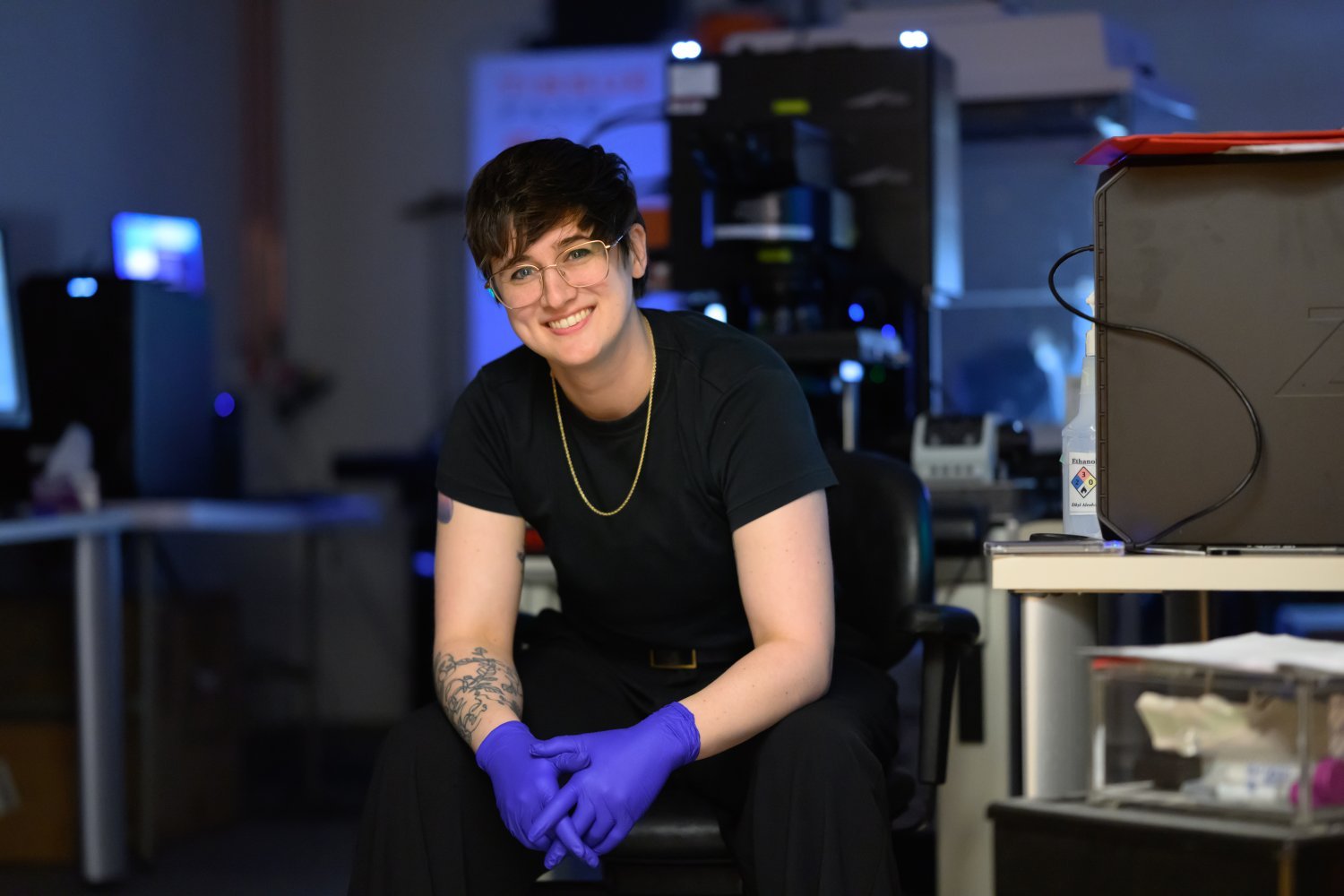
Researching gene therapies
Knight’s interest in the brain flourished as a neuroscience major at Bowdoin College, working with Professor Hadley Horch. While she had originally planned to be pre-med, Knight ultimately decided that it wasn’t the best fit. She enjoyed the research she did as part of her honors thesis, exploring the regeneration of neurons in the auditory system of crickets, and decided that she wanted to pursue more research in molecular neuroscience, as well as genetics.
After graduating, Knight worked at the Perrimon Lab at Harvard University, where she first learned about CRISPR, applying it in a fruit fly model. She worked for two years in the lab, co-authoring a few papers and applying to graduate schools.
She ultimately landed in the lab of MIT Professor Guoping Feng, studying the potential of utilizing CRISPR to develop a gene therapy treatment for Phelan-McDermid Syndrome, a rare genetic disorder caused by a deletion or mutation on the 22nd chromosome.
“Many of our graduate students are passionate about making a positive impact to society through cutting-edge research, and Shannon is a perfect example,” says Feng, the James W. and Patricia T. Poitras Professor and associate director at the McGovern Institute. “She is developing gene therapy technologies that have the potential to help many kids with devastating neurodevelopmental disorders.”
Building off of the gene therapy research around Phelan-McDermid syndrome, which is now in clinical trials in patients, Knight is now in the early phases of testing gene therapy for SYNGAP1 disorder. The goal is to go through the same process for the SYNGAP1 gene therapy as for the Phelan-McDermid gene therapy — eventually obtaining U.S. Food and Drug Administration approval and beginning clinical trials.
The testing of the gene therapy on mice with a version of SYNGAP1 disorder has alleviated seizures and all of the behavioral phenotypes. This promising work is being accelerated by the Rare Brain Disorders Nexus, an MIT initiative that launched in the fall of 2025.
“Something I think about a lot is the idea of who ‘deserves’ the attention of a gene therapy. I feel that, regardless of how rare a genetic disorder might be, it still deserves care,” says Knight. “SYNGAP1 disorder is extremely rare, only impacting one to four out of every 10,000 children. I am very fortunate to be at an institution like MIT that has so many labs and brilliant researchers working on diseases that impact large portions of society, and it was really important to me to spend my PhD years helping a small, often unseen population. Although I don’t actually have a relationship with someone who has SYNGAP1 disorder, I know so many people who feel invisible in systems, and it is really important to me to be able to focus on people who feel unseen and give them hope.”



