

(Image credit: Getty Images)
If you notice you home’s energy bills have crept up you’re not alone. Electric bills have risen significantly in recent years, with some estimates showing increases of around 30% over the past five years.
With more data center construction, harsher weather, and the Iran war increasing gas prices, it’s a recipe for higher electric bills heading into the summer. But these factors alone are not the only reasons your bills are rising.
There’s a hidden factor that could add another $1,000 to your yearly costs. I’ll explain what it is, how to spot it, and how to fix it.
Article continues below
Sign up for Kiplinger’s Free Newsletters
Profit and prosper with the best of expert advice on investing, taxes, retirement, personal finance and more – straight to your e-mail.
Profit and prosper with the best of expert advice – straight to your e-mail.
A lesser known culprit increasing energy costs
The hidden culprit spiking your energy costs and shortening the lifespan of appliances could be dirty electricity. So, what is it?
“Dirty power shows up as voltage spikes, sags and harmonic distortion running through the wiring of your home,” remarks Daniel Vasilevyski, owner and director of Pro Electrical. Symptoms of this include unusual variances in your electric bill, a loud humming coming from your appliances and devices, and devices shorting out well before they should.
What causes dirty power?
Modern electronics are a major contributor. Many devices convert AC power to DC using switching power supplies, which can introduce high-frequency electrical noise into your home’s wiring.
In some cases, issues can also stem from outside the home. Problems with your utility’s infrastructure, such as poor grounding or aging equipment, may contribute to voltage irregularities. Improperly installed equipment, including smart meters, can occasionally add electrical noise as well.
Even everyday appliances, especially those with motors or variable-speed components, can create harmonic distortion over time.
“Think of harmonic distortion this way: the louder the volume is on your stereo, the more distorted the sound becomes. The same applies to power.” Bob Marshall, CEO and co-founder of Whisker Labs, told Kiplinger. “When your home has dirty power, your appliance motors vibrate instead of running smoothly.”
When a home has a total harmonic distortion of greater than 6% to 8%, it can affect anything plugged in, causing it to overheat and possibly fail prematurely. “Homes with this distortion or higher can pay more than $1,000 extra in electric bills each year,” remarks Marshall. “It could also shorten the operating life of your HVAC, which could lead to future costlier replacements you’ll have to make more often.”
Cities where dirty energy hit the hardest
(Image credit: Whisker Labs)
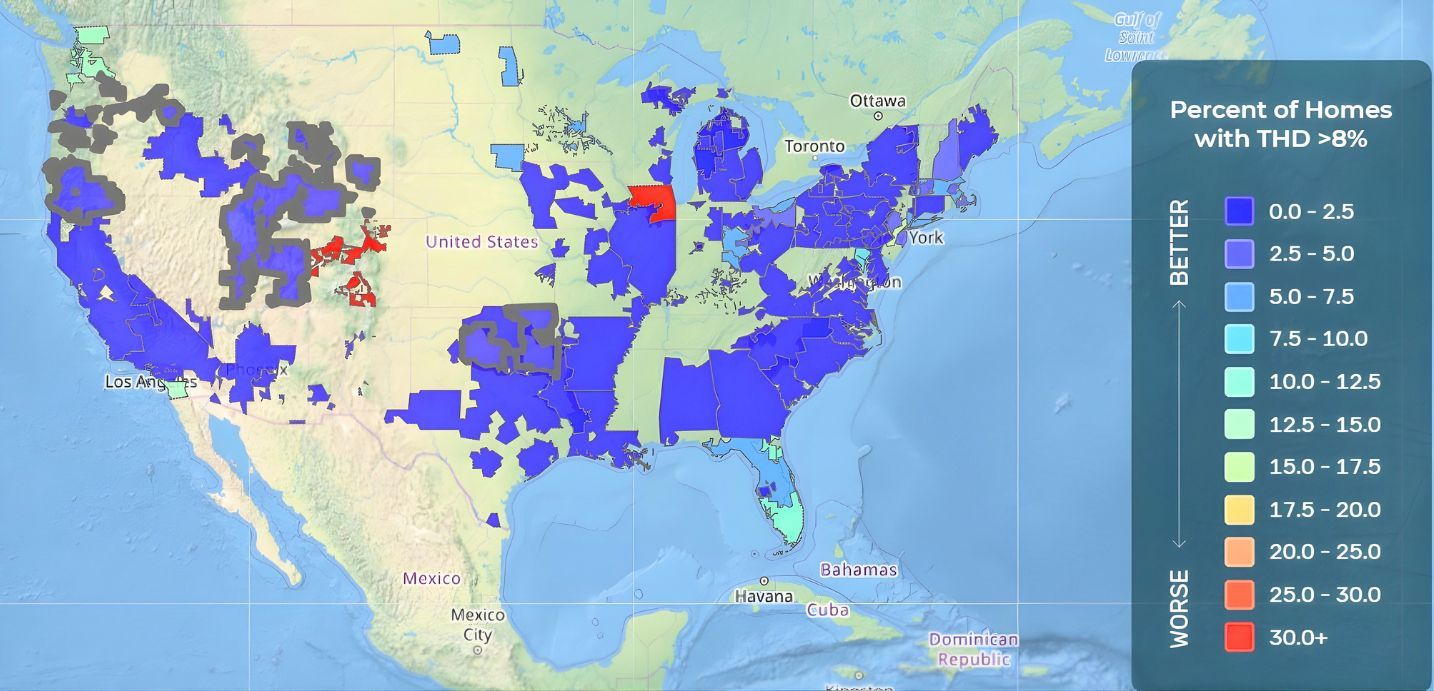
Whisker Labs uses data from its 1.2 million nationwide Ting sensors to monitor total harmonic distortions across the country.
This information allows them to identify and map the areas with the highest levels of total harmonic distortion, indicated in red sections. Here are the locations most affected by this distortion:
Utility | Percentage of homes with THD > 8% |
|---|---|
COMMONWEALTH EDISON CO | 41.50% |
PUBLIC SERVICE CO OF COLORADO | 31.50% |
PUBLIC SERVICE ELEC & GAS CO | 15.10% |
PUGET SOUND ENERGY INC | 13.50% |
SAN DIEGO GAS & ELECTRIC CO | 12.50% |
FLORIDA POWER & LIGHT CO | 10.30% |
BALTIMORE GAS & ELECTRIC CO | 9.80% |
ATLANTIC CITY ELECTRIC CO | 9.70% |
NATIONAL AVERAGE | 4.30% |
As you can see, the cities hardest hit have older energy infrastructures. “We found over 40% of the homes in Chicago have high total harmonic distortion for six months of the year, ” Marshall notes. “And it costs billions of dollars nationwide, impacting homeowners, businesses and utilities alike.” That’s why it’s imperative to determine the quality of your electricity, or you could be losing money every month.
How to determine if your electricity is clean
If you notice some of your appliances humming or failing well before they should, have your home’s electricity checked. There are a few ways of doing this:
- Contact your utility company: Utilities companies will test your home’s power to ensure the problem doesn’t reside on their end, because if it does, it’s costing them money too. They could place a voltage recorder on your electric meter for a few months. If they find issues, then it’s a problem they might have to fix, especially if the issue originates with loose wiring in the transformer or other issues.
- Install a smart sensor: Sensors like Ting detect abnormalities in your home’s electricity with 30 million measurements per second. It can alert you to unseen issues, such as faulty wiring or device failures.
Fixes that will lower your energy costs
(Image credit: Getty Images)
If you use a smart sensor and it detects problems, you should contact your utility. From there, they can determine the source of the problem.
If it’s on your end, you’ll need to enlist the help of an electrician. A common fix for this problem is “Installing whole-home surge protection rated at about 40,000 amps intercepts voltage spikes before they reach your electronics,” Vasilevski says. This could run you between $70 to $700 per Angi.
“In addition to that, having sensitive things such as computers and home theater systems in dedicated 20-amp circuits eliminates most of the interference from other appliances.” Dedicated circuits can be a more expensive fix. Angi states you’ll spend between $570 to $1,000.
Taking these steps can ensure your home uses clean electricity. Not only will it lead to lower bills at a time when many homeowners need relief, but you’ll also gain more savings by keeping your appliances running longer.



