
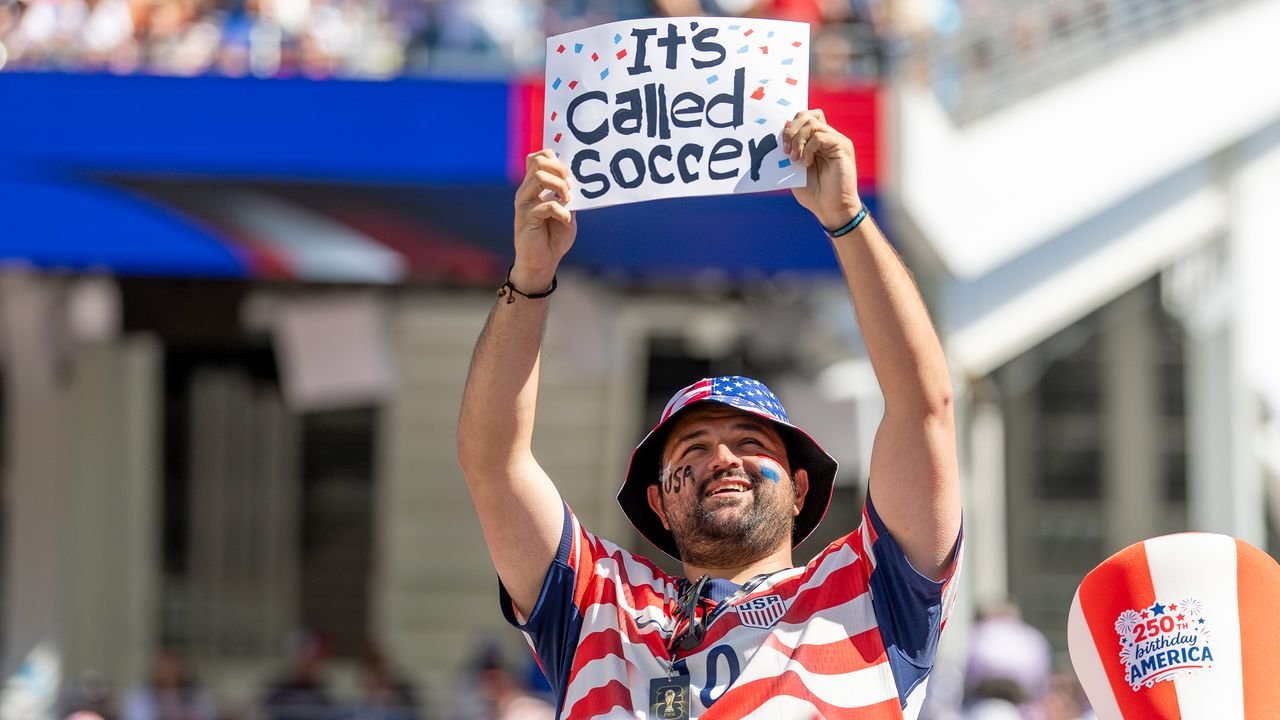
The World Cup doubles as a beauty pageant for each country’s fans, who strut around, sing their anthems, and try their best to look hot, happy, and, above all, passionate. Regional—and, if we’re being honest, racial—categories play into how these contestants are judged: the Brits and the Scots will be drunken, weepy singers; the Ivorians, the Ghanaians, and the Congolese will wear bright colors and dance in the stands; the Koreans will drink, rage, and try to overthrow the government when their team inevitably loses; the Dutch will light flares and do their cute little hoppy dance. All of them, of course, are doing a crude sort of propaganda for their respective countries, or, more generously, acting as a travelling tourism board. Come to England if you want to drink and sing. Come to Korea if you want to drink and get mad. Come to the Netherlands if you want to drink and hop.
Now that America’s run in the tournament has come to an end, thanks to last night’s dispiriting and arguably karmic 4–1 loss to Belgium, it’s worth asking how they did in the World Cup’s secondary contest. First, the bad news: Any hope of an apolitical, or, at least, only mildly political, World Cup was lost when President Donald Trump announced that he had pushed FIFA to review the mandatory one-game suspension of our striker, Folarin Balogun, a birthright citizen whose parents are from Nigeria and raised their son in England. (Trump also said that he had nothing to do with the decision.) The resulting scandal, which feels like a matryoshka doll of comical corruption, has probably ended any hopes that we might win over hearts and minds with our aggressive, positive, if sometimes naïve style of play—but nothing is forever when it comes to world soccer, and especially when it comes to a little bit of self-serving rule-bending. Such shenanigans are more or less expected, and certainly haven’t forever sullied the American soccer fan base, at least here at home. The scandal has, however, reinforced the abiding dynamic of men’s soccer in this country: We are underdogs whom nobody pities. When we win, the world rolls its eyes and says something dismissive and condescending. When we lose, as we did last night, the world laughs in our face.
The good news is that America, as a nation, is quite good at building traditions in defiance of the rest of the world. Last Wednesday, I drove with a few friends and three fourth graders down to what’s known for the moment as the San Francisco Bay Area Stadium, to see the United States play their round-of-thirty-two knockout game against Bosnia and Herzegovina. Jubilant, urban scenes such as those in Mexico City which have been circulating online for the past two weeks were nowhere to be found, for the simple reason that the game wasn’t being played in the middle of a city but in what amounts to a nice office park. Levi’s Stadium—as it’s known when it’s not being commandeered by FIFA and its blanket ban on brands that aren’t official sponsors—is surrounded by well-paved but sterile streets that were filled with people wearing the same red-and-white-striped U.S. jersey as us, which, as many passersby noted, made us all look like we were in a “Where’s Waldo?” book in which everyone is Waldo. The mood was excited but a bit anxious. Some people tried starting up “U.S.A.! U.S.A.!” chants but were generally met with smiles rather than more chanting. The most aggressive people on the walk were the various religious groups—Scientologists, Christians—handing out literature, including a million-dollar bill that promised the path to heaven.



