
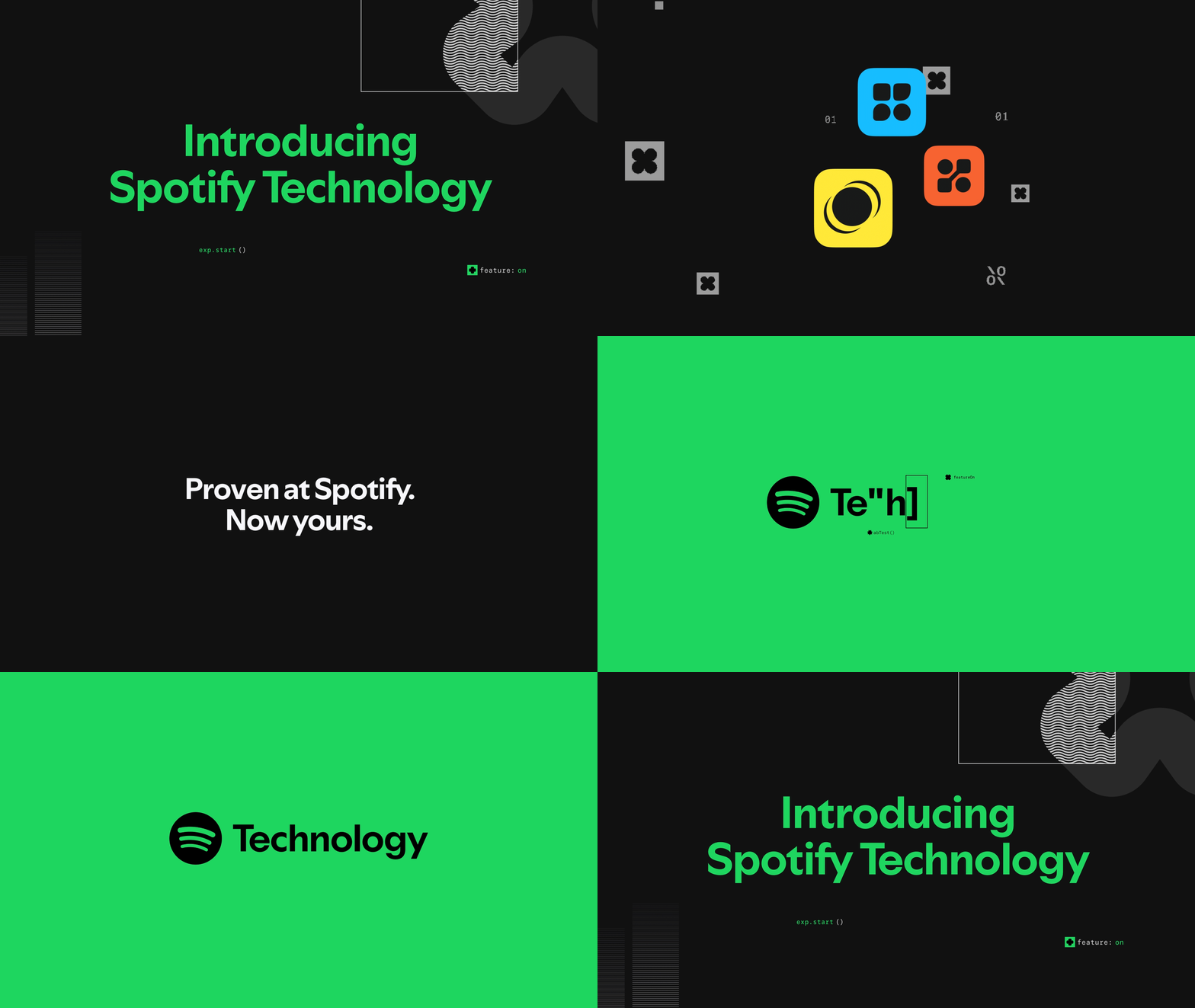
Today Spotify is introducing Spotify Technology – a home for everything we’ve built to help R&D organizations build, ship, and learn, faster. Portal. Confidence. Xirp. Spotify for Backstage. They were always designed to work as a system. Now they live under one roof, and we have more to share.
Born out of necessity
I get asked a version of this question every day: why is Spotify in the business of selling software?
The truth is, the Spotify you know and love is more than a great streaming service. Behind our consumer app are hundreds of cross-functional squads shipping products and code day in, day out.
These squads build across music, podcasts, and books on a platform woven into the daily lives of 777 million monthly active users around the world, and at a scale and speed that demands best-in-class engineering and tools. To ensure we had the best software for the job, we built it ourselves – and now we’re making it available to others.
This idea isn’t really new to us. We open sourced Backstage in 2020. Companies have been buying Confidence since 2023, Portal by Spotify since 2024, and Xirp launched earlier this year. What’s new is the identity. Spotify Technology brings these tools and future products under one brand because they work best as one system, and because we’re doubling down on this rather than dabbling in it.
And it goes well beyond developer tooling. Spotify Technology covers the full product development lifecycle, from idea to impact. Alongside it sits the media technology we’ve built for our own needs. And, at our scale, all of it has to run cost-effectively, which is an engineering discipline in its own right.
How we build
The core DNA of The Spotify Way still holds: teams decide what to build, how to build it, and how to work together, and that sense of ownership runs through every level of the company, leadership included.
But as we scaled, we learned firsthand that autonomy alone leads to fragmentation. So a few years ago, we pulled hard in the other direction with “One Experience,” a push for one unified product rather than a federation of separately good ones. Neither extreme works on its own.
Autonomy and alignment have to hold at the same time. In practice, that means teams keep real ownership of their work, while a shared ecosystem ensures their individual choices still fit together into one product and one technology stack. Tooling that can strike that balance is rare, which is a large part of why we built our own.
Every product under Spotify Technology follows the same path. A real problem surfaces, we build something to solve it, and we prove it at scale with our own backend engineers, data scientists, ML engineers, product managers, and designers, who are very technical, very particular, and quick to tell us when something isn’t working. Then we share it, either as open source or as a commercial product.
That cycle only works because we let it take time. Good tools don’t fall out of pressure automatically; they come from years of building, watching things break in ways we didn’t predict, and rebuilding until they hold up.
What we believe
Three principles run through the identity of Spotify Technology.
We do the hard work so you don’t have to. We’ve spent years solving the infrastructure, tooling and operational challenges that come with building at Spotify’s scale. That’s an effort our customers don’t have to repeat.
Proven at Spotify, first. Every product we sell runs on real production workloads inside Spotify, every day. We pressure-test it at our scale and keep improving it until it earns the trust of our own teams. Then, and only then, does it reach yours.
Our tools earn their place. Spotify teams choose their own tools. They can build their own or buy from anyone. Everything in Spotify Technology won out over the alternatives and proved itself in front of the toughest critics we know: our own engineers, shipping to hundreds of millions of listeners.
The system in practice
So what does an R&D organization look like when it’s running on Spotify Technology products?
It starts with the product development lifecycle. Specifically, closing the loop on it. Building and shipping is just one element of this lifecycle. The real value lies in the full circle from discovering what to build, to building and shipping it, measuring whether it worked, and deciding what to build next.
Portal by Spotify provides the context layer. It encodes what your organization knows – your architecture, your standards and your systems – so that every person and agent builds with that knowledge.
Xirp brings that context into agentic development, so teams can work across multiple coding agents without losing state or building in silos.
Confidence closes the loop, turning experimentation into a product intelligence layer where every decision about what to build next is informed by evidence.
The connection is structural. The products share one context layer and one agent runtime, so they compound rather than just coexist.
You start wherever you need to, whether you’re one engineer, one team, or a whole R&D organization. The pieces are designed to connect, and every cycle makes the system smarter. It’s one unified system of modular products covering the full product development lifecycle, rather than a monolith that locks you in or a patchwork you stitch together yourself.
The shift
Here’s what’s changed. Across the industry, AI has made building faster than ever. But faster doesn’t mean simpler. The complexity, the cost, and the operational surface area all grow with it.
More output means more software to secure and operate. More creation means more risks of fragmentation in how things get built and more data sprawl across models, pipelines, and artifacts that nobody has a full picture of. More usage means budgets that risk growing faster than anyone planned for. And speed makes it harder to tell whether any of it worked. Teams ship more and measure less, and end up with a growing pile of software that nobody can say is earning its keep. Shipping faster only helps if you can still tell the difference between what’s working and what isn’t.
There’s a deeper shift happening underneath the speed. When execution gets cheap, judgment becomes the constraint. Deciding what to build matters more than ever when anything can be built. And AI makes forgetting expensive. Without shared memory, teams and agents re-learn what the organization already knows, rebuild what’s already been built, and retest ideas that have already been tested, now at machine speed.
These are problems we’ve been navigating for years. AI has compounded them for us, just like it has or will for everyone else. But the tooling we’ve built along the way, systems that help learning persist and compound, is what’s allowed us to stay ahead. This isn’t a framework we came up with. It’s what we do every day.
What’s next
With the rapid rate of innovation, it’s hard to tell what engineering organizations will look like in the future. We’re betting that software product development will still require the same base ingredients, regardless of whether a human or an agent does the work. And, that the organizations with their context organized and accessible will be the ones that benefit most from whatever new capabilities come next.
We’re making the connections between our products deeper and more seamless, and investing in agent-readiness across everything we build.
On a longer horizon, we’re building toward something bigger. Spotify Technology is becoming the R&D operating system. Not in the sense of controlling everything your teams do. In the sense of being the connective tissue that makes everything work together. The layer that captures what your organization knows, how it builds, what it’s learned, and makes all of that available to every person and every agent doing the work.
We’ve been building this for years inside Spotify. We’re excited to share it with the world.
If you want to learn more, try the products, or talk to our team, visit technology.spotify.com.
Tyson Singer is SVP of Technology and Platform at Spotify, where he oversees the teams behind Spotify Technology, including Portal by Spotify, Xirp, and Confidence.
Spotify Technology as used here refers to the brand name under which Spotify builds and externalizes our in-house made developer products. It does not refer to “Spotify Technology S.A.”, the Luxembourg public limited liability company.
Source: engineering.atspotify.com



