
Developers say data centers bring jobs and money. Maine policymakers aren’t buying it.Mother Jones illustration; Jim West/ZUMA, Connie Zhou/Google/ZUMA
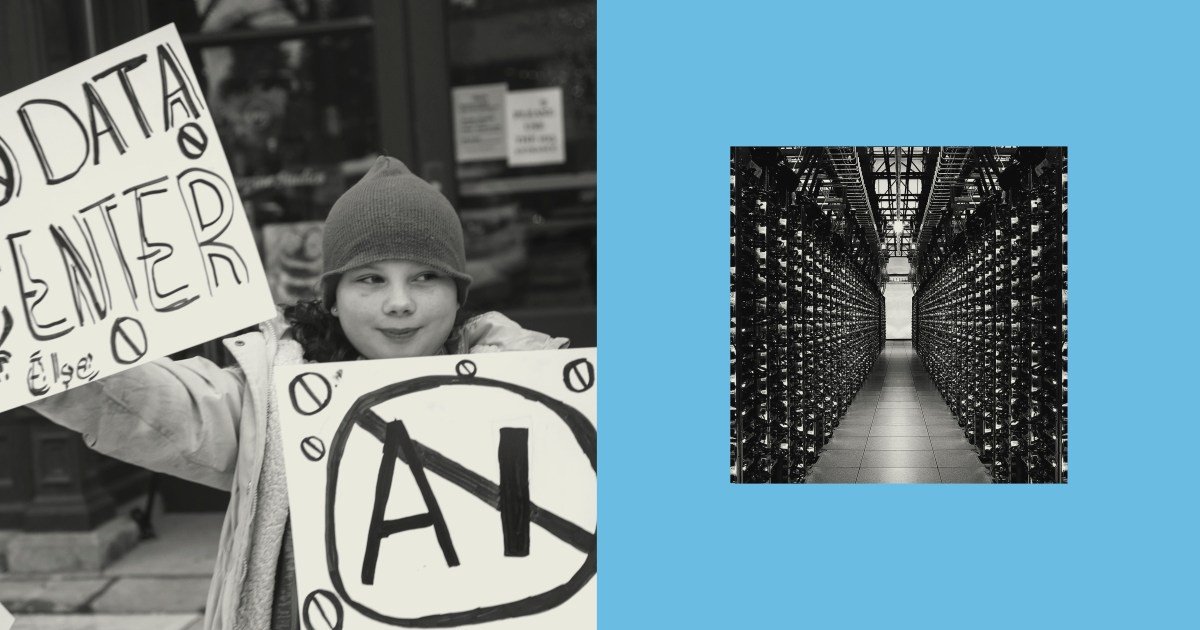
The AI infrastructure reckoning has until recently stayed local, its battles fought in the relatively puny arenas of town council and zoning commission meetings. But the pushback to hyperscale data centers has now stepped onto a larger stage: this week, Maine’s legislature passed the nation’s first state-level hyperscale data center moratorium, freezing construction approvals for data centers requiring more than 20 megawatts of power—the level of massive computing facilities required to train and deploy AI models—for the next year and a half.
In Maine, electricity bills have already increased by 58 percent on average over the last 5 years. Much of that price jump is likely due to the state’s reliance on natural gas—but some Mainers fear that data center buildout will only increase their expenses.
By pressing pause on data centers, says Dan Diorio, who represents the industry lobbying group Data Center Coalition, Maine is missing out on money. “A statewide moratorium on data centers would discourage investment and send a signal that Maine is closed for business,” he said in a statement. “It would deprive local communities of the opportunity to compete for investment and jobs, while forcing Maine to relinquish significant long-term economic investment.”
Democratic state Rep. Melanie Sachs, who sponsored the measure, doesn’t buy it. “Frankly, the tradeoffs have not been shown to be of benefit to our ratepayers, water usage or community benefit in terms of economic activity,” Sachs told the Associated Press.
These facilities can strain the electric grid and pollute the air—the NAACP is now suing Elon Musk’s xAI for allegedly violating the Clean Air Act by using gas-burning turbines to power data centers in Memphis—while further enriching some of the world’s wealthiest men. Data center developers promise that they’ll bring economic benefits to the places where they build. But although they consistently receive millions of dollars in tax breaks, they are legally allowed to shield many of the financial details of their operation from state regulators. That makes it difficult to tell whether or not they’ll actually yield dividends for the communities in which they build.
Arjun Krishnaswami, who studies data center energy use at the Federation of American Scientists, says moratorium bills like Maine’s show that “tech companies failed to demonstrate that they are taking those risks seriously.” Their sales pitch, Krishnaswami said, isn’t working—in part because of a lack of transparency.
“They’re so secretive,” said Greg LeRoy of the corporate accountability research organization Good Jobs First. “They come in under LLCs and code names, they insist on non-disclosure agreements—as long as they’re acting like they have to come in the dark of the night, it just makes you ask, what are they hiding? And the answer is, it’s a bad deal.”
Maine’s moratorium bill represents a “seismic shift in public opinion,” LeRoy said. Data center construction is a massive industry, representing about 3 percent of US GDP growth in the past year. The electricity demands of data centers used for AI could increase as much as 165 percent by 2030—and President Donald Trump has thrown his weight behind building them big and fast.
But the data center opposition is growing, too: beyond Maine, twelve additional states are now considering legislative moratoriums on data center construction, and dozens of municipalities have already passed such laws. Sen. Bernie Sanders (I-Vt.) and Rep. Alexandra Ocasio-Cortez (D-N.Y.) introduced a proposal for a nationwide moratorium in late March. “A year ago, nobody was entertaining a moratorium,” LeRoy said. “Now a fourth of the states are.”
There are some ways data center developers could sweeten the deal. “Tech companies are not very sensitive to the price of electricity,” Krishnaswami said. Instead, they’re more interested in how fast they can get things built. That gives policymakers a chance to make AI infrastructure companies pay a premium for the electricity they use—cash that could then be reinvested into “clean energy, direct bill reductions, or other social programs that could directly benefit people.” But right now, that’s not what he’s seeing. “They’ve failed to demonstrate that they’re committed to figuring out how to really, truly, benefit the nearby communities, and take accountability for negative impacts.”



